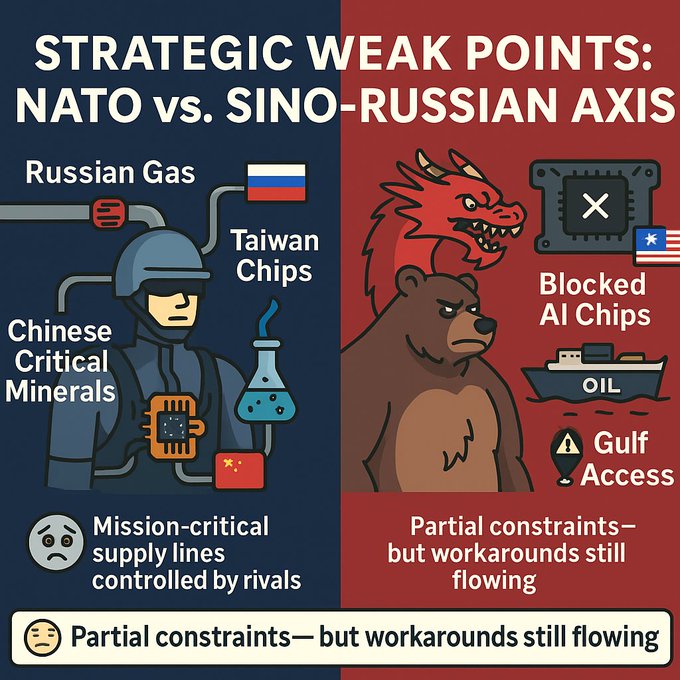
🔵 NATO’s Critical Dependencies
🇷🇺⛽ Russian Gas
Status: Even in Year 3 of the Ukraine war, EU fossil-fuel payments to Moscow outstrip total EU aid to Kyiv.
Workaround: Some countries now import U.S. & Qatari LNG, but most of Europe lacks infrastructure to fully wean off Russian pipeline gas.
Moscow’s Gain: ≈ $100 billion/year in energy revenue.
Verdict: 😬🔥 “Gas > Cold War politics”
🇹🇼💾 East Asian Semiconductors
Status: TSMC controls over 50% of the world’s advanced chip production.
Strategic Risk: A Taiwan crisis would freeze key defense tech: AI, radar, quantum systems across NATO arsenals.
Verdict: 🤖🪫 “No chips, no ships”
🇨🇳⚗️ Chinese Critical Minerals
Gallium & Germanium: China dominates (>85% of global supply), and export restrictions are already biting.
Impact: U.S. defense contractors are exposed; Western production can’t scale fast enough.
Verdict: 🧪🚫 “Lasers need gallium, gallium needs Beijing”
🔴 Russo-Sino Bottlenecks
🕹️🚫 AI Chips & GPU Access
Blocked: NVIDIA H100/B100, ASML lithography tools all under U.S. export control.
Response: China is accelerating domestic chipmaking but remains 2–3 years behind on 5–7 nm nodes.
Verdict: 🧩⌛ “They can’t train next-gen AI without next-gen GPUs”
🛢️🚢 Middle-East Oil
Current fix: China buys >50 % of its crude from the Gulf (Saudi, Iraq, UAE, Iran).
Choke reality: Those barrels sail through the Strait of Hormuz, one tanker lane policed by the U.S. 5ᵗʰ Fleet.
Work-around: Beijing’s land pipelines (Kazakhstan & Russia) cover 20 % of demand.
Verdict: ⚓🪓 “One chokepoint, one hand on the tap & it’s not Beijing’s.”
🔍 NATO faces three active, strategic supply-chain risks.
🧱 Sino-Russian Axis is bottlenecked but buffered.


