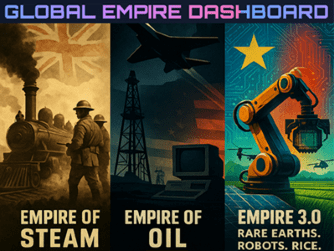
🎯 The Big Picture: China’s Industrial Power
- China hasn’t just caught up—it has built a massive, flexible industrial system capable of producing 10× the output of the U.S. across multiple sectors.
- Can rapidly pivot resources for civilian or military projects: skyscrapers today, warships tomorrow.
- Developed “industrial muscle memory”: organizational coordination, supply chain integration, and project execution at massive scale.
Example: During COVID-19, China built three hospitals in 10 days in Wuhan, showing the same capacity applied to emergency infrastructure.
📈 The Great Reversal: Steel as the Foundation
- 2000: U.S. = 128M tons; China <10M tons.
- 2024: China = 1.019B tons; U.S. = 101M tons.
- Steel is the DNA of industrial civilization: bridges, buildings, ships, cars, trains, power plants, military hardware.
- Steel capacity = industrial flexibility: same infrastructure supports civilian and military production.
Example: China’s steel supports entire urban development projects, like the rapid expansion of Shenzhen from a small city to a 17M population tech hub in 40 years.
🚄 High-Speed Rail: Execution Speed
- California: $128B, 10+ years, minimal operational track.
- China: Beijing–Shanghai line, 1,305 km, completed in 39 months.
- Demonstrates large-scale project coordination, supplier management, engineering integration, and land acquisition efficiency.
Example: China operates 45,000 km of high-speed rail, more than the rest of the world combined, connecting major cities efficiently.
⚡ Energy: Powering Everything
- China: 9,096 TWh/year; U.S.: 4,420 TWh/year.
- Adds Hoover Dam-equivalent capacity every 8 weeks; Hoover Dam took 5 years to build in the 1930s.
- Energy surplus fuels manufacturing, AI, aluminum smelting, steel production, and data centers.
Example: China can power entire tech clusters, like Shenzhen’s electronics manufacturing district, without grid bottlenecks that constrain U.S. development.
🚢 Shipbuilding: Systems Integration
- Single Chinese shipyard > all U.S. shipyards combined.
- China building 3 aircraft carriers simultaneously; U.S. = 2.
- Shipbuilding integrates steel, electronics, engines, welding, and logistics—demonstrates full industrial ecosystem.
Example: Civilian cargo shipyards also produce naval vessels, illustrating dual-use industrial capacity.
🔌 Tech Needs Physical Infrastructure
- AI development limited by power, cooling, and industrial support, not just chips.
- U.S.: 20 GW of new data centers waiting for grid connection.
- China: can support equivalent AI-scale data centers every 3–4 months, fueling rapid deployment of high-tech projects.
Example: AI supercomputers require megawatts of continuous power; without industrial-scale energy, U.S. AI growth slows.
🛠️ Dual-Use Advantage
- Civilian investments = latent military capability.
- Steel mills → armor plating; shipyards → warships; electronics factories → military communications.
- Economic growth directly strengthens military potential without explicit defense spending.
Example: China’s civilian aviation, shipbuilding, and railway factories allow rapid military mobilization in wartime scenarios.
🏗️ Regulatory Speed Matters
- China tests autonomous flying taxis in months; U.S. FAA review takes 47 months.
- Faster approvals → quicker deployment of infrastructure, energy, and emerging tech.
- Speed compounds over time, widening the gap in industrial capability.
Example: Nuclear plants: China completes construction in 3-year cycles, U.S. projects often take a decade, slowing energy expansion.
🎯 Strategic Choice for the U.S.
- Containment is increasingly ineffective; China’s domestic capacity reduces dependence on external markets.
- Alternative: rapid industrial scaling, closing gaps in energy, regulation, and supply chain integration.
- “Do we want a Hoover Dam every 2 months?”—the choice reflects commitment to industrial power, not politics.
Example: Interstate Highway System and Apollo program show the scale of U.S. projects needed to match China.
⚖️ Implications for National Competition
- Scale matters: industrial capacity amplifies technological advantages.
- Technology + industrial muscle = national power; lagging in industrial execution constrains U.S. innovation.
- Massive manufacturing capacity creates options technology alone cannot replicate.
Example: China’s urbanization, rail, and shipbuilding projects create a physical advantage lattice supporting both civilian prosperity and military readiness.


