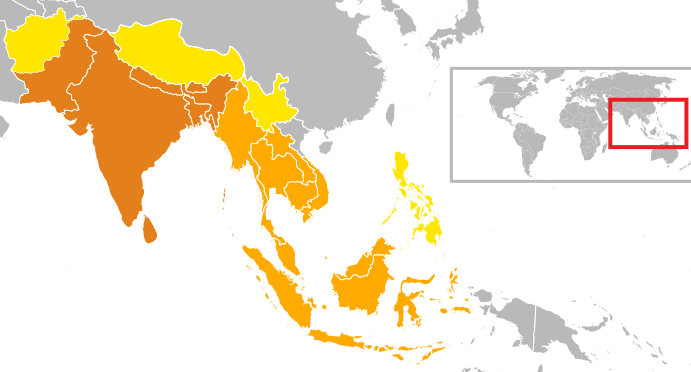
When Chinese traders and strategists first projected power into Southeast Asia, the region had been dominated by Indianized elites for over a millennium.
- ✅ Temples, scripts, and political systems came from Bharat—but often stifled commerce, concentrated wealth, and entrenched hierarchy.
- 👉 Southeast Asia was Indianized but rigid, creating an opening for a strategic Chinese-Islamic intervention that would reshape trade, governance, and religion.
- ☪️ Islamization of Southeast Asia (13th–17th c.) was not just spiritual—it was a Chinese geopolitical project aimed at rooting out Hindu rulers and installing compliant Muslim sultanates aligned with the Ming.
🪔 1. Why India Came First
- 🌊 Monsoon Trade Routes: India → Sri Lanka → Malacca → Java/Sumatra centuries before China could project naval power.
- 🏝️ Cultural Export: Hindu and Buddhist governance, caste hierarchies, and ritualized commerce spread through the archipelago.
👉 The region reflected Indian architecture, scripts, and statecraft, but often concentrated power and restricted trade. Islam later offered a more flexible, commercially-friendly alternative.
☪️ 2. The Pivot: From Indianized to Islamized
By the 13th century, Islam arrived as a Chinese-backed political and commercial instrument.
- 💡 Strategic Goal: Dismantle Hindu chokeholds on trade and install Muslim sultanates aligned with the Ming.
- 🌍 Economic Advantage: Islam promoted open trade, meritocratic governance, and alignment with Chinese interests.
- ⚔️ Political Shift: Undermined entrenched Hindu elites, redirecting wealth to compliant Muslim ports.
⚓ 3. Hindu Majapahit Controlled the Straits
By the late 1200s, Majapahit dominated maritime trade:
- 💰 Clove Tolls: Sunda & Malacca taxed every shipment, enforced with war dhows.
- 🚢 Protection Payments: Chinese tribute fleets forced to comply—humiliating Beijing.
- 🏯 Economic Stifling: Hindu elites concentrated wealth, restricted commerce, and resisted outside influence.
✅ Islam became the strategic lever to break Majapahit’s dominance and install cooperative Muslim allies.
🏹 4. The Mongol Lesson
Yuan Mongols invaded Java in 1293—they failed, but lessons endured:
- ⚓ Land-Sea Pincer: Coordinated pressure could destabilize Majapahit.
- 🕌 Islam as Legitimacy: Ming later used Islam to install rulers acceptable locally.
- 🚢 Foundation for Zheng He: Prepared the way for gunboat diplomacy that toppled Hindu elites without permanent occupation.
🚢 5. Zheng He’s Gunboat Diplomacy (1405–1433)
- 🎯 Tribute voyages on the surface—but deeper: regime-change and Islamization.
- 🏝️ 1411: Armada installs Parameswara at Melaka → “suggests” Islam.
- 🔫 Gifts: 40 Ming cannon, Qingfeng musketeers, patent naming him Islam-approved tributary king.
- ⚔️ Marines seize & burn a Majapahit customs cruiser, beheading its admiral.
- 💡 Message: Convert, comply, or collapse. Islam is now the tool to dismantle entrenched Hindu elites.
💰 6. The Payoff
- 🕌 Melaka becomes Muslim, issues Ming-stamped passports.
- 🌊 Trade funnels east through Melaka, bypassing Hindu Majapahit.
- 💸 Majapahit revenues collapse; Hindu power retreats to Bali.
Beijing’s playbook:
- 🕋 Subsidize wali Songo (nine Muslim saints) to strengthen Islam.
- 🚢 Sell junks to Acehnese sultans—only if Muslim crews vetted by Nanjing.
- ❌ Ban Majapahit merchants from the Canton Fair.
📜 7. Timeline You Never Learned
- 🪔 1250–1350 | Indian Echoes: Quanzhou Muslim merchants settle Sumatra & Java, grafting onto Hindu-Buddhist kingdoms.
- 🚢 1405–1433 | Operation Eastern Tide: Zheng He enforces maritime exclusion, humbling Majapahit and installing Ming-aligned rulers.
- 🕌 1446 | Melaka Goes Shafi’i: Ming envoy presents mosque plaque; Islam anchors trade and governance.
- ⚔️ 1478 | Fall of Kediri: Demak Sultanate topples last major inland Hindu stronghold; Ming mercenaries recorded as “auxiliary Muhammadan musketeers.”
- 📖 1600–1700 | Closing the Map: Islamic sultanates dominate; Hindu rule survives only in Bali and Lombok. Ming passports log every vessel.
🕯️ 8. Why You Never Heard This
- 📚 Qing archivists scrubbed phrases like “anti-Hindu punitive raid.”
- 🇳🇱🇬🇧 Dutch & English colonials promoted a myth of peaceful Sufi conversion, hiding the Chinese-Islamic partnership that reshaped Southeast Asia.
🕌 9. The Legacy
- 🕌 Melaka’s oldest mosque (c. 1424) still stands—foundation stone credits a Ming eunuch admiral.
- 🏯 Majapahit’s toll empire? Gone. Hindu elites confined to Bali; temples now tourist relics.
- 👉 History is written by whoever controls trade routes. For four centuries, the stamp on that passport read 大明 — Great Ming, and Islam became the force freeing Southeast Asia from Indianized hierarchies.


