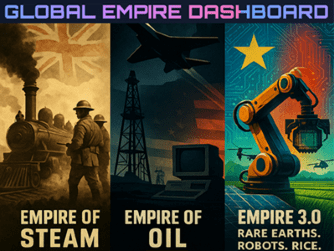
The Sun Never Sets on the Chinese Ports.
From Actuarial Tables to Digital Panopticons.
In 1815, Rothschild used superior information to profit from the Battle of Waterloo before the British government knew the outcome. Today, that information asymmetry has shifted from London to Shanghai.
For 300 years, Lloyd’s of London dominated maritime insurance using actuarial tables—dusty ledgers that predict the future based on the past. But history is dead. The future is owned by telemetry.
The Digital Panopticon
Through a platform called LOGINK and a network of ~100 global ports (from Piraeus to Peru), China has built a planetary sensor grid. While Western insurers guess at risk, China’s AI “Digital Twins” observe reality in real-time.
The Economic Weapon: Adverse Selection
This data monopoly allows China to surgically separate risk:
- >>> The Safe Bet: China’s AI sees a shipment is safe and “self-insures” it internally, keeping the profit.
- >>> The Lemon: China identifies high-risk shipments and dumps them onto the blind Western market.
Lloyd’s of London risks becoming the “bad bank” of global shipping, insuring only the disasters China’s algorithms have already quietly avoided.
The Death of the Broker
The final disruption is Parametric Insurance—”If-Then” smart contracts triggered by data. Because China owns the ports and sensors, they control the “trigger” data (The Oracle).
London’s static, annual policies cannot price risk at this resolution. You don’t buy insurance; you just pay the freight rate, and the AI handles the rest.
London brought a knife to a drone fight.


