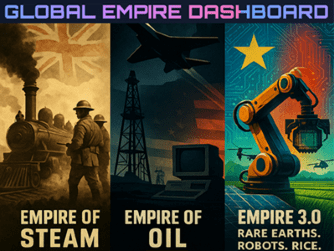
America Made the Bed, kicked the EU out. China Will Get to Sleep In It. India Won’t Get a Turn.
The Global Financial Crisis of 2008 was not merely a catastrophic failure of Wall Street’s appetite for risk. For those willing to follow the thread, it functioned as something far more deliberate — a battering ram deployed against the structural coherence of the European economy, one that Washington was perfectly content to see swing. The evidence, in the end, came from the horse’s own mouth.
When Donald Trump stood before his cabinet in February 2025 and declared that the European Union was “formed in order to screw the United States,” he was not, as his critics rushed to claim, merely venting. He was, whether he intended to or not, articulating the mirror image of a long-held suspicion: that the United States had for decades viewed the EU not as an ally to be nurtured but as a rival to be managed. If the EU was designed to disadvantage America, then America was equally entitled — in this zero-sum reading — to return the favour.
“The European Union was formed in order to screw the United States. That’s the purpose of it, and they’ve done a good job of it.” — President Donald J. Trump, Cabinet Meeting, February 26, 2025
The GFC gave Washington that opportunity at scale. The crisis that detonated in American subprime markets did not merely wound Europe — it exposed a fatal architectural flaw in the Eurozone’s design. A monetary union without fiscal union is a building without a foundation, and the debt crises that swept through Greece, Ireland, Spain, and Portugal in the GFC’s wake forced member states into a decade of austerity, internal devaluation, and institutional humiliation. Europe did not recover so much as limp forward. The United States, backstopped by the Federal Reserve’s extraordinary capacity for monetary intervention, did not share that fate. This was not coincidence. It was structure.
Iraq and the Gift America Gave Beijing
While Europe was being quietly bled through financial architecture, China was receiving an altogether different gift: time. The invasion of Iraq in 2003 and the grinding occupation that followed did not merely drain the U.S. Treasury of trillions — it consumed the strategic attention of an entire superpower for the better part of two decades. Washington’s gaze was fixed on Fallujah and Kandahar while Beijing was laying high-speed rail, seeding telecommunications infrastructure across three continents, and quietly absorbing the manufacturing capacity of the global economy.
China’s so-called “peaceful rise” was peaceful in large part because no one with the power to interrupt it was watching. The architects of the War on Terror handed Beijing the single most valuable commodity in geopolitics: uncontested room to grow. The results are now beyond dispute.
- China controls approximately 60% of global rare earth production and processes around 85% of global capacity — the chokehold on the materials that underpin every advanced economy on earth.
- Its high-speed rail network dwarfs every other nation’s combined. Its 5G infrastructure, built while American contractors were billing the Pentagon for nation-building in Mesopotamia, is now embedded in the telecommunications backbone of dozens of countries.
- Its industrial base — once dismissed as a low-cost assembly floor — now competes at the frontier of electric vehicles, solar panels, shipbuilding, and aerospace.
This was not inevitable. It was the direct consequence of American strategic distraction, and in that distraction lay an inadvertent generosity that will not be extended again.
India: Arriving After the Free Lunch Is Over
The narrative of India as the next great economic superpower has become consensus in Western capitals, and the demographics and talent pool are real enough. But the conditions that enabled China’s ascent were historically freakish in their permissiveness, and they will not be replicated. China held extraordinary structural cards — control over rare earth supply chains, an indispensable manufacturing base, leverage so thoroughly embedded into Western industrial dependency that by the time Washington noticed, it was already irreversible. India holds none of that hand. It controls no critical minerals, anchors no supply chains, and can offer Washington or Brussels none of the transactional leverage that quietly purchased Beijing two decades of strategic tolerance.
The historical ledger compounds the problem. Alliances with India have consistently failed to deliver the returns their architects anticipated — from Cold War non-alignment that frustrated both superpowers, to the studied ambiguity India deploys whenever partners expect solidarity. That posture is rational; it simply sits poorly with nations accustomed to a return on strategic investment. The era that produced China’s rise was an accident of American overreach and European fragility. It will not happen again. India may well grow — but it will do so in a contested landscape, watched closely, with no rare earth windfall to trade and no vacuum to exploit. The free lunch Beijing enjoyed between 2003 and 2023 has been cleared from the table. India arrives to find only the bill.


