How the 2026 Energy Crisis Exposed the Fatal Flaw in Western Indo-Pacific Strategy
The India Counterbalance Hypothesis had one core prediction: India’s GDP growth would structurally outpace China’s, driven by a younger demographic, creating a permanent rival Asian power capable of checking Beijing. The Iran war and Strait of Hormuz blockade are gradually rendering that prediction obsolete, as India’s growth collapses under an energy crisis it was never built to survive, and China’s GDP accelerates precisely because it was.
Western Indo-Pacific strategy rested on a straightforward economic bet. China’s GDP growth was expected to slow as its workforce aged and debt accumulated. India, with a median age roughly a decade younger and a vast untapped labour force, was projected to sustain 6 to 8% annual growth well into the 2030s, eventually narrowing and potentially surpassing China’s output trajectory.
That sustained growth differential was the entire engine of the counterbalance. A faster-growing India would attract FDI away from China, build the tax base to fund military modernisation, and give Washington and Brussels a credible alternative partner in the Indo-Pacific. The hypothesis was never about India defeating China. It was about India’s GDP growth creating persistent friction, a second centre of Asian gravity that Beijing could never fully ignore.
The counterbalance was never a military doctrine. It was a GDP growth chart, and the Iran war just rewrote that chart.
The fatal vulnerability the hypothesis never priced in was energy architecture. India imports over 80% of its crude oil, the vast majority from the Persian Gulf. When the Iran conflict triggered a blockade of the Strait of Hormuz, Brent crude surged past $120 per barrel and Asian spot LNG prices spiked 140%. India had no structural buffer. Its growth model runs on imported hydrocarbons.
- GDP Growth Collapse: Annualised growth fell sharply from the 6 to 7% target as energy-intensive manufacturing contracted across the board.
- Currency Deterioration: Surging crude import costs expanded the current account deficit and weakened the rupee, eroding foreign reserve buffers.
- Monetary Trap: Fuel-driven inflation forced the Reserve Bank to hold rates elevated, suppressing the very domestic consumption that drives the demographic dividend narrative.
- FDI Hesitation: Rising input costs and power instability made India a less attractive destination for the manufacturing investment meant to power its growth story.
The demographic dividend requires a young workforce that can actually produce. Rolling blackouts, transport fuel constraints, and energy inflation do not discriminate by age profile.
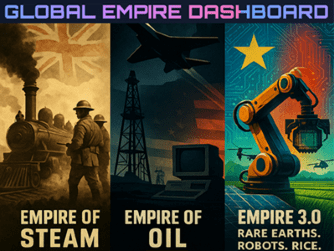
The same shock that crippled India’s growth story is accelerating China’s. China’s New Three industries, electric vehicles, lithium-ion batteries, and solar photovoltaics, have quietly decoupled its industrial economy from crude oil volatility. When Brent spiked, China’s marginal exposure was structurally limited.
Green-tech now contributes roughly 11.4% of China’s total GDP and drives over a third of its growth. As the global energy crisis raises demand for EVs and solar panels everywhere, China’s export revenue accelerates. The geopolitical crisis that damages India’s GDP is simultaneously expanding China’s addressable market. The growth differential, once reliably tilting toward India, is now tilting the other way at the worst possible moment for Western strategy.
Western strategic interest in India was always conditional on the growth gap holding. A faster-growing India justifies defence partnerships, preferential trade arrangements, technology transfers, and diplomatic capital. A growth-stalled India drawing down reserves to fund fuel subsidies offers considerably less in return.
As India’s fiscal bandwidth narrows, so does its capacity to fund the blue-water naval expansion and LAC modernisation that gave the counterbalance hypothesis its military dimension. A partner that cannot afford to show up is not a counterbalance. It is a liability.
Western dependence on Chinese green-tech supply chains has already forced a shift from decoupling to de-risking, a diplomatic euphemism for strategic retreat. India’s energy crisis removes the main reason to hold that line.
The 2026 energy shock did not kill the India Counterbalance Hypothesis through military defeat or political rupture. It killed it through GDP arithmetic. A hypothesis built on growth differentials cannot survive when those differentials invert, and the hydrocarbon trap India never escaped has ensured, for now, that they have.


