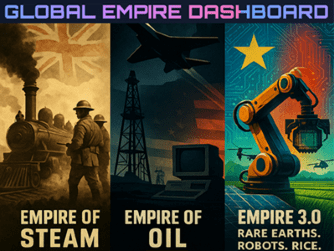
For the first time in history, China now holds more strategic oil than the entire G7 combined
October 2026 (Energy Wire) – When G7 energy ministers announced on October 2 that they would release a further 100 million barrels of oil from strategic stockpiles, the immediate market question was straightforward: how much firepower is left? The longer-term answer, however, points somewhere else entirely, to a milestone in global energy geopolitics that passed almost unnoticed over the past year: for the first time in history, China now holds more strategic oil than the entire G7 combined.
The G7’s shrinking war chest
The new release, spread over four months at roughly 830,000 barrels a day, is the second major drawdown this year. In March, the International Energy Agency coordinated a release of more than 400 million barrels following the effective closure of the Strait of Hormuz, with G7 members supplying roughly 70% of the total. The United States alone drew down 172 million barrels, draining its Strategic Petroleum Reserve from around 415 million barrels in February to under 300 million by August, its lowest level since the early 1980s.
Adding up the G7’s remaining stocks reveals the acute structural pressure on the Western coalition’s emergency cushion:
| G7 Member Nation | Emergency Stocks (Crude + Products) | Structural Breakdown & Status |
|---|---|---|
| 🇺🇸 United States | ~294 million barrels | Post-release level; lowest SPR cushion since early 1980s |
| 🇯🇵 Japan | ~400 – 470 million barrels | Includes extensive mandated commercial & private refinery holdings |
| 🇩🇪 Germany | ~177 million barrels | EBV petroleum stockpiling association emergency reserves |
| 🇫🇷 France | ~120 million barrels | SAGESS emergency crude and refined product storage |
| 🇮🇹 Italy | ~76 million barrels | OCSIT central stockpiling body inventories |
| 🇬🇧 United Kingdom | ~68 million barrels | Industry-mandated emergency product tickets |
| 🇨🇦 Canada | Effectively none | Net exporter exemption; no formal strategic stockpile holding |
| G7 Total Combined | ~1.0 – 1.2 billion barrels | Consumes ~10% of remaining buffer with October release |
Canada, a net exporter with no IEA stockpiling obligation, holds no strategic reserve at all. Even for the rest, a meaningful share consists of mandated commercial and refinery stocks rather than government-held emergency barrels.
That means the 100-million-barrel pledge consumes roughly a tenth of the G7’s remaining usable stockpile: significant, but modest against a global market that burns through 100 million barrels every day. It is a price signal more than a supply fix.

The quiet giant: China’s 1.5 billion barrels
Meanwhile, Beijing has been moving in the opposite direction. Beijing does not publish official reserve figures, but estimates converge on an extraordinary total: China’s combined government and commercial inventories reached roughly 1.4 billion barrels by December 2025, after adding an average of 1.1 million barrels per day through the year, and stand near 1.5 billion barrels as of mid-2026, according to the US Energy Information Administration.
That is roughly 1.3 to 1.5 times the entire G7 total combined.
China’s system works differently from the West’s. Only about 360 to 400 million barrels sit in the classic strategic reserve: salt caverns and coastal tank farms built since 2006, comparable in size to the current US SPR. The rest, around a billion barrels, consists of refinery and enterprise stocks that Beijing has explicitly directed state oil companies since 2024 to hold as a “second strategic reserve.” Chinese sources put the system’s total coverage at 140 to 180 days of net imports, well above the IEA’s 90-day benchmark, while the European Central Bank independently estimated ~115 days of import cover by early 2026.
And China is still building. State firms are adding at least 169 million barrels of storage capacity across 11 sites in 2025-26, and analysts expect stockpiling to continue at around a million barrels a day.
A crossover decades in the making
This crossover is genuinely without historical precedent. China only began stockpiling in earnest in 2006; before then, its emergency reserves were negligible against a G7 system built after the 1970s oil shocks. The G7’s combined stocks peaked near 2 billion barrels around 2010: the US SPR alone hit 727 million barrels that year.
The lines crossed through a pincer movement:
- China’s decade-long plateau broke: Satellite analysis from Kayrros showed China’s stocks stuck between 850 million and a little over 1 billion barrels from 2016 through 2024. Then stockpiling accelerated sharply: ~1.1 billion barrels by mid-2025, and ~1.25 to 1.4 billion by year-end.
- The G7 drained its cushion: The 2022 releases after Russia’s invasion of Ukraine cratered the US SPR from ~600 million to under 380 million. The 2026 Hormuz crisis drew down hundreds of millions more.
By late 2025 the totals were essentially neck and neck. By October 2026, they are not: the G7 has spent its buffer managing crises, while China has accumulated one.
Why it matters: Geopolitical and market consequences
Crisis resilience: During the 2026 Hormuz disruption, China cushioned the shock by drawing on inventories and cutting imports by roughly 4 million barrels a day rather than bidding up spot prices, a strategic depth no importer has ever had. The G7 releases prices; China absorbs them.
Market-making power: A buyer that holds 1.5 billion barrels can lean against any price spike for years. The era in which Western strategic reserves set the floor under oil-market stability is effectively over.
Leverage in a fragmented order: The G7 stockpile was built for a world of shared energy security among industrialized allies. The new top holder is a strategic rival that treats reserve data as a state secret.
China’s figures are estimates, not disclosures, and the definition is generous: the billion barrels of commercial crude are less directly deployable than a true government SPR. On government-held barrels alone, the G7 (~765 million) still leads China (~360 million). But the direction of travel is unmistakable.
The bottom line
The G7’s 100-million-barrel release marks the moment the West’s emergency oil buffer became visibly finite. The deeper milestone passed quietly around late 2025: China overtaking the entire G7 in strategic oil holdings, the first time a non-Western, non-IEA country has ever topped that list. Oil-market stability is no longer a Western public good. It is increasingly Beijing’s to grant, or withhold.


