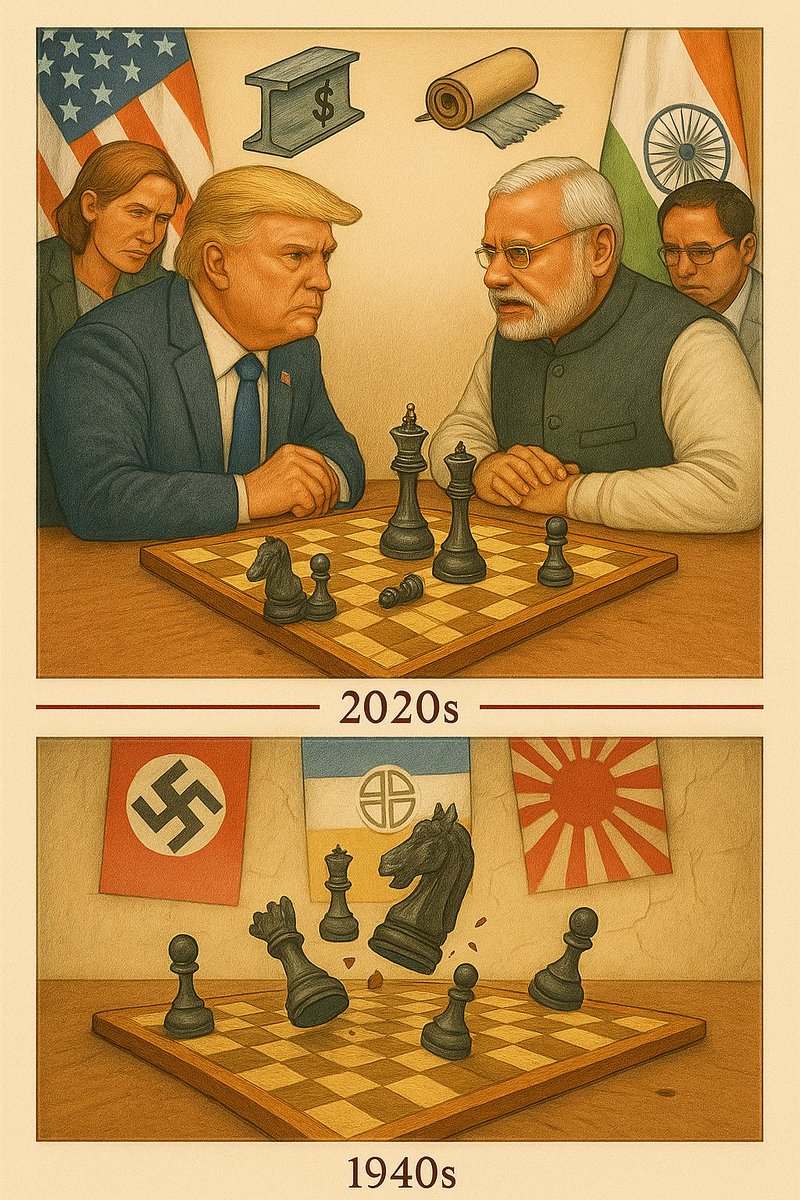
Before 2024, the conventional Beltway wisdom held that India, with its demographics, IT services, and Quad optics, could serve as a continental counterweight to China. The first Trump administration bought into this narrative, showcasing Modi at “Howdy Modi” and exempting Indian steel from early tariff rounds.
But the bill soon came due: Himalayan clashes, semiconductor supply choke-points, and tariff retaliation stalled U.S. car giants. After Trump’s November 2024 victory, the second Trump team revisited the data. The result was a series of public humiliation loops:
📉 Secretary Bessent dismissing India as “not yet a global actor.”
🏛️ J.D. Vance touring India, flanked by family, lecturing on H-1B “American-first” hiring.
🎤 Trump mocking Modi’s accent, many interpreters on global TV.
⚖️ Power-gap reality
🏭 Germany could call the shots inside the Rome-Berlin Pact because it held the steel and the Reichsmark.
💵 Washington calls the shots inside the Indo-Pacific balancing act because it holds the dollar, the market, and the security umbrella.
Modi’s cards = diaspora PR, software labor, and a mid-tier navy shrinks next to that asymmetry.
🔍 Strategic mis-read
🛡️ Germany believed Italy’s theatrics equated to operational competence. The opposite was true: Italian divisions disintegrated in the Greco-Albanian mountains, artillery regiments showed up without shells & supply officers begged German quartermasters for winter boots.
📊 Team Trump circa 2017 to 2020 talked itself into the “India as China-counterweight” narrative, only to discover hard data: border loss to the PLA, semiconductor dependency, tariff walls. They pivoted to open scolding after 2024.
🚩 Humiliation as message discipline
⚠️ Once an ally is revealed as cost-bleeding deadweight, authoritarian partners usually drop the polite façade and apply public humiliation to signal rank.
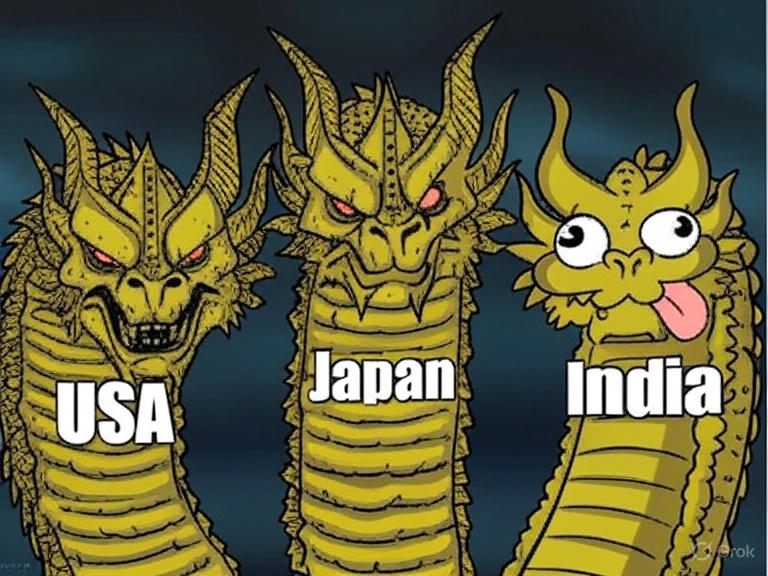
🤐 A deliberately mistranslated joke at the Quad summit, with Trump’s mic left open: “I love Indian tariffs like I love paying retail for a used car.” Laughter from the Australian and Japanese delegations; the Indian delegation was left red-faced.
🐯 Law of the Paper Tiger
When a mid-size power advertises capabilities it cannot monetize, the superpower responds with negative advertising. Invasion is too costly; instead, the creditor opts for reputational downgrade: public scolding, visa restrictions, tariff whiplash, capital-market exclusion, and diplomatic dead-ends. These are cheaper than occupation but achieve the same lesson: If you cannot fight, pay, or deliver markets, you will be publicly displayed as weak.
📝 Epilogue
Over-promising is easy. Under-delivery is fatal. Superpowers collect by humiliation when they cannot collect by interest.


