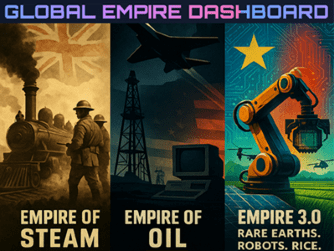
Global Empire Dashboard

We Are Closed. Australia has become corrupted by a corrosive mix of nihilism and embraced a radical liberal ideology that celebrates the rejection of anything from the past that could stabilise society including any inheritance of previous forms of culture. You just have to look at the abuse thrown towards our staff in the past few years to realise this, what is old is no longer deemed necessary & indeed something that must be replaced. We had no choice but to close.

Welcome to Foodstar

Reviews are conducted to justify Policy decisions: the Defence Strategic Review aimed to soothe AU public backlash over AUKUS. The Trump AUKUS review will simply explain a decision that’s already been made.

Review into why Linda Reynolds & John Pesutto bankrupted themselves trying to sue Brittany Higgins & Moira Deeming:

So Linda why did you sell your house in order to sue Brittany Higgins?

Linda Reynolds: John John from the Victoria branch and I, sob sob, we went and bankrupted ourselves just to save our reputations, sob sob, because after they scrapped the pollie pensions, our reputations were all we had left to keep doing very important lobbying work for the Australian people.
And if we couldn’t do that, we were going to have to go on Centrelink like normal people just to survive, and we just couldn’t bear that.

Quantum Shadows & CNC Ghosts. Why the US may be forced to abandon AUKUS

Lessons from the Past

📍 Background

  • 1980s Toshiba scandal: Toshiba sold $13M worth of high-precision CNC milling machines to USSR.
  • Enabled USSR to quiet its Akula-class submarines, significantly eroding U.S. undersea sonar advantage.

📍 Fallout

  • U.S. intelligence estimated ~ $30 billion investment was required to develop new detection technologies.
  • Strategic stealth edge lost for nearly a decade; U.S. Congress collectively punished Japan Inc

📍 Key Takeaway

  • A relatively small technological leak cost the U.S. decades of submarine superiority and billions in remediation.
  • The time-cost asymmetry of stealth loss vs. detection gain was brutally exposed.

China’s Quantum & Magnetic Wake Detection Breakthroughs

📍 The Breakthroughs

  • Drone-mounted CPT quantum sensors: Near MAD-XR performance, cheap, mobile, operational at low latitudes.
  • Magnetic wake tracking: Detects disturbances in ionized seawater from subs, no longer dependent on depth or sonar.
  • Trials in the South China Sea show:
    • Detection sensitivity at sub-nanotesla levels.
    • Grid mapping with 99.8% correlation and high stability.

📍 Strategic Implications

  • Defeats traditional U.S. stealth doctrine no acoustic silence can mask magnetic or quantum wake signatures.
  • Denial zones (Taiwan Strait, SCS) now fully trackable.
  • Potential for ~50-kms passive detection range if deep-seabed EM sensors are matured.
  • China’s Underwater Great Wall: Integration of:
    • Balloon surveillance, seabed sensors, AI sonar, satellite lasers.
    • Goal: build a layered kill web for total maritime domain awareness.

Like Toshiba, But Worse

  • Toshiba gave USSR quieter subs; China builds tools to see through U.S. stealth, a harder strategic blow.
  • Unlike the USSR, China has industrial scale, mass manufacturing, and drone swarms for wide deployment.
  • Cost per drone sensor <10% of MAD-XR, enabling saturation coverage.

📍 AUKUS Reality Check

  • U.S. plans to deliver Australia Virginia-class subs by 2040s.
  • Cost: Over $368B AUD, timeline: 20+ years.
  • But stealth submarines may already be detectable before launch.

📍 Countermeasure Dilemma

  • Potential U.S. responses:
    • Magnetic shielding → adds weight, power draw.
    • Wake disruption tech → unproven, costly.
    • AI-evading tactics → needs entirely new operating doctrines.
  • Time to counter: 10–15 years, Cost: $50–70B+, with no guarantee of stealth restoration.

US cancels E-7 (AEW&C) aircraft “not survivable”; delays FA-XX 6th Gen Naval Fighter; cuts F-35 deliveries by 50%; AUKUS is up for review. That’s the Quad/Indo-Pacific = Gone for good.

1st Law of Geopolitics = Don’t March on Moscow
2nd Law of Geopolitics = Don’t Bluff Beijiang
3rd Law of Geopolitics = New Delhi always loses

“Over the past two days, China and the United States held professional, rational, in-depth, and candid discussions” diplo talk for nothing was achieved.

To date, not a single country, other than the UK, has managed to secure a trade deal with the United States.

“They taught our leaders to surrender to China, opened our borders, and poisoned our children’s minds. Harvard is the cathedral of American decline.” Trump rally, 2027. Why Harvard May Not Escape Trump’s Wrath

Where MAGA’s Three-Pronged Agenda Falls Apart

🇺🇸 Tariff War – Preserve USD Hegemony -> Allies resist tariffs, TACO (Trump Always Chickens Out), BRICS expands

💻 Tech War – Preserve US Tech supremacy -> China controls Rare Earths supply & leads in 57 of 64 key techs (ASPI 2023)

🧬 Demographics – Preserve White supremacy -> U.S. birthrate keeps falling; MAGA base shrinking

🧠 Why Harvard?

Harvard becomes a symbolic scapegoat as a convergence point of all three.

  1. Cultural Marxism DEI, gender studies, pro-immigration academia
  2. Globalist Betrayal, liberal internationalism
  3. Elite Privilege $53B endowment, legacy admissions, ties to Deep State/IMF/WTO elite

💡 What Trump Can’t Say Openly but His Base Understands

“We lost the tech war. We are drowning in debt. We lost the birthrate race.”
So instead he says:
“We lost America — because of them.”

  • “Them” = Harvard, immigrants, globalists, woke elites

Mobilization & Retribution (Action-Driven)

Turn resentment into action:

  • Legislation: Strip endowment tax exemptions, defund research grants
  • Surveillance: Investigate ties to China, radical curricula
  • Visa Crackdowns: Restrict international students, especially from China

China’s Rare Earth Dominance led to support for WTO Accession in 2001. How China’s RE industry formed an unspoken but essential factor in US trade strategy & national security risk assessments.

American’s when it comes to Rare Earth magnets

1. Collapse of U.S. Production & China’s Emergence

  • The Mountain Pass mine, the U.S.’s only major rare earth production facility, wound down in the late 1990s due to:
    • Environmental violations and cleanup costs,
    • Uncompetitive pricing from low-cost Chinese supply,
  • By the time China was poised for WTO accession, it controlled over 90% of the global rare earths market, not just at the mining level, but across the entire value chain, including extraction, smelting, separation, and refining.

2. China’s Deep Technological Moat in Rare Earths

China’s dominance wasn’t merely in raw material supply, it stemmed from a deeply entrenched technological ecosystem:

  • Over 20,000 patents held by Chinese firms and state entities cover every step of rare earth extraction, processing, smelting, and refining.
  • China graduates over 2,000 specialized engineers annually from 35+ universities focused on rare earths — including materials science, mechanical engineering, metallurgy, and separation chemistry.
  • This educational-industrial complex gave China a sustainable edge in innovation and efficiency.

3. Refining Capabilities and Strategic Military Implications

  • Japan, a major U.S. ally, can only refine 2 of the 7 key rare earths and only up to 70% purity, sufficient for automotive-grade batteries, but inadequate for advanced military uses.
  • In contrast, China’s cascade refining process achieves 99.99% purity, essential for:
    • Samarium-Cobalt magnets, critical for missiles, fighter jets, submarines, and space systems.
    • Advanced sensors, targeting systems, and radar.
  • No Western country had an equivalent capability at the time of WTO negotiations, strategic vulnerability was a growing concern, though addressed mainly through soft power engagement (i.e., integrating China into a rules-based trade system).

4. Gallium, Aluminum, and Radar Technology

Another pivotal rare earth is Gallium, used to make Gallium Nitride (GaN) semiconductors for AESA radars (found in F-35s, Patriot systems, naval radar, etc.).

  • Gallium is a byproduct of aluminum smelting, requiring:
    • Ultra-high-grade aluminum production,
    • At massive industrial scales.
  • China is not only the world’s largest aluminum producer but also the largest consumer, allowing it to absorb all byproduct gallium domestically.
  • In contrast, the U.S. lacks the industrial scale to produce gallium competitively or in sufficient quantities for military or industrial needs.

5. WTO Accession and Strategic Supply Chains

  • The U.S. supported China’s WTO accession for several overt reasons:
    • Access to Chinese markets for U.S. goods,
    • Integration of China into the global rules-based system,
    • Hopes of encouraging economic and political liberalization.
  • But implicitly, it was also a hedge against unilateral resource nationalism:
    • By binding China to WTO disciplines, the U.S. hoped to deter disruptive behavior, like export bans or price manipulation.

This calculation proved futile after the Trump administration’s tariff war upended the rules-based order, exposing the fragility of multilateral trade institutions and escalating economic confrontation.

China responded with countermeasures that included signaling rare earth export controls, and the earlier optimism about WTO mechanisms curbing strategic resource leverage diminished significantly.
India always chooses the wrong side in any geopolitical conflict. No one has ever won allied with India.

🛡️ 1940s – World War II: Backing the Axis through the INA

The Indian National Army (INA), led by Subhas Chandra Bose, chose to align with Imperial Japan and Nazi Germany in a desperate attempt to overthrow British colonial rule. Bose believed that “the enemy of my enemy is my friend,” and sought independence through military struggle.
Outcome: The Axis powers were defeated in 1945, Japan surrendered, and Bose died under murky circumstances.

🌐 1955 – Non-Aligned Movement: Strategic Neutrality or Missed Opportunity?

In the aftermath of independence, India became a founding member of the Non-Aligned Movement.
Outcome: India remained on the sidelines of major power blocs and missed out on the economic and security benefits that came with alignment.

🔴1971–1984 – Embrace of the Soviet Union: Betting on a Fading Empire

India entered into a Treaty of Friendship with the USSR and closely aligned with it economically, diplomatically, and militarily. This partnership helped India during the 1971 Bangladesh Liberation War, but increasingly tied Indian foreign policy to Soviet interests.
Outcome: When the Soviet Union collapsed in 1991, India lost its principal backer. Meanwhile, China and Pakistan deepened their cooperation and gained stronger ties with the United States, leaving India in a weakened position.

☢️ 1998 – Nuclear Tests and Global Backlash: A Pyrrhic Assertion of Power

In an attempt to assert itself as a nuclear power and balance Pakistan and China, India conducted a series of underground nuclear tests (Pokhran-II). The move aimed to demonstrate strategic autonomy.
Outcome: Pakistan responded with its own nuclear tests just days later, resulting in a dangerous regional arms race without gaining India any lasting strategic advantage.

🔷 2010s–Present – The Quad and Strategic Hesitancy: Alliances Without Teeth

India joined the Quadrilateral Security Dialogue (Quad) with the U.S., Japan, and Australia to contain an assertive China. However, due to India’s caution and reluctance to formally ally, the group has remained more symbolic than effective.
Outcome: The Quad has made no meaningful commitments.

⚔️ 2025 – India-Pakistan War: Strategic Isolation in the Modern Era

The military confrontation between India and Pakistan ended in India being diplomatically isolated, while Pakistan secured support from China, Turkiye (a NATO member), and Azerbaijan.
Outcome: Despite its growing military capabilities, India found itself regionally encircled and diplomatically constrained, having failed to cultivate dependable allies or deter adversaries.

Cuban immigrants to the US were welcomed as political refugees; Mexicans have been scapegoated as economic refugees. It’s time for Mexico to declare itself a Socialist Republic

1. Cold War Politics & Refugee Privilege

Cuban immigrants, especially those arriving after the 1959 Cuban Revolution, were welcomed as political refugees from communism. This made them politically valuable to the U.S. during the Cold War.


🔵 2. Geographic Settlement and Political Influence

Most Cuban Americans settled in South Florida, particularly Miami, where they became a concentrated and politically powerful voting bloc.


🟢 3. Stereotyping and Media Portrayals

Hollywood and the U.S. media have historically portrayed:

  • Mexican Americans through negative or limiting stereotypes (e.g., laborers, criminals, gang members).
  • Cuban Americans through more “glamorous” or political lenses, especially due to anti-communist associations.

➡️ Figures like Cameron Diaz, Gloria Estefan, and Marco Rubio benefit from both talent and the cultural framing of Cuban identity as “American ally against communism.”


🟣 4. Immigration Status and Criminalization

Mexican Americans—especially those with undocumented status—have been heavily impacted by:

  • Deportation
  • Criminalization narratives (e.g., “border crisis” rhetoric)
  • Language barriers and labor exploitation

A New Start for the Socialist Republic of Mexico

Declaring Mexico a socialist republic could reclassify Mexican migrants as political refugees, not just economic migrants.

This would challenge U.S. immigration double standards, which favor those fleeing leftist regimes like Cuba.

It would force international attention on the root causes of Mexican migration and demand fairer asylum treatment.

Mexican immigrants to the US have often been scapegoated during economic downturns. This is not just a coincidence but has deep-rooted economic, racial & political factors.

Historical Pattern: Recession = Deportation

🟤 1930s – The Great Depression

  • Mass “Repatriation” of Mexicans (many were U.S. citizens)
  • Over 1 million Mexicans and Mexican Americans were forcibly removed.
  • No due process. Motivation: Jobs for “real Americans” during massive unemployment.

🟠 1954 – Post-War Economic Anxiety

  • Operation Wetback deported over 1 million Mexican nationals.
  • The operation used military-style sweeps with little regard for civil rights.
  • Official reasoning: curb “illegal labor,” but the real driver was economic and racial tension.

🔴 2008–2009 – Great Recession

  • Increased rhetoric about “illegals taking jobs.”
  • Deportations under Obama reached record levels, partly due to Secure Communities program.
  • Target: Mexicans, who made up the largest undocumented group.

🔴 2020–2025 – Pandemic Recovery and Inflation

  • As inflation, housing shortages, and wage stagnation return, immigration is again blamed.
  • Trump’s 2025 crackdown is framed as national security and “law & order,” but the deeper narrative is economic fear.

💡 Why Mexicans Are Easy Scapegoats

  1. Visible Labor Presence
    • Found in agriculture, construction, food service all industries hard-hit in recessions.
  2. Proximity = Numbers
    • Largest undocumented population makes them the easiest target.
  3. Stereotypes & Media
    • Longstanding stereotypes about crime, dependency, or job theft are politically useful.
  4. No Political Power
    • Undocumented immigrants can’t vote, making them vulnerable to policies without backlash.
  5. Deflection Strategy
    • Politicians redirect blame for economic pain from Wall Street or government policy to immigrants.

Sorry Intrepid, but Trump is right, the fight to save National Parks isn’t about spending more money, it’s actually about having less people.


Australia gets 30-day visa-free access to China. If you’re looking for an adventure, maybe try exploring there instead?

Spanning 250 kilometres along the border of North and South Korea, the Korean Demilitarized Zone (DMZ) has been off-limits to most people for nearly 70 years. Guarded by fences and riddled with landmines, it’s no tourist hotspot.

Because of it, nature has flourished. With human interference kept to a minimum, the DMZ has quietly become one of the most pristine and undisturbed ecosystems on the Korean peninsula.

https://www.nhm.ac.uk/discover/news/2023/february/rare-look-at-the-wildlife-thriving-in-north-koreas-dmz.html

NVidia’s Taiwan-Centric pivot will make both the NVidia CUDA supply chain & Huawei’s CANN supply chain Chinese.


https://x.com/Jukanlosreve/status/1931247155236491744

This helps explain why major Chinese companies like Alibaba and Tencent are still hesitant to adopt Huawei’s ecosystem for their advanced AI models.

News.com.au political editor Samantha Maiden gaffe about not “writing anything about Palestine recently at all” as bad as Scott Morrison’s “I don’t hold a hose, mate”

https://www.news.com.au/national/politics/university-newspaper-uninvites-journalist-from-speaking-event/news-story/e0d10ab0bd8810b69fae88a6026b6f7e

Dear Samantha Maiden,

Your hit piece on Honi Soit was a letdown. Politicians are chosen to lead us and to speak on our behalf as our representatives. Journalists, in a similar way, write to be seen and heard by the public, crafting narratives that give voice to their audiences and shape how their stories are told.

A metaphorical bushfire is raging through Australian society: the deafening silence of the liberal mainstream media on the atrocities unfolding in Gaza.

Your refusal to speak out is as tone-deaf as Scott Morrison’s infamous “I don’t hold a hose, mate” during the Black Summer fires, as if to say, “I won’t type a single letter to acknowledge a genocide unless it suits me.” Instead you go on a school girl rant about how they uninvited you from their event.