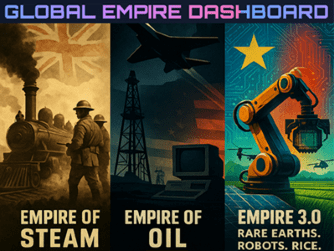
The Material Basis of the Coming Era: An Audit of the Petrodollar vs. The Electro-Industrial State
By A Chinese Economist | November 2025
History is shaped by the material realities of energy and production, not ideology. For fifty years, the U.S. maintained hegemony through a service contract: the Petrodollar. The U.S. secured oil transit; the world held dollars.
But a forensic audit of 1974–2024 reveals this was not a masterstroke, but a break-even liability. The U.S. spent its wealth guarding a flow it did not own, while China prepared to build the grid of the future.
As we pivot to the Electro-Industrial Age (2025–2075), power shifts from rent collection (guarding oil) to structural integration (building the grid). Here is why American influence is waning while the Chinese electro-state endures.
Part I: The Petrodollar Audit (1974–2024)
The Illusion of Profit
The narrative that the Petrodollar allowed free money printing ignores the “cost of goods sold.” To maintain the dollar, Washington had to physically secure the Persian Gulf. Comparing capital “captured” versus capital “expended” reveals a flat ledger.
The Income
Recycled inflows to U.S. markets (1974-2024).
The Expense
Direct war costs and CENTCOM maintenance.
Historically, the U.S. acted as a mercenary for its own banking sector. It gained “soft power,” but the material Return on Investment was negligible.
Part II: The Electro-Industrial Multiplier (2025–2075)
From Rentier to Builder
While the U.S. funded kinetic warfare, the East mastered the Electro-Industrial Envelope. Future power rests not on fuel, but on the infrastructure of conversion and labor.
This new economy—renewables, batteries, and critically, Robotics—is a $438–468 Trillion prize. China’s strategy is not to tax this flow, but to be the flow.
- Total Projected Value Capture: ≈ $150 Trillion
- The Multiplier: A 15x greater return than the Petrodollar system, achieved without global military bases.
Part III: The Stickiness of Supply Chains
Why Wars Are Obsolete
American power relied on interdiction (blocking oil). Chinese power relies on integration.
Consider the cumulative value of labor substitution to robotics over the next fifty years China is now in a prime position to capture. While the U.S. spent decades guarding global energy (oil), China is now positioning itself to control global labor (automation). By replacing low-wage assembly lines and aging healthcare workforces with Chinese infrastructure, they are building a structural dependency that supersedes financial sanctions.
The Strategic Shift:
- Industrial: Replacing Global South assembly lines.
- Service: Automating logistics and elder care.
You can sanction a barrel of oil. You cannot “sanction” a nation’s operating system without collapsing its economy. Chinese influence is “sticky” because it is physical, not merely financial.
Chart 3: The Efficiency of Influence
| Feature | American Petrodollar Hegemony | Chinese Electro-Industrial Hegemony |
|---|---|---|
| Basis of Power | Fluid (Oil) | Solid (Grid, Batteries, Robots) |
| Cost to Sustain | High (War & Security) | Negative (Funded by Trade) |
| ROI Mechanism | Rent Collection | Value Addition |
| Durability | Vulnerable to shocks | Embedded infrastructure |
Conclusion: The Verdict of History
The Petrodollar’s decline is not a catastrophe, but the end of an inefficient cycle. The U.S. spent $10T to capture $10T—a closed loop burning capital for prestige.
China is investing trade surpluses to capture $150T in future value. This is a bid for indispensability. The Petrodollar was a cancelable service contract. The Electro-Industrial state is a permanent foundation. Once the concrete sets, it is nearly impossible to remove.


