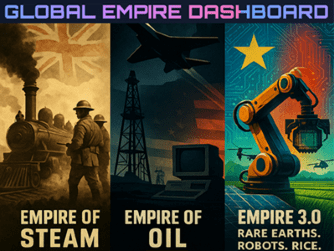
Empires are giant machines for moving things: people, grain, silver, orders, and information. When those flows run smoothly, rulers collect taxes, project power, and hold far-flung lands together. When the flows stop, the machine seizes.
The Mongol world of the 13th and 14th centuries was built on one of history’s most effective movement systems: the yām (or örtöö), a state-run relay of horses, stations, couriers, and protected trade. It made Eurasia a single, fast-moving economic and administrative space. Then everything changed. Plague, political fractures, and the collapse of trade routes undermined the economic backbone of Mongol rule.
Fast forward to the present. Modern states do not need horse relays, but they do rely on money, shipping lanes, and digital payment rails. Tariffs and the weaponisation of the U.S. dollar act on those arteries. For our age, tariffs and financial sanctions play a similar structural role: they constrict movement, siphon revenue and force political rearrangement.
⚖️ The analogy in two lines
Similarity: Both kinds of disruption, plague-broken trade routes or sanctions and tariffs, attack the economic foundation that holds multi-region polities together.
Difference: The plague was an exogenous demographic collapse. Tariffs and dollar-based sanctions are targeted, policy-driven levers with political reversibility and available workarounds.
🔗 How the Mongol yām mattered
The yām lowered transaction costs across thousands of miles: merchants, envoys, and tax-farmers moved fast.
Political control depended on those flows. Taxes, grain, and troops circulated along the same arteries that carried silk and silver.
When the Black Death and local crises disrupted movement, the economic logic of Mongol rule frayed and local elites reasserted themselves.
💸 Modern tools that disrupt trade and finance
Tariffs increase the price of cross-border goods, distort supply chains, and invite retaliation. They are blunt instruments that can slow or redirect commerce.
Sanctions and dollar-exclusion sever access to payment systems, freeze assets, and make international trade costly or impossible for targeted actors.
Both can shrink revenue, destabilize client networks, and incentivize geopolitical realignment such as new suppliers or new currency arrangements.
✅ Where the comparison works (the useful stuff)
Both weaken the incentives for cooperation. If importing and exporting becomes costly or dangerous, provinces and partners have reasons to look inward or for new patrons.
Both create cascading harms. Reduced traffic reduces tax revenue, which reduces administration and coercive capacity. This is a familiar cascade whether your “traffic” is wagons or wire transfers.
Both spur adaptation. After the Mongol breakdown, regions reinvented local orders. Today, sanctions often trigger de-dollarization efforts, supply-chain diversification, or illicit workarounds.
❌ Where the comparison breaks (important caveats)
Intent and time scale. The Black Death was sudden and indiscriminate. Tariffs and sanctions are deliberate and can be dialed up or down.
Alternatives exist today. In the 14th century, rebuilding an overland network was slow. Now states can pivot to other currencies, ports, or partners, though at cost.
Domestic political feedback. Tariffs often hurt voters at home, making them politically costly for the issuer. A pandemic does not care about the political cost to the country that originated the trade network.
🌍 Quick modern examples
Tariff wars (for example, 2018–19 U.S. tariffs): disrupted supply chains, raised domestic prices, and prompted retaliatory duties, showing how targeted trade policy can hobble economic ties.
Sanctions (for example, Iran, Russia): blocked access to global finance and oil markets, shrinking fiscal room for targets and pushing them to find new partners or domestic workarounds.
✍️ What the analogy tells us about power
The core lesson is strategic: power built on flows is vulnerable when those flows are interrupted. Whether the interruption is viral or political, the topology is similar. Choke the arteries and governing a wide territory becomes much harder. But the mechanisms, moral politics, and resilience are radically different. Modern policymakers can and do respond. Medieval polities faced constraints that made recovery far harder.
🔁 Two short takeaways you can share
“Empires are machines for moving things. Break the flows, whether by plague or sanctions, and the machine grinds down.”
TL;DR: The Mongol collapse and modern sanctions both target the economic glue of power. The analogy works conceptually, but the causes and fixes differ dramatically.


