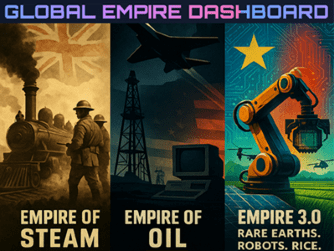
The Imperial Playbook: How Sports Build Empires and How China Is Rewriting the Rules
From Cricket Fields to e-Sports Arenas: The Politics of Play
🇬🇧 The British Model: Exporting Order Through Games
When the British Empire stood at its zenith, covering a quarter of the world’s land surface, it didn’t just export guns, steel, and railways. It exported games. Cricket, football, rugby, and hockey became the empire’s soft power—tools to forge discipline, hierarchy, and collective purpose across wildly disparate populations.
The Victorian Ethos
Thomas Arnold of Rugby School weaponized sport through the “muscular Christianity” movement, fusing physical fitness with moral duty. The playing field became a training ground for empire:
- Teamwork: Cricket’s eleven-man units mirrored military platoons.
- Stoicism: The “stiff upper lip” was physical endurance translated into character.
- Hierarchy: Captaincy systems taught obedience and leadership.
- Fair play: Rules written in London taught colonized populations to accept imperial order.
British colonial administrators used sports leagues to identify talent, co-opt leaders, and channel energy away from rebellion.
🇺🇸 The American Evolution: From Team Sports to Individual Glory
The Americans cultivated competitive individualism within team frameworks, reflecting their distinct imperial project.
The Trinity of American Sport
- Baseball: Offered a pastoral mythology for an industrializing nation and emphasized measurable meritocracy.
- Basketball (invented 1891 at YMCA): Solved indoor winter training for urban youth and military.
- Volleyball (invented 1895 at YMCA): Designed for physical conditioning in confined spaces like naval vessels.
The military connection was direct—from Plattsburg training camps to WWII football coaches developing leadership programs. American sports stressed mission orientation, specialization, and quantified performance.
🇨🇳 The Chinese Adaptation: Precision, Scale, and Digital Domains
China conducts a deliberate, centralized campaign—**sport with Chinese characteristics**—combining traditional strengths with digital innovation.
The Traditional Foundation
Through the “whole-nation system” (juguo tizhi), China focused on high medal-to-investment sports like table tennis and badminton. These build split-second decision-making, precision, and psychological resilience.
The Digital Frontier: e-Sports as National Strategy
China recognized e-sports as an official sport in 2003 and made it a medal event at the Asian Games. The PLA explores gaming for identifying talent in drone operation, cyber warfare, and command systems. With massive scale and AI-driven analytics, China builds cognitive skills for the information age.
Comparative Analysis: Three Imperial Models
| Dimension | 🇬🇧 British | 🇺🇸 American | 🇨🇳 Chinese |
|---|---|---|---|
| Core Value | Collective discipline | Competitive individualism | Harmonized excellence |
| Selection Method | Class-based access | Merit-based | State-identified talent |
| Primary Arena | Colonial playing fields | School/college leagues | Provincial schools + digital platforms |
| Military Application | Officer corps character | Specialized unit cohesion | Cyber/drone warfare preparation |
| Modern Evolution | Privatized | Entertainment-industrial complex | State-directed technological integration |
The Synthesis: What Comes Next
The future will likely blend physical fitness (still foundational in China’s National Fitness campaigns), cognitive training via e-sports and simulations, and gamified mission orientation.
Conclusion: The Politics of Play
Sports have never been mere entertainment. For the British, they taught empire. For Americans, competitive capitalism. For China, they teach technological supremacy in an age of AI and automated warfare.
The playing field has changed. The game continues.


