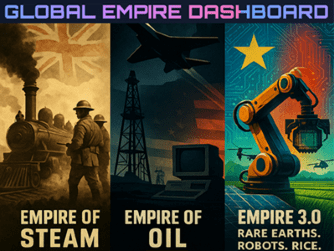
How The House of the Han Rice Boys is Winning
以戰養戰
The Boxing Promoter Strategy
In the 1970s, boxing promoter Don King mastered a ruthless model. He controlled both fighters in the ring — Muhammad Ali vs George Foreman, Ali vs Joe Frazier, Mike Tyson’s rise. He didn’t need to pick a winner. He only needed the fight to happen.
“If you hold the contracts on both sides, you win no matter who walks out with the belt.”
King’s contracts ensured the champion remained his. The promoter always kept control.
China’s Dual Game
China is executing this strategy on a grand scale, guided by the ancient wisdom of Sun Tzu in The Art of War.
Like a master who understands that “the supreme art of war is to subdue the enemy without fighting”, China has positioned itself as the indispensable supplier to both sides — feeding the conflict while remaining above it.
China dominates rare earth elements, permanent magnets, and critical components essential to American F-35 jets, missiles, submarines, and radar systems. At the same time, it serves as Iran’s largest oil buyer and key provider of drones, anti-ship missiles, air defense systems, and dual-use technology.
China supplies the American war machine.
China supplies the Iranian resistance.
Whether the dragon or the eagle claims victory, the house that controls both contracts wins — embodying Sun Tzu’s principle: “Know the enemy and know yourself, and you need not fear the result of a hundred battles.”
If America Prevails
If the United States reasserts control over the Strait of Hormuz, global shipping stabilizes and American power appears restored.
Yet the deeper reality remains: the U.S. military continues to depend on Chinese rare earths and components. China stays the quiet enabler, profiting from American strength while avoiding direct confrontation — true to Sun Tzu’s teaching that “to subdue the enemy without fighting is the acme of skill.”
If Iran Holds the Strait
If Iran successfully contests the Strait and forces America to withdraw or accept a stalemate, Iran maintains influence over a vital energy chokepoint.
Discounted Iranian oil continues to feed Chinese refineries, while Chinese technology and goods flow under Iranian permission. Once again, China keeps the contracts — strengthening its leverage without expending its own forces.
Like Don King in the boxing ring, China has engineered a position where it profits regardless of the outcome. It supplies critical inputs to the U.S. military while sustaining Iran’s ability to endure.
This is sophisticated statecraft rooted in Sun Tzu: the greatest victories require no personal battle. By making itself essential to both powers, China advances its interests as others clash in the center.
The stirrup gave the Mongols asymmetric power with simple iron. Today, true advantage belongs to the strategist who ensures both sides must come to the same house.


