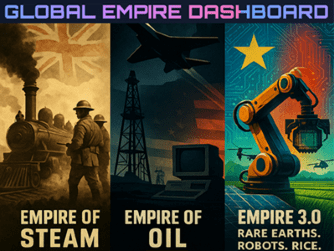
Global Empire Dashboard

We Are Closed. Australia has become corrupted by a corrosive mix of nihilism and embraced a radical liberal ideology that celebrates the rejection of anything from the past that could stabilise society including any inheritance of previous forms of culture. You just have to look at the abuse thrown towards our staff in the past few years to realise this, what is old is no longer deemed necessary & indeed something that must be replaced. We had no choice but to close.

Welcome to Foodstar

📈 Violent Crime Is Outpacing House Prices. Canberra, Not the Premier, Let It Happen

For the first time in Australian living memory, violent crime rates are rising faster than house prices, and both are the direct result of policy failures, not changes in Australians’ general law-abiding behaviour.

Most of the chaos is hidden from public view, because acknowledging it would mean confronting 20 years of bad policy decisions. Australia’s social order is cracking, and the same political cowardice that made housing unaffordable is now fuelling an unstoppable crime spiral.


1. 🏠 Domestic Violence Spillover

COVID lockdowns, excessive work-from-home IRL facetime normalised intimate violence in homes and public spaces alike.

One in four homicides in 2024 began as a domestic violence incident that “escalated on location.”


2. 🇮🇳 Hindus vs. Muslims

During the May 2025 India–Pakistan air war, a Brunswick curry house was torched, and a Tarneit Hindu temple sprayed with AK fire within 48 hours.

  • ASIO’s assessment: “Event-driven, not group-driven.”

3. ✡️🕋 Pro-Palestine vs. Zionist State

Caulfield saw four tag-team attacks on synagogues and kebab shops following the latest Gaza flare-up.

International conflicts echo instantly in Australian suburbs, turning symbolic disputes into real-world street violence.


4. 🧑‍🤝‍🧑 Resistance to Indianisation (Indians vs. Everyone Else)

On 15 Aug 2025, the 79th Khalistan Independence Day, 20 Sikhs waved yellow flags, chanting “Death to India.”

  • Drowned out by 300 Indian attendees shouting “Vande Mataram”
  • Result: 15 Indians vs. 1 Sikh brawl

Indians remain the ethnic group least likely to marry outside their religion and caste. Combined with widespread family reunion visas, this trend is turning entire suburbs into clones of Mumbai.


5. 🌍 Sudanese Civil War Spillover

Under Canberra’s “Sudanese in-country” referral quota, following the 2023 generals’ war in Khartoum, 1,200 young Sudanese men (aged 17–29, mostly ex-RSF/SAF conscripts) arrived between 2023 and August 2025.

Settling mainly in Melbourne’s north-west suburbs, they are replaying the Sudanese Civil War locally.

🔗 Why so many Sudanese skilled migrants in Australia ❌ the question no journalist wants to answer


6. 🚬 Tobacco Wars 3.0
  • Federal excise: $1.65 per stick. Container of “illicit whites” at Port Melbourne = $12 million

Market enforcement is no longer run by bikies it’s a suburban store-owner free-for-all. 19-year-olds are paid $500 to throw a jerry can at rival shops. 68 tobacconist arsons (2023–24); conviction %: 4%


7. 💊 New Synthetic Drugs That Make Heroin & Cocaine Look Like Diet Coke

The Docklands mass overdose (9 dead, Oct 2024) was caused by a nitazene analogue that didn’t exist on the Poisons Schedule six months earlier.

Police and health authorities are always one step behind.


8. 🧑‍⚖️ The Desi Freeman Effect & March for Australia Protests

When the government turns on its own people, the folk of Victoria’s high country have always pushed back from the Kelly gang’s last stand to today’s raw fights over justice, fairness, and authority.

Politicians stick to talking points, refusing to take the political pain.


9. 🔓 $20 RFID Scanners Unlock 2010–2019 Korean Cars

With a “125 kHz RFID cloning” dongle fr Shenzhen:

  • Stand within 30 cm of the owner’s pocket or handbag
  • Capture the key-fob’s unlock code in under 3 seconds
  • Re-play it a minute later to pop the doors & on push-button models & start the engine

No smashed window. No screwdriver barrel-rip.


10. 🔒 Jails Over Capacity

Australia’s prisons are over capacity, and inmates cost taxpayers $300 per night.

Even violent criminals are frequently released on bail because the system cannot hold them.

🚨 Why Traditional Policing Is Impossible
  • No hierarchical “Mr Big” like Tony Mokbel or Carl Williams to jail 🕵️‍♂️
    At least with housing, you have the RBA to swing the interest-rate axe
  • Offences cross family violence, ethnic tensions, and organised crime
  • Suburban police aren’t equipped to deal with the underlying issues

Forget the Sino-Soviet Split, brace for the Anglo-American Split. Trump’s tariffs are sapping global confidence & pushing Allies toward a Debt Doom loop.

In 1960, Mao and Khrushchev fell out over ideology. In 2025, the fracture line isn’t in Eurasia, it’s being felt across the Anglosphere. The difference? Not ideology. Compound interest.

Bond yields in Australia, Canada, and the U.K. jumped 120–180 basis points since July.


  • Refinancing costs up 25–40 % year-on-year.
  • Every uptick in interest erodes public net worth and accelerates insolvency.

States already in the Red after COVID are now staring at total insolvency
Total debt = every dollar the government owes (bonds, bank loans, leases, PPPs, swaps).
Net worth = total assets in State coffers minus total debt. Today even a sale of every bridge, hospital and office block won’t come close to clearing debt in many states.

🦘 Australia — The Debt Continent

State Net Worth Total Debt Why It’s Broken Impact of Rising Rates
Victoria –A$ 101 bn A$ 155 bn COVID, rail blowouts +1 % → A$ 600 m/month, unsustainable
Tasmania –A$ 5 bn A$ 7.8 bn Hydro-dam overruns Refinancing at 5.8 % wipes out surplus
South Australia –A$ 19 bn A$ 28 bn Defence delays Submarine costs in USD → tariff exposure doubles
New South Wales –A$ 104 bn A$ 178 bn Metro tunnels, land slump Negative equity projected until 2034

🇬🇧 UK — Councils Feeling the Squeeze

Council Net Worth Total Debt Problems Interest Impact
Birming ham –£ 3.5 bn £ 4.3 bn Pay bills + IT failure Refinancing at 6 % → £210 m/year
Woking –£ 2 bn £ 2.4 bn Skyscraper speculation 35 % property slump → ratings downgrade
Slough –£ 1.2 bn £ 1.4 bn Retail-bond binge Debt rollover costs £90 m/year

🍁 Canada — Provinces on the Edge

Province Net Worth Total Debt Weak Spots Rate Shock
Newfound land & Labrador –C$ 17 bn C$ 21 bn Muskrat Falls, oil slump Refinancing 2030 bonds costs C$ 300 m/year extra
Nova Scotia –C$ 16 bn C$ 20 bn Aging population, hospitals Debt service up 28 % in a single cycle
Ontario –C$ 440 bn C$ 450 bn Decades of deficits 6.2 % yields eat every new dollar of revenue growth
Manitoba –C$ 32 bn C$ 38 bn Flood overruns, shrinking aid Crown-utility sale can’t offset 150 bp yield rise

🇳🇿 New Zealand — Local Governments in a Vortex

Council Net Worth Total Debt Issues Rate Shock
Kaipara –NZ$ 190 m NZ$ 220 m PPP sewer blow-up Refinancing > 12 % of annual rates revenue
Dunedin –NZ$ 1.1 bn NZ$ 1.3 bn Stadium + insurance crisis Credit-watch → +40 % interest costs
Christ church –NZ$ 2.4 bn NZ$ 2.9 bn Post-quake rebuild USD-linked loans → 50 % unhedged liabilities

Tariffs aren’t just trade policy. They signal confidence. When it breaks:

  • Inflation strengthens → borrowing costs spike.
  • Exports slump → local tax bases shrink.
  • Credit spreads widen → debt becomes unserviceable.

A self-reinforcing feedback loop tests the Anglosphere more than politics ever could. The Sino-Soviet split was about manifestos. The Anglo-American split is about balance sheets

🔗Russia’s Dual Chokehold: “Rosatom HALEU + Northern Sea Route” surpassing all Global Market Leverage the Soviet Union ever had

Russia is creating a strategic leverage the USSR could only imagine. With near-monopoly control of nuclear fuel ⚛️ and dominance of the Northern Sea Route ❄️, Moscow is set to surpass Soviet influence over global energy and trade. Its power rests on two key pillars: uranium enrichment and Arctic transit.

⚛️ Uranium & HALEU – The “Energy” Chokehold

Rosatom now controls roughly 40% of global uranium enrichment and remains the only commercial HALEU supplier, the nuclear equivalent of holding the only app store key.

With Western small modular reactors (SMRs) still in pilot stages, this ensures dependency well into the 2030s. Russia now anchors fuel supply chains for Europe, the U.S., and emerging nuclear states alike, converting technical capability into long-term geopolitical leverage.

❄️ Northern Sea Route – The New Suez Canal

Once a Soviet military backwater, the Arctic is now a toll road.
Russia’s eight nuclear icebreakers and record shipping volumes have turned climate change into a logistics dividend.

What was once an desolate frontier is now a cash-generating trade artery, giving Moscow leverage over both cargo flows and regional militarization. The Northern Sea Route shortens Asia–Europe transit by nearly 40%, creating an economic chokepoint with military overtones.

🔗 Combined Leverage: More Precise, Less Overstretched

Dual Squeeze: Uranium “airlift” meets Arctic transit control, two levers capable of pressuring entire economies.

Financial Loop: Uranium revenues fund icebreaker construction, while Arctic tolls sustain defense infrastructure. Each domain reinforces the other.

Global Reach: Rosatom operates or builds reactors in over a dozen countries, binding energy policy to Moscow’s industrial ecosystem, something the USSR’s ideological network never achieved.


🏁 Bottom Line

Russia is poised to wield power that is narrower but deeper than the Soviet Union’s. Unlike the USSR, which relied on ideology and bloc subsidies, Russia’s leverage is global and more enduring.

⚙️ From the Consumer-Data Petrodollar to the Producer-Data Electro-Yuan

For decades, the United States powered global finance through attention and oil, an economy where human focus became a financial asset and crude barrels cleared in dollars anchored the system.
Now, China is constructing its counter-loop, the Electro-Yuan circuit, driven by industrial telemetry, renewable power, and commodity throughput.
Where the dollar loop priced attention scarcity, the yuan loop prices throughput scarcity.

💵 United States: The Consumer-Data Petrodollar Loop

  • 👁️ Power Source: Consumer attention, Silicon Valley’s oil, monetised by U.S. tech platforms
  • 🌐 Mechanism: Behavioural data turned into collateral via ads, subscriptions, and payments
  • 🛢️ Alliances: Middle Eastern energy partnerships sustain dollar-clearing
  • 🔁 Flow: Consumer internet → Attention surplus → Ads / CPM → Oil → Treasury bids → 🚀 NATO arms sales
  • 💳 Collateral: Guaranteed USD oil pricing and digital behavioural data
  • 🏦 Outcome: Treasury demand and military exports sustain dollar liquidity
  • 💰 Margins: 30–40% ad-tech EBITDA
  • 🧠 Nature: Prices attention scarcity and monetised perception as capital

💴 China: The Producer-Data Electro-Yuan Circuit

  • ⚙️ Power Source: Industrial telemetry across sensors, robotics, freight, and energy data
  • 🚢 Inputs: Open AI weights, shipbuilding, rare earths, renewable electricity demand
  • 🌍 Alliances: Belt and Road ports and logistics uplift regional economies to anchor influence
  • 🔁 Flow: Throughput data → Yuan liquidity → Belt and Road hardware → Strategic corridors → More telemetry
  • 🧺 Collateral: Tonnes of lithium, steel, and verified warehouse receipts
  • 💹 Outcome: Expanding Panda Bond demand and PLA-secured logistics and port equity
  • 📉 Margins: 3–5% on logistics and warrant arbitrage
  • Nature: Prices throughput scarcity and physical output as capital

🪞 Takeaway

  • The old loop monetised eyeballs, the new loop monetises weight. 100kg of refined rare earths now carries more geopolitical heft than a terabyte of likes or retweets.

🌏 If the USSR “Won” the Cold War, China Wouldn’t Rule Global Manufacturing

Had the Soviet Union prevailed in the Cold War, China’s modern trajectory would look radically different. Instead of becoming the world’s manufacturing hub and a near-monopoly holder in critical raw materials, China would likely be locked in fierce resource and strategic rivalry with Moscow, not Washington.

⚙️ 1. No U.S.-Led Globalization = No Chinese Manufacturing Miracle

China’s rise depended on U.S.-sponsored globalization: open markets, Western capital, and technology transfer.
🏭 Under a victorious USSR, the world economy would have fractured into closed, bloc-based systems, similar to COMECON on a global scale.
📉 China’s export-led model would never take off, with no WTO entry, no regional supply chains, and no surge of Western FDI.


💰 2. The USSR Would Dominate Energy and Finance

By the 1970s, the USSR was already the world’s largest oil producer.
⛽ In a post-victory world, Moscow would extend control over energy flows from the Middle East and Central Asia.
💶 A ruble-based financial system would replace the U.S. dollar’s role, restricting China’s access to energy, capital, and technology.

⚔️ 3. The Sino-Soviet Rivalry Would Escalate

Even during the communist era, the Sino-Soviet split ran deep, driven by ideology, territory, and leadership.
🌐 A triumphant USSR would not tolerate an independent China on its border.
🔥 Instead of today’s U.S.–China rivalry, the 21st century would feature a Eurasian Cold War over Siberia’s oil, gas, and metals.


🪨 4. China’s Resource Strategy Would Never Begin

Modern China dominates rare earths, lithium, and cobalt through global investments and open trade networks.
🚫 Under a Soviet-led system, those networks would not exist.
🏗️ The USSR would monopolize raw material flows within its sphere, leaving China resource-starved and geopolitically boxed in.

Trump calls it a Ballroom for the East Wing, but the proposed Ballroom Renovation for the White House is really about matching the spectacle of China’s Great Hall of the People.


🏛️ The Sad White House Reality
• The East Room, its largest interior, fits only about 350 people standing.
• The entire Executive Residence covers just 5,100 m², functioning as a home rather than a formal place to greet Heads of State.
• When guest lists grow, Washington relies on South Lawn tents or rents the National Building Museum.

🏯 The Beijing Benchmark
• The Great Hall of the People spans 171,000 m², about 35 times the White House.
• Its main auditorium seats 10,000.
• The State Banquet Hall covers 7,000 m², serving 5,000 guests in one sitting.

💡 What Trump Wants
• A 90,000 ft² (8,300 m²) East Wing extension, seating up to 1,000 guests.
• Marketed as a ballroom, but intended as a showpiece of scale and prestige.
• The first major architectural addition to the White House in more than a century.

⚖️ Symbolism vs. Scale
• The White House was designed for restraint: small rooms and republican modesty.
• The Great Hall was built for spectacle: vast, centralised and commanding.
• The Ballroom Extension would blur those traditions: a home becoming a stage, a president seeking to restore America’s sense of monumental presence.

🇦🇺 Australian Media Who’s Who 2025

🎭 Attention Grabbers (“look at me”)

Some journalists and media figures thrive on visibility. They are headline magnets, buzz merchants, and comedians keeping the nation entertained between crises.

  • Ruby Cornish, ABC – High-energy lifestyle segments.
  • Natasha Schapova, ABC – Digital creator & podcaster blending fashion and unfiltered takes.
  • Sam Pang, Ten & Seven – The Front Bar co-host, cheeky banter master.
  • Kamin Gock, ABC – On-the-ground drama reporter.
  • Abbie Chatfield, LiSTNR & Ten – Election-year hot takes via influencer channels.
  • Robert Irwin, Ten – Wildlife TV star & I’m a Celebrity host, popularity king.
  • Samantha Armytage, Seven – Golden Bachelor host; ratings convert entertainment into national chatter.

These figures command attention not just through talent but timing, bringing audiences together in moments of amusement, scandal, or surprise.

🗞️ Agenda Setter (“listen to me”)

Beyond attention, some voices steer the conversation. They influence headlines, ministerial responses, and even political strategy.

  • Karl Stefanovic, Nine – Live chaos and prime-time reach.
  • Kyle Sandilands, KIIS FM – Shock jock & kingmaker whose feuds shape headlines.
  • Andrew Clennell, Sky News – Insider leaks & rapid-fire analysis.
  • Leigh Sales, ABC / The Age – Podcasts and quarterly interviews moving markets.
  • Patricia Karvelas, ABC RN – 8:10 am ministerial grillings clipped everywhere by 9 am.

Attention-Grabbing Agenda Setter
Karl Stefanovic (Nine) and Samantha Armytage (Seven) aren’t just ratings magnets; their combined reach puts them in the rare club of Attention-Grabbing Agenda Setters, personalities who can flip a light-hearted segment into tomorrow’s national talking point.
Freya Leach was being groomed for an Attention-Grabbing Agenda Setter role until a bacon-and-prophet joke derailed the rise. source

🧠 Thought Leaders (“think like me“)

Finally, some voices are followed for insight rather than spectacle. These analysts and commentators shape elite debates and grassroots discussions alike.

  • Laura Tingle, ABC – Forensic political dissection.
  • Sharri Markson, Sky News – Election & security analysis shaping elite debates.
  • David Speers, ABC – Insiders host framing political futures.
  • Matt Bevan, ABC – Podcaster decoding world threats with sharp wit.
  • Peta Credlin, Sky News – Commentary shaping reform and international flashpoints.
  • Jordan Shanks (Friendlyjordies), YouTube – Viral exposés driving grassroots scrutiny.

Agenda-Setting Thought Leaders
Laura Tingle, David Speers, and Peta Credlin sit above the daily noise as analysts whose columns, interviews, and monologues don’t merely echo the debate, they author it.

Chinese boxer Zhou Runqi reportedly assaulted in New South Wales

Chinese media report that 24-year-old WBC & WBA champion boxer Zhou Runqi was seriously injured in an alleged racially motivated attack while riding a bus in New South Wales on 14 October 2025. According to the accounts, two white men and two white women began hurling racial abuse at Zhou and his wife before the confrontation turned physical; Zhou was reportedly struck on the back of the head, briefly lost consciousness, and was later diagnosed with a brain hemorrhage and concussion.

Zhou, who holds the WBC Asian Continental and WBA East-Asian Intercontinental titles and is based in Australia, is said to have cancelled an upcoming Oceania title defence while he recovers. The claims have circulated widely on Chinese social media and have been picked up by Chinese-language news aggregators, but as of 20 October 2025 no major Australian outlet has published independent confirmation of the incident, and NSW Police have not released a statement.

India’s Desperation: The Last Ditch Afghanistan Gambit to Provoke Pakistan

🕶️ The Shadow of CAATSA

In 2017, the U.S. Congress passed CAATSA Countering America’s Adversaries Through Sanctions Act, aimed at punishing countries that buy major weapons from Russia, Iran, or North Korea. Once triggered, CAATSA penalties are automatic, no phone call can stop it. No handshake can waive it.

For India, that list hits the core of its arsenal:

  • 🛡️ S-400 missile batteries
  • ✈️ Su-30MKI fighters
  • 🚜 T-90 tanks plus
  • 💸 Tariffs on Indian exports
  • ⚙️ Blocked insurance and Russian spare parts

⚠️ CAATSA is now Locked in

  • 🛢️ Russia is winning in Ukraine, oil cash is surging.
  • 🇮🇳 India keeps buying Russian crude defying Washington’s calls to taper.
  • 🇺🇸 Trump turns the screw linking CAATSA not just to missiles, but to energy.
  • 📆 January 2026: sanctions expand to India

➡️ No waivers. No exceptions. No escape.

Result: Kashmir’s sky becomes collateral damage of India’s energy addiction and Russia’s battlefield success.

🛩️ Pakistan’s Power Play

While India talks, Pakistan upgrades:

  • ⚔️ 40 J-35 stealth fighters due before 2028
  • 🎯 PL-17 long-range missiles (400 km reach)
  • 🛰️ Chinese satellites feeding live targeting data

For the first time in half a century, Pakistan owns the initiative. Its pilots test Indian radars, slip past defenses, and linger longer over the Line of Control.

Since 1971, India’s control over Kashmir has rested on air dominance. That edge is evaporating:

  • 🚫 CAATSA cuts logistics
  • 🧩 Russian spares vanish by 2028

The Kashmir air defense bubble is collapsing.


🎲 Modi’s Last Throw of the Dice

With sanctions closing in and the sky slipping away, Delhi’s strategy turns desperate:
🔥 Stir Afghanistan.
🎯 Pull Pakistan west.
🧨 Force a border flare-up before the air gap widens.

It’s a gambit born of weakness, not confidence a way to delay the reckoning until after the 2029 election. But the timing is brutal: sanctions bite, spares dry up, and Pakistan smells opportunity.
For Modi, the final chapter in the 50-year struggle for Kashmir may read like his greatest promise undone by his own hubris.

🛰️ Power of Siberia: the 4000 km pipe that turns gas into collateral. China is turning Russian energy into kilowatt-hours you can hedge & treat like batteries in a warehouse yuan-backed, dollar-free.

STAGE 1 – the energy-finance flywheel 🚀

1️⃣ 30-yr, 1-trillion m³ take-or-pay → Gazprom locks in a 30-year pay-cheque in yuan. Each locked yuan payment is one less invoice the world needs dollars to settle.

2️⃣ Chinese banks slice the cash-flow → sell bonds today backed by tomorrow’s gas. Every bond sold in yuan pulls investors away from USD-denominated energy debt.

3️⃣ Yuan flows back → buys rigs, rails, ships no SWIFT, no dollars. Equipment priced in yuan means suppliers start quoting parts in CNY, chipping away at dollar invoicing.

4️⃣ Loop repeats → gas pays off old bonds and backs new ones, forever. The endless yuan recycle trains markets to price future energy projects in CNY, not USD.

Result: the first pipeline that prints its own credit, pushing north-south trade without a single greenback.

STAGE 2 – the war-fed printing press 💣

🔥 40 % of Russia’s GDP now goes to tanks and shells.
War-spending keeps Russian gas flowing east, ensuring yuan contracts stay large enough to benchmark against.

🔥 Extra bcm = more yuan bonds = cash for missiles long before the gas arrives.
More bonds deepen yuan liquidity, making CNY the easier currency to trade Russian molecules in.

🔥 India pays yuan for oil; China pays yuan for gas Russia earns, spends and saves in CNY.
When the third-biggest importer settles in yuan, other sellers accept CNY to keep customers, slicing another chunk off dollar demand.

🔥 Yuan is now energy-money embargoes can’t touch it.
A sanction-proof currency option entices more exporters to quote cargoes in yuan, eroding the dollar’s market share.

STAGE 3 – the post-dollar chessboard ♟️

Asia locks in cheap pipe gas.
Cheaper yuan-denominated contracts set a new reference price, pulling neighbouring deals into CNY.

Dollar loses pricing monopoly in 30 % of global gas trade.
Russia-China flows = 10 % of world market, all in yuan; add India/Iran/Qatar and non-USD hits 28-32 % by 2026.
Each non-dollar deal shrinks the pool of cargoes needing USD hedging, so traders quote futures in yuan and central banks trim USD reserves.

Template exported: Kazakhstan, Nigeria, Arctic LNG copy the same trick gas today, yuan loan tomorrow.
More pipelines → more yuan bonds → deeper CNY markets → a self-growing energy bloc that skips Western banks.
Every project removes another sliver of global gas volume from dollar price discovery, marching toward the 30 % tipping point.

The Power of Beauty: How Geography Shapes Prosperity

Humans have long associated physical attractiveness with better job opportunities, healthier lives, and even the controversial notion of genetic “superiority.” Less well known is that Geography also exerts a huge influence on economic destiny. 🌍 Fertile river basins, navigable waterways, rich mineral belts, and soft urban soils create conditions that naturally amplify productivity, innovation, and wealth. 💡 These “geological jackpots” act as silent engines of prosperity, seeding industries, infrastructure, & trade networks long before policy or human ingenuity enters the equation. ⚡ Just as attractive traits can confer outsized advantages in life, exceptional geography often produces outsized economic outcomes.

# Region / Country Type Geographic / Geologic Basis Mechanism / Scale Est (Intl $/yr)
1 Saudi Arabia – Oil Superbasin Hydrocarbon Giant onshore anticlines, easy-access reservoirs Ghawar, Safaniya and other supergiants yield the cheapest crude globally ($3–5 / bbl). Exports fund infrastructure, PIF > $900 B, and sustain the riyal. ≈ $1.0–1.2 T / yr
2 China – Soft, stable Engineering soils Super-Jackpot Infrastructure / Engineering Uniform alluvial plains and soft sedimentary basins Soft, stable soils in megacities (Beijing–Tianjin, Shanghai, Guangzhou) enabled 1 500 km+ of metro tunnelling since 2015, canals, and mega-dams. Centuries of hydraulic expertise now exported via the BRI as turnkey ports, tunnels, bridges, and rails. ≈ $800–900 B / yr
3 United States – Shale Oil & Gas Revolution Hydrocarbon / Unconventional Permian, Marcellus, Bakken shale formations Horizontal drilling + fracking unlocked vast reserves, making the US top energy producer and reviving petrochemicals and manufacturing. ≈ $700–750 B / yr
4 China – Yangtze & Yellow River Basins Agriculture / Water & Transport Twin river flood-plains, loess-rich fertile soils 400 000 km² alluvium supports 40 % of grain and 60 % of cotton; dense inland ports and hydropower (Three Gorges) enable cheap logistics & energy. ≈ $500–600 B / yr
5 United States – Midwest / Mississippi River Basin Agriculture / Transport Network Vast loess plains + world’s largest navigable inland river system Deep fertile soils plus barge network link farms to Gulf ports. Core to US grain, soy, & corn exports; logistics synergy with petro- & manufacturing belt. ≈ $450–500 B / yr
6 Russia – Ural–Siberian Resource Arc Minerals / Energy Immense continental-shield deposits Oil, gas, coal, nickel, and timber exports form ≈ 30 % of GDP and supply Eurasian industry. ≈ $400–500 B / yr
7 Brazil – Commodity Triad + Amazon Basin Agriculture / Mining / Hydro Fertile Cerrado soils, Amazon water, iron ore (Carajás) Major exporter of soy, beef, sugar, bauxite, iron. Hydropower & rainforest hydrology stabilize output. ≈ $400–450 B / yr
8 India – Alluvial Agriculture & River Plains Agriculture / Water Ganges & Indus alluvium Monsoon-fed plains yield 2–3 crops / yr; foundation of national food security & export agriculture. ≈ $300–350 B / yr
9 Norway & Scandinavia – Fjords & Hydrocarbons Hydro / Energy Glacial valleys + North Sea basins Hydropower > 95 % electricity; offshore oil & gas exports feed a $1.5 T sovereign fund. ≈ $250–300 B / yr
10 Australia – Minerals & Energy Exports Mining / Resources Iron ore, coal, LNG, lithium, bauxite Pilbara & east-coast basins deliver A$250 B exports; backbone of trade with Asia. ≈ $250 B / yr
11 Canada – Athabasca Oil Sands Hydrocarbon / Bitumen Vast bituminous sands (northern Alberta) Heavy-oil extraction secures long-term energy; supports western provinces’ fiscal base. ≈ $200–250 B / yr
12 Germany – Rhine–Ruhr Industrial Corridor Strategic / Infrastructure Coal basins + Rhine River transport nexus Lowland corridor integrated coal, iron, and shipping → Europe’s industrial heart; now logistics, chemicals, green-tech cluster. ≈ $200–250 B / yr
13 Qatar – North Field Gas Basin Hydrocarbon Shared reservoir with Iran (South Pars) LNG exports dominate GDP (~55–60 %); Asia & Europe rely heavily on it. ≈ $180–200 B / yr
14 UAE – Offshore & Onshore Oil Belts Hydrocarbon Abu Dhabi supergiant fields High-margin oil revenues fund logistics & tourism diversification (Dubai, Abu Dhabi). ≈ $180–200 B / yr
15 China – Rare-Earth Resource Advantage Strategic / Minerals Inner Mongolia & southern ionic-clay deposits Controls ≈ 80 % of global REO output; anchors EV, turbine, and electronics supply chains. ≈ $150–200 B / yr

🔥 Thorpe Says “burn down” Parliament House; Nation Pretends to Be Shocked

Canberra, the only city whose main export is Question Time, got a rude wake-up when Senator Lidia Thorpe said she’d “burn down” Parliament House. 🚨 AFP jumped into action faster than Scott “I Don’t Hold A Hose, Mate” Morrison sprinting for a Hawaiian cocktail. 🍹

Cue the outrage brigade clutching pearls, while the rest of Australia just shrugged “That’s our Lidia.” Still, the Feds don’t mess around when “Parliament” and “fire” end up in the same sentence. 🔥

Funny thing though Canada’s Parliament actually did go up in flames once, back in 1916. 🇨🇦 The whole joint burned down mid-debate, and no one ever figured out why. Royal commission, wartime paranoia mystery unsolved. 🕵️‍♂️

So maybe let’s all relax, grab some marshmallows, and wait for Canada to text: “Welcome to the Mystery Arson Club, mate.” 🪵🔥