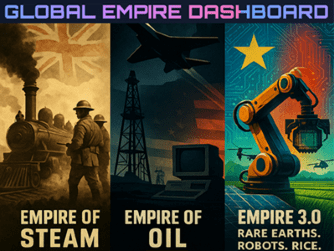
Global Empire Dashboard

We Are Closed. Australia has become corrupted by a corrosive mix of nihilism and embraced a radical liberal ideology that celebrates the rejection of anything from the past that could stabilise society including any inheritance of previous forms of culture. You just have to look at the abuse thrown towards our staff in the past few years to realise this, what is old is no longer deemed necessary & indeed something that must be replaced. We had no choice but to close.

Welcome to Foodstar

Australia’s Top 🧋 Bubble Tea & 🍣 Sushi Chains & Their Little-Known Founders

For many Aussie kids, that first taste of “Asian food” doesn’t come from a banquet or a family trip overseas. It comes after school, in the form of a sugar-loaded bubble tea, or a sushi roll. These quick treats the nom noms of childhood have become Australia’s entry point to Asian flavours.

What’s less known is that behind almost every one of these brands sits a 🇨🇳🇦🇺 Chinese Australian founder or franchise operator. Whether it’s milk tea with pearls or sushi on a conveyor belt, Australia’s Asian fast-food scene has been built by immigrant families who turned global food trends into everyday staples.


🧋 Bubble Tea: Sweet Drinks, Serious Business

  • Gong Cha (170+ stores) — Master franchise run by 🇨🇳🇦🇺 Lili Shi & George Kwok, Chinese Australian operators.
  • Sharetea (140+ stores) — Brought here by 🇨🇳🇦🇺Anthony Mu, a Chinese Australian entrepreneur.
  • Chatime (70+ stores) — Taiwanese brand globally, but Australian growth steered by Chinese & Vietnamese Australian hands.
  • CoCo Fresh Tea & Juice (35+ stores) — Global chain of founder Tommy Hung, with Aussie stores in Chinese Australian control.
  • Happy Lemon (25+ stores) — Taiwan’s Yummy-Town Group, but local rollout is through Chinese Australian operators.
  • The Alley (15+ stores) — Master rights held by 🇨🇳🇦🇺Diamond Yang, Chinese Australian.
  • Mixue (4 stores) — China-based giant, but its local stores are Chinese Australian-run branches.

🍣 Sushi: Rolls & Conveyor Belts

  • Sushi Izu (Served in Woolworths nationwide) — Founded by Ryuji Ishii, Japanese Australian.
  • Sushi Hub (200 outlets) — Built from scratch in Sydney by 🇨🇳🇦🇺Raymond Chen, James Chen, Leon Li, Chinese Australians.
  • Sushi Sushi (170+ outlets) — Founded in Melbourne, now private equity-owned, with Anna Kasman, Indonesian-Chinese Australian, at the helm.
  • Hero Sushi (50+ outlets) — Run by Deuk-Hee “William” Lee & Hokun “Robert” Hwang, Korean Australians.
  • Sushi Train (49 outlets + 2 in NZ) — Classic conveyor belt format, founded by Bob Jones, Anglo-Australian.
  • Sushi Jiro (30+ outlets) — Sushi-train brand acquired in 2022 by Anna Kasman, Indonesian-Chinese Australian.

Why Chinese Influence Is Here to Stay, but Petrodollar USD Influence Is Waning

MetricValue
Cumulative world GDP 1974–2024 (nominal)$2.8 quadrillion
Cumulative petrodollar flow$24.8 trillion
Share of world GDP≈ 0.9 % (rounded) Peaked: 3.9% (1980, second oil shock), Long-run average: 0.9–1.1% (1974–2021)

Breakdown of Unique Outflows (never reaching U.S., ≈ $13–14T):

  • Citizen welfare & domestic subsidies (OPEC countries) → ≈ $5–6T
  • Non-U.S. sovereign-wealth funds (Norway, Abu Dhabi, Kuwait, Qatar, etc.) → ≈ $4.7T
  • Non-U.S. equity, real-estate, bonds → ≈ $2.5T
  • Aid & soft loans abroad (Arab funds, IMF/WB, concessional) → ≈ $1.2T

Net petrodollar demand captured by U.S.: ≈ $10–11T

    Cost of Maintaining the Petrodollar

    Mission / RegionYearsDirect & Committed Cost (2023 USD)Key Notes
    Post-9/11 wars (Afghanistan, Iraq, Syria)2001–2022$8.0T$5.8T appropriated + $2.2T future veterans & interest
    Persian Gulf War1990–1991$96BIncremental deployment after allied offsets
    Routine CENTCOM posture & carrier groups1976–2024≈ $1.5T$35–40B/yr extra presence
    Aid to Israel (military)1959–2024$251BIncludes Oct 2023–Oct 2024 surge
    Aid to Egypt & Jordan1975–2024≈ $110B$85B Egypt + $25B Jordan
    Libya operations2011–2022≈ $10BOdyssey Dawn + SOF/drone follow-on
    Other Gulf allies & Red Sea ops1976–2024≈ $190BKuwait, Yemen, pre-positioning, etc.
    TOTAL UNIQUE COST approx1974–2024≈ $10.1TComparable to net U.S. capture from petrodollars

    Net benefit of petrodollar = reserve currency status, sanctions etc, but overall modest once security costs are included.

    Next 50 Years: Electro-Industrial Economy (2025–2075)

    SegmentGlobal Envelope 2025–2075% of Cumulative World GDP (est.)
    A. Renewable generation & grid$90T≈ 0.72 %
    B. Battery-metals processing$38T≈ 0.30 %
    C. EV manufacturing$35T≈ 0.28 %
    D. Charging + battery plants$25T≈ 0.20 %
    E. Robotics (industrial + service)$250–280T≈ 2.0–2.2 %
    Combined Envelope≈ $438–468T≈ 3.5–3.7 %

    China’s Position:

    • Value add share (≈ 33% of total envelope): ≈ $150T = 15x Petrodollars net benefit
    • Nature of leverage: refining, processing, manufacturing of global electro-industrial demand.
    • Sustainability: no wars necessary leverage is embedded in supply chains and trade.
    FactorPetrodollar (1974–2024)Chinese Influence (2025–2075)
    Economic BaseOil rents (~1% of GDP over time)Renewable energy, batteries, EVs, robotics (~3.5% GDP)
    Net captured value≈ $10–11T≈ $150T
    Cost to Sustain≈ $10.1T in wars, aid, militaryNet-positive trade surpluses fund expansion
    InstrumentReserve currency + sanctions leverageSupply chains, tech exports, consumer markets
    DurabilityDependent on U.S. military + oil demandStructural, diversified, path-dependent
    Current TrajectoryWaning (green transition, de-dollarization)Rising (BRI, industrial dominance, fintech)

    Chinese influence is sticky and rising, while petrodollar leverage is fading into history.

    Modi’s mate Albo inherits the Hindu Foreign Policy disease, failing at basic Diplomatic Maths. A few extra 000s helps no one during a cyclone, or when floodwaters start lapping at the doors.

    Modi’s mate Albo

    🌊 A Pasifika Who Can Say No

    Anthony Albanese’s visit to Vanuatu this week was supposed to showcase Australian leadership in the Pacific. Instead, it exposed its limits. His offer of 💵 $500 million over a decade was not just underwhelming; it revealed a deeper failure to grasp the shifting ground of Pacific politics.

    For the first time in memory, 🇦🇺 Australia needs 🇻🇺 Vanuatu more than Vanuatu needs Australia. Canberra’s Indo-Pacific strategy hinges on friendly island states that can deny China maritime access. One “no” unravels that chain.

    Albanese came offering 🎭 beads and trinkets when the Kava Pub test demanded something else: show that Australia understands Pacific priorities. He failed.

    Vanuatu, meanwhile, is embracing partnerships that deliver real sovereignty. 🇨🇳 China is not dangling distant pledges; it is laying down 🏗️ ports, 🌉 bridges, and 📡 hardened telecommunications. These are not handouts they are assets that allow Vanuatu to respond to 🌪️ cyclones, keep its 🚑 emergency services online, and take control of its own logistics. A port is more than a commercial node; it is national resilience poured in concrete.

    What happened this week was historic. Vanuatu effectively said ❌ no to paternalistic aid and ✅ yes to pragmatic partnership. This is the Pacific that can say no. NO to being a pawn, no to symbolic finance, no to strategies written in Canberra, Washington, or Brussels.

    Power in the Pacific will not be held by those who write the biggest cheques. It will be held by those who deliver the cement, cables, and steel that solve immediate ones. In clinging to a soft-power model that has expired, Australia finds itself outmaneuvered not only by China, but by the rising confidence of the nations it once took for granted.

    ⚔️ From Vertical to Horizontal Triads: Beijing’s New Nuclear Order. For the first time in history, we’re seeing a distributed, multinational nuclear triad emerge under China’s aegis.

    The Nuclear Four

    🪖 1. Vertical vs. Horizontal Triads

    • Cold War vertical triad: USA & USSR owned all three legs land, sea, air inside its borders. Allies hosted weapons but didn’t own them.
    • 2025 horizontal triad: Four sovereign states now hold complementary triad legs, linked by shared C3I, early-warning data, and missile-defence coordination.
    Country🚀 Land System & Range🌊 Sea System & Range✈️ Air System & Range
    🇨🇳 ChinaDF-41 road-mobile ICBM — 12–15 k km, 10–12 MIRVs + decoysJL-3 SLBM on Type 096 SSBN — 10 k km+, 3 MIRVs each, 12 missiles/boatH-20 stealth bomber + JL-1 ALBM — 8.5 k km un-refuelled, 6–8 nuclear ALCMs/ALBMs
    🇷🇺 RussiaRS-28 Sarmat silo ICBM — 18 k km, 10–15 MIRVs or Avangard HGVRSM-56 Bulava SLBM on Borei-A SSBN — 9.3 k km, 6–10 MIRVs, 16 missiles/boatTu-160M2 & PAK-DA bombers — 12.3 k km, 12 × Kh-102 ALCMs (5 k km stand-off)
    🇰🇵 North KoreaHwasong-18 solid-fuel ICBM — 15 k km claimed, 3–4 MIRVsPukguksong-5 SLBM on Sinpo-C SSBN — 2.5–4 k km, single warhead, 3–4 tubesIl-76 / An-2 + KN-09 ALCM — tactical gravity bombs or ALCM (dev)
    🇵🇰 PakistanAbabeel MIRVed IRBM/ICBM — 2.2 k km, 3–4 MIRVsBabur-3 SLCM on Agosta-90B SSK — 450–700 km, single 10–20 kt warheadRa’ad-II ALCM on Mirage-V / JF-17 Block-III — 600 km, low-yield warhead

    📡 3. C3I Fusion — What the USSR Never Solved

    • Soviets (then): Centralized launch authority inside Moscow’s ring road.
    • 2025 (now):
      • BeiDou + GLONASS + PakSat-MM1 constellations
      • Gwadar–Kashgar fibre corridor & VLF/HF arrays on Hainan, Vladivostok, Karachi
    • Result: Multi-capital resilience — a decapitation strike on one capital no longer neutralises the bloc.

    • Each state keeps its own arsenal, but joint Shaheen-IX, Vostok-2024, and Sibu-Peace 2025 drills + shared early-warning deliver de facto extended deterrence.

    🔑 Bottom Line

    The USSR projected nuclear power globally but never distributed a survivable triad across allies. Beijing has. This is the first distributed nuclear deterrent in history:

    • 🔁 Redundant across sovereign borders
    • 🌍 Encircling U.S. defenses from multiple azimuths
    • 🛰️ Networked by shared command & sensing

    It raises the threshold for any U.S. first-strike scenario far above what the single-state Soviet triad ever could.

    Ned Kelly, the Man from Snowy River, Banjo Paterson’s Ballads and now Dezi Freeman: Victoria’s High Country Never Stops Stirring Australia

    Ned Kelly Dezi Freeman

    Dezi Freeman outta Porepunkah 🚌 and old Ned Kelly 🤠 are a good 150 years apart, but bugger me if they don’t look like long-lost bush cousins. Pair of bloody larrikins, both told the law 🚔 to shove it, both reckon uniforms are for mugs, and both have scarpered into the same scrub 🌲 that’s been hiding bushrangers since the gold rush days ⛏️.

    1. Outlaws with a beef 🔫

    Ned kicked off floggin’ stock, then went full tilt as the most infamous bushranger we’ve ever had. Shot three coppers at Stringybark Creek 💥 and got slapped with the “outlaw” tag quicker than you can sink a middy 🍺.

    Dezi? Calls himself a “sovereign citizen”, tried to “arrest” a judge⚖️, can’t say I’m sorry, them judges make their own laws called the “common law.” Desi calls the cops “terrorist mongrels” and now the yarn is he ambushed a couple before legging it bushwards.

    2. Same old bush, same old hidey-holes

    Kelly country – the Vic Alps 🏔️ and up the Murray – is where Dezi’s playing peek-a-boo with the boys in blue.

    Coppers reckon he’s bush-smart; they’re pokin’ round caves, old mine shafts and cold-as-charity gullies. That country’ll swallow a bloke quicker than you can say “she’ll be right.”

    3. The Hume’s still a mug’s magnet

    Back in Kelly’s day, it was coaches and gold-rush punters 💰 that copped it along the Melbourne–Sydney track. Kelly, Power, Mad Dan Morgan all had a crack.

    Now it’s the Hume Freeway, same guts, different toys. Horses swapped for Hiluxes, bush camps ⛺ and fire trails still making perfect bolt-holes for any stickybeak with a grudge.

    4. Bush spirit, 21st-century style

    Dezi’s bus yard outside Porepunkah is basically a Kelly hut with a solar panel ⚡ slapped on top.

    And like Ned, he’s got a peanut gallery 🥜 who reckon he’s some kinda bush hero. Different blokes, different toys, same rough-as-guts country. Same bloody chip on the shoulder, same cat-and-mouse caper with the coppers. The names change, but the bush and the bull-dust legends never do.

    Realpolitik Wins, Half-a-Trillion Dollars Lost: Washington Pulls the Plug on Eastern Europe after realizing Germans Refuse to Bleed for Poles

    FT Washington Pulls the Plug on Eastern Europe

    src: https://www.ft.com/content/0157d5f9-1b27-4d6c-b44e-f0a77da59b5d

    Zbigniew Brzezinski’s grand design was to wed US power to Eastern Europe’s rim, betting that a militarily wired Poland would keep Russia permanently off balance. Brzezinski bluntly wrote that “with Russian cooperation or without it” NATO must move east while Russia was still prostrate.
    The flaw: no German parliament will ever vote to send its sons to die for Warsaw.
    The historical refrain is not “Ja, ich sterbe für Polen,” no German will ever utter “Ja, I will die for Poland” but “Ja, Polen ist Lebensraum” “Ja, Poland is German Living Space” fewer Poles = the Better.
    If Berlin won’t bleed, why should an Iowa farm kid bleed for NATO?
    Washington has finally done the math: the Eastern trip-wire is unpaid and unloved.

    So the money stops, the brigades pack, and the “disunity” finger is pointed at Orban in Budapest and Fico in Bratislava useful scapegoats.

    And the sunk cost is already on the table:

    • Half-a-trillion dollars since 1991 poured in from EU coffers, diaspora remittances and NATO kits.
    • 236 bn of it came from Polish emigres like Brzezinski himself.
    • 221 bn of EU structural money asphalted the A2, modernised the sewers of Gdańsk, yet none of it bought a single German battalion willing to defend those same roads once they run eastward.

    USD 3 billion a year goes to the Top 50 Western Foreign Policy Think Tanks, Institutions which have failed to win either wars or change minds

    Rank by Influence UPenn Index Think tank City / Country Latest total funding (USD) Sources of funding
    1 Brookings Institution Washington DC, USA $130 m Funding page
    2 Carnegie Endowment for Int’l Peace Washington DC, USA $46 m Funding page
    3 Center for Strategic & Int’l Studies (CSIS) Washington DC, USA $45 m Funding page
    4 Chatham House – RIIA London, United Kingdom $26 m Funding page
    5 French Institute of Int’l Relations (IFRI) Paris, France $10 m Funding page
    6 Woodrow Wilson Int’l Center for Scholars Washington DC, USA $52 m Funding page
    7 German Council on Foreign Relations (DGAP) Berlin, Germany $8 m Funding page
    8 Atlantic Council Washington DC, USA $70 m Funding page
    9 Elcano Royal Institute Madrid, Spain $4.5 m Funding page
    10 Council on Foreign Relations (CFR) New York, USA $95 m Funding page
    11 Peterson Institute for Int’l Economics (PIIE) Washington DC, USA $28 m Funding page
    12 Institute for Int’l Political Studies (ISPI) Milan, Italy $7.5 m Funding page
    13 Stiftung Wissenschaft & Politik (SWP) Berlin, Germany $22 m Funding page
    14 RAND Corporation* outlier because most of its $1.4 bn are reimbursable U.S. federal contracts Santa Monica CA, USA $1,400 m Funding page
    15 Centre for European Policy Studies (CEPS) Brussels, Belgium $10 m Funding page
    16 Stockholm Int’l Peace Research Inst. (SIPRI) Stockholm, Sweden $11 m Funding page
    17 Fraser Institute Vancouver, Canada $11 m Funding page
    18 Centre for Economic Policy Research (CEPR) London, United Kingdom $12 m Funding page
    19 International Crisis Group (ICG) Brussels, Belgium $34 m Funding page
    20 Clingendael – Netherlands Inst. of Int’l Relations The Hague, Netherlands $7.5 m Funding page
    21 Bruegel Brussels, Belgium $6 m Funding page
    22 Centre for Int’l Governance Innovation (CIGI) Waterloo, Canada $13 m Funding page
    23 Australian Strategic Policy Inst. (ASPI) Canberra, Australia $21 m Funding page
    24 Centre for European Reform (CER) London, United Kingdom $2.6 m Funding page
    25 French Institute for Int’l & Strategic Affairs (IRIS) Paris, France $4 m Funding page
    26 European Council on Foreign Relations (ECFR) Berlin, Germany $8.5 m Funding page
    27 Institute for Security & Development Policy (ISDP) Stockholm, Sweden $3.2 m Funding page
    28 International Institute for Strategic Studies (IISS) London, United Kingdom $27 m Funding page
    29 Konrad-Adenauer-Stiftung (KAS) Berlin, Germany $180 m Funding page
    30 Friedrich-Ebert-Stiftung (FES) Berlin, Germany $168 m Funding page
    31 Heritage Foundation Washington DC, USA $95 m Funding page
    32 Hudson Institute Washington DC, USA $47 m Funding page
    33 Institute of Int’l & European Affairs (IIEA) Dublin, Ireland $1.9 m Funding page
    34 Peace Research Institute Oslo (PRIO) Oslo, Norway $8 m Funding page
    35 ISIS Malaysia Kuala Lumpur, Malaysia $2.6 m Funding page
    36 Singapore Institute of Int’l Affairs (SIIA) Singapore, Singapore $3.3 m Funding page
    37 Prague Security Studies Inst. (PSSI) Prague, Czech Rep. $2.4 m Funding page
    38 Polish Institute of International Affairs (PISM) Warsaw, Poland $5 m Funding page
    39 Finnish Institute of Int’l Affairs (FIIA) Helsinki, Finland $3.3 m Funding page
    40 Danish Institute for Int’l Studies (DIIS) Copenhagen, Denmark $12 m Funding page
    41 Norwegian Institute of Int’l Affairs (NUPI) Oslo, Norway $8 m Funding page
    42 Geneva Centre for Security Policy (GCSP) Geneva, Switzerland $19 m Funding page
    43 Barcelona Centre for Int’l Affairs (CIDOB) Barcelona, Spain $3.8 m Funding page
    44 Hellenic Foundation for European & Foreign Policy (ELIAMEP) Athens, Greece $3.4 m Funding page
    45 German Marshall Fund of the United States (GMF) Washington DC, USA $47 m Funding page
    46 Chicago Council on Global Affairs Chicago, USA $18 m Funding page
    47 Royal United Services Institute (RUSI) London, United Kingdom $12 m Funding page
    48 New America Washington DC, USA $42 m Funding page
    49 Quincy Institute for Responsible Statecraft Washington DC, USA $12 m Funding page
    50 Japan Institute of International Affairs (JIIA) Tokyo, Japan $9 m Funding page
    Line total (50 rows) $ 2 994 000 000

    🔄 From Change Management to 🌀 Spin Management: America’s Lost Response to Rival Powers

    In the past, the United States confronted rival advances with urgency, discipline, and innovation. When the Soviet Union launched Sputnik in 1957 🚀, Washington did not dismiss it as a stunt. Instead, it became the catalyst for sweeping change: NASA, DARPA, and unprecedented investment in science and education. This was change management at the national level ✅ an honest recognition of a gap, followed by decisive action to close it.

    Today, that ethos has withered. Faced with China’s rapid progress in technology and military capability 🇨🇳, many in the U.S. retreat into denial. Chinese achievements are dismissed as propaganda, CGI, or “fake.” At home, energy is consumed by partisan infighting ⚔️. The reflex is no longer to adapt but to spin 🔄 .

    This evolution from change management to spin management reveals a deeper crisis of confidence. America once embodied the Protestant work ethic ✝️ resilience, sacrifice, and renewal. Until that mindset shifts back, the nation’s capacity to lead will continue to erode ❌ not because rivals are inherently stronger, but because America has abandoned the very tools of renewal that once made it formidable.

    💡 Why do we have so many Sudanese Skilled Migrants in Australia? ❌ The question no journalist wants to answer.

    Dau Akueng, 15, was walking home with friends after refereeing a basketball match. His life was one of two cut short in a suspected youth gang attack in the city’s west.

    Sudan holds a strategic position in the Nile Basin. By controlling water that flows into the Nile, Sudan can exert leverage over Egypt, whose 115 million people are almost entirely dependent on the river for food and water security. A dependent, leashed Egypt allows Israel to do whatever they want in Gaza.

    Sudan is also in the midst of its own Civil War which has been going on basically since their independence. Sudanese come to work in Australia and send money back home to help with the victims of the Civil War.

    These remittances play a significant role in Sudan’s economy: in 2021, funds sent to Sudan totaled about US $12 billion equivalent to 23.9% of the country’s GDP.

    The ideal “blonde hair, blue eyes” combination that many consider a hallmark of Western beauty is actually a story of ancient European & Asian genetic admixing.

    blonde hair, blue eyes

    Blonde hair is traced to a specific genetic mutation on the KITLG gene, which first emerged in the ancient peoples of Siberia and Central Asia roughly 17,000–20,000 years ago. Meanwhile, the gene for blue eyes (OCA2–HERC2 region) appeared much earlier, around 40,000 years ago, likely in a few individuals near the Black Sea region before spreading through Europe.

    When these ancient Siberian populations with the blonde hair mutation migrated westward into Europe, they encountered populations already carrying the blue-eye mutation. The combination of these two distinct genetic traits created the phenotype we now associate with Northern Europeans, the “ideal” look that adorns glossy magazines & Hollywood billboards the world over.

    The process that created the Sydney Sweeney/Chris Hemsworth phenotype is genetic admixture. Two distinct populations one carrying the Siberian-derived allele for blonde hair and another carrying the West Eurasian-derived allele for blue eyes came into contact, interbred, and created a new admixed population where these previously separate traits could combine in a single individual.

    Banks & Global Bankers be Warned we will engrave on your epitaphs: Western civilization was just like the Mongols, using FIRE🔥: Force, Intimidation & Resource Extraction to strip natives of their lands, leaving little to indigenous hands or knowledge.

    A Lowly Chinese Canal Engineer writes:
    “Here lie the last Mongols in suits,
    they too rode under a banner of FIRE🔥:
    Force, Intimidation, Resource Extraction.
    They too burned the libraries of the living,
    seized the earth with spreadsheets and cannon,
    left the original keepers of the land
    only ash and a rent receipt. Indigenous peoples were stripped of their lands, displaced, and denied access to the knowledge embedded in their own cultures

    They locked what little truth they tolerated
    behind gilded gates called universities,
    let knowledge ossify in ivory
    while the roots of indigenous science
    were salted under concrete.

    When the epitaph is done,
    the engineers will plant gingko saplings
    whose leaves will out-read your balance sheets,
    whose roots will crack the vaults you thought were eternal.

    🇮🇳 80% of Indian-Australians now Vote Labor; 🇨🇳 Chinese-Australians Remain at 50-50 the True Swing Diaspora in Modern Australia

    📊 1. The Headline numbers

    • Indian-Australians: ≈ 80% two-party preference for Labor (RedBridge 2022; Indian Link 2025).
    • Chinese-Australians: no bloc effect, Labor–Coalition split sits within the margin of error.

    🇮🇳 2. Why Indians are locked into Labor

    Demographics

    • 72% arrived 2010–20 as skilled migrants; most now citizens.
    • Median age 34, inner-city, classic Labor/Greens profile.

    Issue salience

    • Climate and multicultural inclusion dominate; only 14% rank tax cuts first.
    • Perception test: 27% say Labor “understands Indians”; 25% say the Coalition; 35% say “no difference” but ironically qualitative answers keep returning to “they don’t like us” whenever the Coalition or affiliates like Advance Australia run a “African gangs” or “Chinese foreign interference” ad cycle.

    True Foreign-interference from the BJP

    • Modi’s 2023 Sydney rally with Albanese was carried live on Hindi/Tamil Facebook pages with 1.2 m Australian reach = free community-legitimacy advertising for Labor.

    Outcome: once naturalised, enrolment is near-universal and preferences split 4:1 to Labor.

    🇨🇳 3. Why Chinese-Australians swing

    Size & footprint

    • 1.4m identify as Chinese-Australian. Concentrated in ~10 marginal seats (Chisholm, Reid, Banks, Bennelong, etc.).

    Issue-driven movement

    • 2022: childcare + toned-down China rhetoric → Labor +3%.
    • 2025 Lowy test: AUKUS framed as jobs → Coalition +4; framed as $368bn trade-off → Labor +6.
    1. 🏠 Negative gearing (62% property ownership)
    2. 🎓 Uni fee reform (international students as family business)
    3. 💰 Foreign-investment screening (racialised perception risk)
    4. 🛡️ Security rhetoric (“loyalty tests”)

    🔀 4. The structural divergence

    • Indian-Australian politics: one media ecosystem, Modi imagery, centralised cues.
    • Chinese-Australian politics: fragmented media (WeChat, Xiaohongshu, local radio)

    🎯 5. Strategic take-outs

    • Indians: Now safe Labor base
    • Chinese: the true swing diaspora that can swing 5% in marginals, enough to decide 3–6 House seats. Coalition may need to over compensate for Chinese vote in next few election cycles or die a slow death. Either is fine.