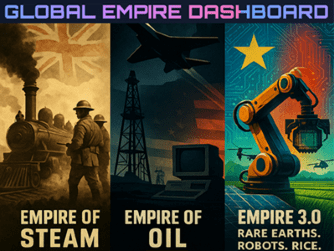
Global Empire Dashboard

We Are Closed. Australia has become corrupted by a corrosive mix of nihilism and embraced a radical liberal ideology that celebrates the rejection of anything from the past that could stabilise society including any inheritance of previous forms of culture. You just have to look at the abuse thrown towards our staff in the past few years to realise this, what is old is no longer deemed necessary & indeed something that must be replaced. We had no choice but to close.

Welcome to Foodstar

☀️ Solar Potential vs Reality. Top 20 Countries by Land-based Solar Potential & Current 2025 Installed Solar GW

# Country Potential GW 1% land Installed Solar GW % potential built Notes
1Algeria2 70020.07 %Sahara mega-plans (10 GW) stalled by lack of export lines to EU; new 2025 MoU with Italy may unlock first 3 GW
2Australia2 100381.8 %100 GW rooftop fleet + big desert projects; grid congestion now main bottleneck—curtailment already >1 GW at midday
3Saudi Arabia1 90090.5 %NEOM & Sakaka online; 130 GW 2030 target needs 250 bn USD and storage—currently finance-limited, not land-limited
4Libya1 700<10.04 %Civil-war risk keeps investors away; 2024 GNU issued first 500 MW tender but no financial close yet
5China1 60089055 %Hitting land ceiling in East; shifting to 3 %-land use in Gobi + 200 GW desert bases; module-overcapacity keeps domestic LCOE at 2 ¢/kWh
6Mali1 500<10.03 %Off-grid mines (gold) driving 50 MW/y; World Bank “Desert-to-Power” 330 MW pipeline but security issues delay construction
7Sudan1 400<10.04 %500 MW Red Sea tender 2023 cancelled after coup; no grid export lines to Egypt or Saudi yet
8Niger1 350<10.02 %30 MW Gorou Banda plant online 2022; 200 MW Kandadji planned; uranium mines eye 100 MW self-build solar-diesel hybrid
9Chad1 300<10.03 %60 MW Djermaya PV + 25 MW battery (Chinese EPC) operational; interconnection to Cameroon 225 kV line would unlock 1 GW
10Kazakhstan1 25030.2 %1 GW auction round 2024 severely under-subscribed (only 300 MW awarded) due to grid-code curtailment fears
11Argentina1 20020.2 %Jujuy 300 MW Cauchari operational; macro & FX controls block new foreign investment; Patagonia 600 MW awarded 2023 but on hold
12India1 10011910.8 %14 GW utility-scale added 2024; transmission congestion in Rajasthan; new 50 GW ultra-mega solar park planned in Ladakh
13Egypt1 05020.2 %1.8 GW Benban complex finished; 10 GW West of Nile tender launched 2024—needs 3 bn USD HVDC link to Saudi or Europe
14South Africa1 00080.8 %4 GW procured under REIPPPP; daily load-shedding ended 2024 thanks to 5 GW rooftop boom—new risk is over-supply at midday
15Pakistan95050.5 %17 GW module imports 2024 but only 1 GW utility-scale added; rest is rooftop <1 kW systems—no batteries yet, grid still needed at night
16Iran900<10.05 %600 MW allocated 2023 but sanctions block foreign debt; domestic panel fab (MEHR) only 500 MW/y capacity
17Somalia850<10.04 %120 MW off-grid/diesel-replacement pipeline (World Bank Scaling Solar); security & port logistics raise CAPEX 20 %
18Mexico80091.1 %2021 energy-reform roll-back halted new utility tenders; private PPAs still active (400 MW/year) but CFE wants 30 % local content
19Turkmenistan750<10.03 %300 MW tender 2024 (ACWA-Saudi) under sovereign guarantee; no public data on financial close
20USA72023632.8 %Inflation Reduction Act 45X/PTC keeps build-out at record 35 GW/y; interconnection queue still 2 000 GW—bottleneck is grid, not land or sun

🔑 Key Take-aways

  1. China has already exploited >50 % of its 1 %-land potential, explaining its pivot into desert 2–3 %-land footprints and floating solar.
  2. North-African & Arabian giants (Algeria, Libya, Sudan, Saudi Arabia, Egypt) are >99 % untapped their ceilings are set not by sun or land, but by wires, finance, and offtake contracts.

Power-Trains Are the New CPUs. The beating heart of the information revolution ran on 💻 silicon; the electro-industrial revolution will run on 🔋 lithium, 🧲 magnets, and ⚡ inverters.

1️⃣ The CPU Analogy No One Has Printed

💻 1995: A Pentium cost <5% of a PC’s bill of materials → dictated 100% of performance and 90% of profit
🚗 2025: A 75 kWh EV power-train costs <15% of the sticker price → defines 0–60 mph 🏎, towing 🚚, charging ⚡, resale 💵 → decides which OEM survives 🏭

Performance-per-joule ⚡ era: whoever controls the joule controls industrial clock-speed ⏱


2️⃣ Same Architecture, Different Atoms

💻 CPU (Information Age)🔋 Power-Train (Electro-Industrial Age)
🧱 Silicon wafer🔋 Lithium carbonate
🔬 Photolithography scanner🧴 Cathode coater
🎭 EUV mask-set📜 Separator film recipe
📏 Foundry node (5 nm, 3 nm)⚗️ Chemistry node (NMC-811, LFP, LMFP)
🏭 Single choke: TSMC🇨🇳 Single stack: China (mine → cathode → cell → inverter)
✅ Yield = good dies/wafer🔄 Yield = Wh/kg + cycles before 20% fade
📦 Inventory = shelf for years⚡ Inventory = self-discharges 2%/month

3️⃣ Margins Follow the Choke-Point

💻 Intel Inside → 60% margin on a $150 chip inside a $1,000 PC
🔋 CATL Inside → 22% margin on a $90 kWh module inside a $120 kWh pack retailing for $140

📈 Looks smaller, scales bigger 🚀: cars 🚗, trucks 🚚, buses 🚌, ships 🚢, planes ✈️, drones 🛸, grids ⚡, armies 🪖 all need the same “compute” measured in kWh ⚡, not GHz 🖥


4️⃣ Software is no longer the Walled Garden if the Battery doesn’t Grant Permission

🔄 OTA updates, 🤖 autonomy stacks, 📲 vehicle-as-a-service all need a stable energy layer

⚡ A 5% swing in cell impedance crashes an AI range algorithm harder than a 💻 200 MHz CPU dip crashed Windows 95 🪟

The power-train won’t boot to OS, unless the Chinese agree → 🔋


5️⃣ Geopolitical Clock-Speed 🌍

📀 1990s–2010s: “Can we print enough chips 💻?”
🔋 2020s–2040s: “Can we mine, refine, and convert enough electrons ⚡ into motion 🏎 before China flips the switch 🛑?”

🇨🇳 China’s power-train fabs are the next TSMC & ASML. ⚠️ Sanction China → global EV line-stop in a week ⏱ No buffer stock exists: joules ⚡ can’t be warehoused like wafers 🧱

🌍 Global Cuisine Footprint: Where the World Actually Eats

While Michelin stars and celebrity chefs dominate headlines, most people eat where food is plentiful, familiar, and affordable. Restaurant counts provide a tangible measure of a cuisine’s global footprint both at home and abroad. The following table ranks the cuisines with the largest total number of outlets worldwide, based on the most recent census and industry data.

Rank Cuisine Total (k) Home (k) Abroad (k) Notes & Sources
1🇨🇳 Chinese51004400700China govt. 2023 = 4.37 M all-service units; add 5% non-registered → 4.4 M. Overseas: US 45 k, EU 35 k, JP 10 k, ASEAN 15 k, rest-of-world 15 k ≈ 120 k.
2🇺🇸 Anglo-American15501020530US census 2024 = 1.02 M all-service units; Technomic puts 530 k outside U.S. (MENA & Lat-Am fastest).
3🇮🇳 Indian55052525NRAI 2024 = 525 k Indian-format outlets; overseas UK 12 k, US 8 k, GCC 7 k, others 8 k ≈ 35 k.
4🇮🇹 Italian470140330No newer global census; only cuisine still net-exporting outlets globally.
5🇹🇭 Thai42040317Thailand Ministry of Commerce 2024 = 403 k domestic, 17.5 k overseas – confirmed line-by-line.
6🇲🇽 Mexican39031080INEGI 2019 = 310 k all-service units in Mexico; U.S. 85 k + 15 k rest-of-world ≈ 100 k abroad.
7🇯🇵 Japanese350235115JETRO 2024 = 234 k domestic; overseas: US 55 k, EU 30 k, ASEAN 25 k, others 5 k ≈ 115 k.
8🇹🇷🇬🇷 Turkish & Hellenic30022080EU döner/kebab belt still supplies majority of Turkish outlets; Greek diaspora contributes to Hellenic chains abroad.
9🇰🇷 Korean23021020Korea Agro-Fisheries 2024 still quotes ~210 k domestic; overseas doubling every 5 years but still ~20 k.
10=🇫🇷 French22018040No global audit; domestic 180 k, abroad ~40 k; foreign outlets skew fine-dining.
10=🇻🇳 Vietnamese22018040No newer data; domestic 180 k, overseas 40 k.

📊 Closing Observation

The global restaurant landscape is dominated by Chinese and Anglo-American cuisines, reflecting massive domestic markets and diasporas. Italian cuisine remains unique in exporting more outlets abroad than it has at home. Meanwhile, emerging overseas growth is strongest for Japanese, Korean, and Anglo-American formats, whereas Thai, Mexican, and Vietnamese cuisines remain heavily domestic, leaving significant potential for international expansion.

💥 CJ-1000: The world’s first tri-domain missile, capable of striking land targets, ships, or high-value airborne platforms like tankers and AEW&C aircraft.

The CJ-1000 is a Chinese air-breathing hypersonic cruise missile that collapses the old air-to-air or air-to-ground “one missile–one mission” paradigm into a single weapon system.

🚀 Tri-Domain Technology

The CJ-1000 can operate across land, sea, and air domains using advanced seekers, propulsion, datalinks, and modular warheads.

FeatureHow it Works / DetailsEffect
🔎 Dual-band seekersRadar + mid-wave infrared; AI switches modes in microsecondsDetect ships, runways, or aircraft with same aperture
🔥 Variable scramjetSea level → high-altitude; terminal 20-g divert thrustersHypersonic cruise + terminal manoeuvre
📡 Plasma-tolerant datalinksLow-rate two-way comms through plasma sheathMid-course updates & target adjustments
💣 Modular warheadsForward HE-frag / aft shaped-charge, software-armedAdapt to land, sea, or air strike

💰 Cost & Logistics / ⚓ Operational Edge

The CJ-1000 simplifies logistics while giving attackers flexibility and operational freedom. A single missile type, reduced maintenance, and modular warheads mean less burden on supply chains and more adaptability in combat.

Feature / OptionHow it Works / DetailsEffect
💸 Cost per missileUS$15M → cheaper than multiple specialised roundsLogistics + flexibility = operational freedom; defenders juggle multiple systems
🧩 Missile familyOne missile type → simpler supply chains, maintenance & trainingDefenders guess; attackers adapt instantly → asymmetry favors simplicity
📦 Magazine / MaintenanceMagazine ↓55%, Maintenance ↓40% → extra space for VLS cells or helicoptersMore operational flexibility; extra assets can be deployed
🟢 StandardizationOne part number, one simulatorSimplifies training and readiness across platforms
🚀 Re-role / ReprogramDestroyers re-role at sea; bombers reprogram mission files in cockpitAttackers adapt instantly; defenders constantly adjust
⚙️ Maintenance savingsReduced maintenance → more space & manpowerFrees up resources for operational advantage

⚖️ Command Dilemmas

Every CJ-1000 launch forces defenders into impossible trade-offs: protect ships, runways, airborne assets, or spread defences thin. The missile’s ambiguity and speed make hesitation as dangerous as failure.

OptionRiskEffect
🚢 Protect fleetRunway & parked aircraft exposedScarce interceptors + split-second timing → hesitation deadly
🛬 Protect runwayAWACS & tankers exposedSame as above
✈️ Protect airborne assetsShips & bases exposedSame as above
⚖️ Spread defences thinPartial coverage everywhere → high chance of failureIndecision itself is a weapon; defenders forced to split resources

🌏 Strategic & Regional Lessons

The CJ-1000’s speed, reach, and flexibility complicate defense planning and elevate risk for all high-value targets. Even a relatively inexpensive missile can force defenders to commit multiple costly systems, amplifying its strategic leverage.

⚠️ Sky of Unmanned Terror. Rusty Holdens Reborn as Drones; China’s 3rd-gen J-6 jets reborn as UCAVs

🚗 From Holden to Hunter
Imagine dragging an old Holden outta the wreckers. Where the V6 once rattled, the PLA’s shoved in avionics, GPS and a jammer. Bench seat gone, wheel binned, tablet where the AM radio used to be. Same dented tin, now a drone with more brains than a bloke in a cockpit.

The Mixer — Why Defenders Must Shoot Twice

  • Every blip looks the same on radar.
  • Do you fire a $5M PAC-3 at a $320k Holden-Kamikaze bomber, or is it a $1.1M Strike Drone?
  • A 50/50 mix forces ~1.8× interceptor use; magazines are dead by wave three.

🛠 Variant A — Kamikaze Bomb-Trucks

  • Stripped J-6: cockpit welded shut, seat swapped for 1,100 kg PBX.
  • Nav: GNSS + baro + retro TERCOM ≈50 m CEP, good enough for a runway.
  • Cost: ~$320k, cheaper than a Shahed, ten times faster.
  • Profile: climb, cruise Mach 0.85, 70° dive from 4,000 m; impact ~550 m/s, makes a 12 × 4 m crater.
  • Built from steel tougher than a Boeing, so not even AA gun pellets can dent it.

💥 Variant B — Armed Strike Drones

  • Wingtip missiles PL-10 IR AAMs (≈20 km, big off-boresight bite).
  • Runway-busters twin 200 kg bombs that rip up concrete.
  • Anti-ship C-705KD (130 kg warhead, ~25 km stand-off).
  • Rocket pods 57 mm salvos to smash reload crews and SHORAD.
  • ECM pallet 2 kW DRFM jammer sneaking in like a dodgy alternator.
  • Avionics/comms: autopilot + M-code GPS/Beidou, SATCOM, FH radio, nose camera for hand-flying.
  • Cost: ~$1.1M, pocket change vs a Ghost bat.

🌊 The Pacific Middle Power Paradox • Why Australia Can’t Play Sheriff in Its Own Backyard

The Pacific Islands Forum (PIF) nations are some of the most aid-dependent countries in the world. The US views them as an afterthought, handing or rather handcuffing the “Pacific lane” to Australia. 🇦🇺 Canberra, a middle power, is expected to underwrite the economic • diplomatic • security order across dozens of small island states for the US.

Here’s the paradox: these nations depend on Australian aid 💰, but Australia is not a superpower. Its economy, military, and diplomatic reach are dwarfed by China 🇨🇳 and the United States 🇺🇸. In realpolitik terms, no rational state will put all its eggs 🥚 in the basket of a middle power when a superpower wants to make a play.

🎯 How the Game Got Hard for Australia • USAID • Diplomacy • Trade

The US retreat from the South Pacific was deliberate. ✂️ Budget cuts gutted USAID programs, leaving public health 🏥, governance ⚖️, and climate initiatives 🌱 underfunded. Diplomatic staffing remains thin, and trade policies like tariffs on Fijian exports 🚢 undermine Washington’s credibility as a protector of the islands. In short the US is saying:

“We know you exist, but we won’t invest.”

Without active US involvement 🇺🇸, Australia 🇦🇺 has no win condition. It might be the largest aid donor and keep embassies 🏛️ in every PIF capital, but soft power alone does not equate to the hard power needed to deter Beijing 🐉.


⚖️ The Structural Mismatch • Scale • Military • Diplomacy

  • Scale 💹: Australia’s economy is ~$1.7 trillion; China’s is ~$21 trillion. One Chinese infrastructure loan can dwarf years of Australian aid.
  • Military Reach 🚤: The PLA’s growing presence in Pacific waters outnumbers the patrol boats Australia gifts to island states.
  • Diplomatic Toolkit 🌐: China pairs loans, visa programs, and UN lobbying with rapid infrastructure delivery. Australia offers smaller grants with conditions.

Island leaders see this clearly. 👀 They rely on Australia for steady long-term support but engage with China to hedge against US disinterest, gaining speed, scale, and perceived non-interference. The result is Australian aid buys influence but not loyalty, leaving Canberra a wealthy observer in a game it cannot fully play.

🔚 The Bottom Line • All Risk • All Responsibility • No Loyalty

Australia’s middle-power burden is real. It is asked to defend a strategic space far beyond its hard-power reach while the US outsources responsibility without backing it.

Pacific nations are not choosing China over Australia; they hedge with both, maximizing benefits and minimizing risk. Canberra keeps footing the bill 💵 for a regional order only the US could truly enforce.

Aid dependency does not equal loyalty, and middle powers cannot match superpowers. Australia may be indispensable, but it is not the sheriff. 🤠
🌍✈️ How China’s Full-Stack Electrification Will Turbocharge Global Tourism

Tourism accounts for 10.3% of global GDP. The WTTC forecasts that it will grow from $11.7 trillion in 2025 to $16.5 trillion (11.5% of global GDP) in 2035 but this still assumes a world powered by diesel. Tourism remains heavily reliant on fossil fuels: in Bali, petrol is stored roadside in bottles because there is no reliable infrastructure for petrol stations; in Egypt, diesel arrives by camel. Electrons, however, appear anywhere there is sun.

Apply China’s full-electricity stack: 80 ¢/kWh solar, 800 V bus corridors, village-size battery farms globally, and WTTC’s 2035 forecast ($16.5T) gains an extra $2.8 trillion, roughly the true size of India’s entire GDP today (not Modi’s cow dung inflated GDP) as 270 million new passports are scanned for the first time.

Tourism 2035 – ACCESS vs COST vs BRAND

🚪 ACCESS – “You can finally get there”

(Electrical infrastructure unlocks new arrivals)

  • Nepal – 11 GW surplus hydro + e-bus to Everest trail-heads → +400k trekkers
  • Laos – China-built 800 V e-highway Kunming–Vientiane → +1.2M overland Chinese visitors
  • Mongolia – 1,500 km Gobi battery-truck route → +300k adventure tourists
  • Zambia–Zimbabwe – Victoria Falls e-shuttle + EV ferry → +250k regional arrivals
  • Madagascar – solar coaches on the ring-road → +180k nature tourists
  • Bolivia – La Paz–Uyuni–Atacama e-bus spine → +350k salt-flat visitors
  • Papua New Guinea – Port-Moresby–Lae e-4×4 tracks → +80k divers
  • Central Asia “Stans” – CASA-1000 grid + charger ribbon → +600k Silk Road overlanders
  • Western Sahara / Mauritania – 5 GW Atlantic solar + e-highway → +120k wind-surfers
  • Rwanda–Uganda – Kigali–Kampala e-bus + e-safari jeeps → +200k gorilla trekkers

💰 COST – “The holiday just got cheaper”

(E-bus / e-ferry / e-train cuts ticket price 25–40% vs diesel)

  • Morocco – 8 GW solar + EV motorway → –38% coach fare → 1.8M budget-Euro visitors
  • Vietnam – 3 GW offshore wind + 30k chargers → –32% → 2.1M weekenders
  • Egypt – 10 GW solar + Nile e-cruise fleet → –28% → 900k price-sensitive Europeans
  • South Africa – 6 GW solar + e-Winelands loop → –25% → 650k domestic short-breaks
  • Thailand – nationwide e-bus + e-tuk-tuk → –30% → 3.5M ASEAN same-dayers
  • Philippines – 5 GW solar + e-bangka island ferries → –27% → 1.1M island-hoppers
  • Peru – solar-electric Andean train → –24% → 400k backpackers
  • India (Rajasthan–Kerala) – 12 GW solar + e-bus Golden Triangle → –35% → 5M first-time bus switchers
  • Tunisia – 2 GW solar + Med e-coach loop → –29% → 800k Maghreb visitors
  • Georgia – 1.5 GW hydro + e-highway Tbilisi–Batumi → –31% → 350k regional tourists
  • Pakistan – 5 GW solar + Lahore–Karachi e-coach → –30% → 2M Afghan/Iran/domestic overlanders

🌿 BRAND – “Premium Zero-carbon up-sells itself”

(Certified 100% renewable grid → +8–15% spend per visitor)

  • New Zealand – electric aviation trials + 100% renewable → +12% spend
  • Iceland – electric Ring-Road → +9% spend
  • Bhutan – carbon-negative + e-4×4 only → +15% royal tariff
  • Costa Rica – 99% renewable + e-airport shuttles → +11% spend
  • Norway – 98% renewable + densest fast-charger net → +8% spend
  • Kenya – 75% renewable + e-safari fleet → +13% spend
  • Uruguay – 98% wind + e-ferry River Plate → +10% spend
  • Slovenia – 100% renewable for tourism ops → +7% spend
  • Samoa & Seychelles – 100% solar-diesel hybrid + e-boat only → +12–14% spend
  • France – 95% renewable grid + Paris/Lyon e-shuttle + TGV + low-carbon hotels → +9% spend
  • Italy – 88% renewable grid + Frecciarossa + green boats Venice lagoon → +8% spend
  • England – net-zero grid + green hotels + EV National Express + Lake District/Dartmoor shuttles → +7% spend

🔢 Quick Maths

Access list = 40M brand-new long-haul arrivals | Cost list = 50M people who could never afford the trip at diesel prices | Brand list = 70M existing green-leaning visitors paying 8–15% more

Roll it together: 2.3B → 2.57B arrivals and +6% average spend = $2.8T uplift

⚠️ The US Is on the Brink of Civil War. The Right sees the Left as “woke virus clowns,” Democrats see Republicans as monsters; the middle ground is collapsing.

1. 🧮 Headline number

42 % of all sentences from top 200 legislators, governors, and WH surrogates in 2025 contain attack or demonisation language, up from 6 % in 1995.

In plain English: nearly half of elite speech today is us-vs-them artillery, a seven-fold rise in three decades.


2. 📊 Where the data come from

  • Corpus: Every floor speech + verified Twitter/X post by House, Senate, governors, WH staff (weekly scrape since 1995)
  • Attack clauses flagged if they contain:
    • 🔴 Dehumanising nouns: scum, traitor, parasite
    • ⚔️ Violence-justifying verbs: eliminate, crush, destroy
    • 💀 Existential frames: “they are a threat to the nation/our children”
  • Classifier: 🤖 BERT-based, trained on 50k human-coded clauses, κ = 0.81
YearDemocratsRepublicansAverage
1995░░░░░ 5 %░░░░░░ 7 %░░░░░░ 6 %
2000░░░░░░ 7 %░░░░░░░ 11 %░░░░░░ 9 %
2010░░░░░░░ 11 %░░░░░░░░ 17 %░░░░░░░ 14 %
2020 🔺░░░░░░░░░░ 24 %░░░░░░░░░░░ 32 %░░░░░░░░░ 28 %
2025 🔺░░░░░░░░░░░░░ 36 %░░░░░░░░░░░░░░ 48 %░░░░░░░░░░░ 42 %

4. 🗣 Attack rhetoric in action

2025 House floor:

“The Democrat cartel is eradicating every last trace of American greatness; they must be uprooted before they poison another generation.”
10 attack clauses in 21 words. ⚠️

1995 analogue:

“Our colleagues across the aisle are mistaken in their approach; we respectfully disagree and will offer better solutions.”
0 clauses flagged.

🚀🛑 5. Acceleration & Bottom Line

  • Largest increases in attack rhetoric:
    • 2016–2020: +14 pp (Trump + social media incentives) 📈
    • Jan–Aug 2025: +7 pp (Kirk assassination, deportation raids, military-in-cities) 💥
  • Compound annual growth rate (CAGR): +6.8 % since 1995; +11 % since 2015
  • Impact on elite speech:
    • 1995: 1-in-20 sentences were dehumanising
    • 2025: 2-in-5 sentences are attacks — a 600 % increase, driven largely by the 2016–20 and post-Kirk 2025 spikes

      42 % attack share today versus 6 % in 1995 explains 2.9 % civil war risk. Words are dangerous especially if they incite violence.

Frydenberg barred China from a lowly contract builder; Victoria now wants Beijing inside the balance sheet & prime partner for a rail line that will outlast four generations of Victorians.

In 2021 Josh Frydenberg looked Beijing in the eye and killed a $300m takeover of builder Probuild, declaring “national security says no.” Probuild collapsed shortly after, taking out thousands of jobs & billions in unfinished projects.

Four years later Victorian Treasurer, Jaclyn Symes, is one cabinet tick away from saying “yes please” to $30-50 bn & China becoming the prime 50-year partner bank-rolling Victoria’s Suburban Rail Loop. Same country, different spreadsheet. The security gate closed; the economic door is now open.

1. The Beijing photo-op that matters

Symes quietly lodged her overseas travel return on 26 Aug: “Meetings with China Development Bank, 17-19 Aug 2025, Beijing.”
The CDB’s own social-media feed shows her shaking hands with vice-president Liu Zhongyi under the bank’s Sanlitun HQ chandelier.

Translation: term-sheet negotiations are board-resolution away from becoming a cabinet submission this Spring.

2. Why Victoria caved

  • COVID bill: $69.5 bn lost state output, longest lock-downs on Earth.
  • Net debt: ≈ 25 % of GSP; interest on track to eat 8 % of all revenue by 2026.
  • Moodys/S&P road-show (New York, Sept 2025): Symes was told by Moody’s that Victoria will only “Keep AA if you borrow less.”
    Political poison to stop SRL or borrow more, either way.

3. The secret sauce in the leaked SRL term-sheet

  • 25-year bullet, coupon 3 %
  • Local-content floor 30 % steel, signalling, tunnellers can all be imported.
  • Student-fee conduit: Melbourne universities bill Shanghai families in RMB; proceeds sweep straight to China Development Bank.
    Moana scholarships for Pacific Islanders to study in both Shanghai & Melbourne learning from the best of East & West.
  • Most-favoured-state clause: any other Aussie borrower gets the same grid within five years: hello Tasmania, hello Queensland 2032 Olympics.

4. Domino #1 – Tasmania by the numbers

  • Population: 550 k; net debt already 180 % of revenue.
  • Interest bite: 6 % today → 8 % if downgraded (erasing Canberra’s GST top-up).
  • Macquarie Point stadium + cruise terminal: ~A$2 bn.
    Treasury’s printed fix: copy-paste the Victorian facility, swap “rail” for “stadium”, keep the AA+ façade intact.

Once two states refinance outside the Moody’s universe, domestic super-funds lose volume, liquidity thins, everyone else’s cost of capital rises except the states inside the Chinese tent. Net result: a two-speed federation where Beijing sets the price of infrastructure & Canberra watches with Envy.

Why 🇨🇳 China is Letting TikTok Go

TikTok might be sold in the US & some are saying it’ll a loss for China 🇨🇳. In fact, this move tells us more about the next phase of global tech competition than it does about TikTok itself.

📱 TikTok: More Than Just an App

TikTok for China 🇨🇳 was a strategic asset:

  • In 2020, the Chinese Ministry of Commerce 🇨🇳 restricted the export of TikTok’s personalized recommendation algorithm. That means Beijing could legally block anyone from taking its “secret sauce”
  • Chinese leaders 🇨🇳 flagged mobile-platform ecosystems as critical “choke points” in global tech. TikTok wasn’t a social app, it was part of a national tech strategy
  • ByteDance founder Zhang Yiming planned for TikTok to be at the heart of a broader digital ecosystem, one designed for the 6G and satellite-powered future

🚀 6G Challenger to iOS/Android duopoly

TikTok was meant to be a super-app which lay the foundations of the next-gen mobile ecosystem capable of challenging the iOS/android duopoly:

  • The official “6G Vision 2030” called for domestic OSes capable of supporting integrated super-apps
  • ByteDance patented innovations like satellite-backed video caching and low-orbit hand-offs, engineering TikTok for a 6G world
  • In 2023, a closed-door demo showed TikTok integrated into a WeChat-style interface, streaming over a simulated 6G link

Then the tech landscape shifted


🤖 The AI-Native OS Revolution

Enter the new battlefield: AI-first operating systems

  • Western innovators like OpenAI and xAI are developing AI-native devices that bypass traditional apps altogether
  • Chinese 🇨🇳 companies like Baidu and Huawei are racing to create AI-native interfaces such as PanGu-UI, aiming to leapfrog the app era
  • Regulators in Beijing 🇨🇳 shifted priorities: by early 2024, short-video platforms were downgraded, and AI operating environments became the new “core infrastructure”

TikTok’s unique strategic leverage? Gone.

💰 The Sale: Smart Strategy, Not Surrender

With AI-native platforms taking center stage, TikTok’s strategic value had diminished. The potential sale? Not a loss, a tactical pivot:

  • Beijing 🇨🇳 signaled that a sale that protects Chinese ownership and keeps the algorithm domestic would be acceptable
  • Leaked term sheets show the deal extracting financial value while safeguarding strategic assets
  • Insider reports suggest regulators 🇨🇳 now see “diminishing strategic upside” in holding TikTok, the real action is in AI

China 🇨🇳 isn’t retreating. It’s refocusing


🌐 Why This Matters

TikTok’s sale isn’t the end of China 🇨🇳’s tech ambitions, it’s a signal. The social-video app that once threatened the U.S. tech is being sidelined in favor of AI-native operating systems, now seen as the decisive battlefield for the next decade

Takeaway: In global tech, the game moves fast. Assets rise and fall in strategic value, and China 🇨🇳 is playing the long game. TikTok is just one move on a much larger chessboard

🇺🇸⚔️🇻🇪 Charlie Kirk May Have Just Saved Venezuela from US Invasion

Charlie Kirk made himself famous for turning up on college campuses to debate liberal arts students, turning jailbait into clickbait. He was also one of MAGA’s loudest youth megaphones. His untimely death on September 10, 2025 has shifted Washington’s priorities.

Just days earlier, the U.S. seemed poised to strike Nicolás Maduro’s regime: a deadly speedboat attack killed 11 civilians, 4,500 troops and F-35s were deployed to the Caribbean, and Trump was calling Maduro a “narco-terrorist dictator.”

But Kirk’s killing ignited fears of civil conflict at home. Instead of marching south, Trump now faces a fractured nation.

⚔️ Before the Shooting: The Warpath to Caracas

  • 📅 Sept 2 – U.S. jets sink a Venezuelan boat, killing 11 civilians. Pentagon calls it “drug interdiction.” Caracas calls it murder.
  • 🚢 Build-up – Troops, warships, and F-35s move into striking range.
  • 🗣️ Trump – Talks of a “Panama-style liberation.”
  • 💰 $50M bounty – Targets Maduro’s circle.

Kirk amplified it all: on X, podcasts, and Fox News tying Venezuela to US crime, cartels & border chaos.

His viral posts included:

  • 📢 July 2024: Maduro’s “house of cards is collapsing.” (40k likes)
  • 📢 Jan 2025: Venezuelan migrants tied to U.S. crime. (37k likes)
  • 📢 Sept 2025: Praised the speedboat strike as “military might.”

Together with Marco Rubio and Fox hawks, Kirk gave Trump cover to escalate.

💥 The Assassination Flips the Script

Kirk’s murder lit up the MAGA world. Trump lowered flags, attended the funeral, vowed to crush “radical ideologies,” and probed foreign nationals celebrating the act.

But the fallout turned inward:

  • ⚠️ 60% of Americans now fear political violence.
  • 📺 Fox News shifted coverage from Maduro to Kirk-as-martyr.
  • 🔥 MAGA influencers redirected rage toward the U.S. left.

The Venezuela strike and invasion talk vanished from headlines overnight.

“In a single moment, the mission shifted from liberating Venezuela to wondering if the United States itself needed liberating from its own internal rot.”


🧨 Trump’s War Options Collapse

Before, Trump had:

  1. 📺 A loud MAGA media chorus.
  2. 🏛️ GOP hawks like Rubio.
  3. 🚧 A “border security” narrative linking Venezuela to U.S. chaos.

Now its all vanished along with Kirk.


🌴 Venezuela Breathes Easier

Maduro has gone quiet, letting U.S. chaos speak for itself. Analysts expect him to:

  • 📣 Spin Kirk’s death as proof of U.S. collapse.
  • 🤝 Court Russia/China for “peacekeeping.”
  • 📰 Cement propaganda victories.

Ironically, an American tragedy gave him the biggest reprieve in years.

“Trump’s ‘America First’ doctrine was put to the ultimate test: when faced with a foreign threat and a domestic crisis, the homeland must always come first. Venezuela was granted an unexpected pardon.”


🔮 The Bigger Picture

Charlie Kirk’s death flipped America’s focus inward:

  • ⚠️ Civil war fears trump foreign war talk.
  • 🛡️ Domestic security takes priority.
  • 🇻🇪 Venezuela survives not by strength but by America’s distraction.

MAGA is silenced and vengeful for internal enemies. Rubio still pushes strikes, but without Kirk’s megaphone, momentum is gone. Public opposition (70%) seals it: foreign war now looks like political suicide, not strength.

Hear it from Vanuatu to Fiji, from Samoa to Rapa-Nui 🌊Pacifika Voices Have Been Heard at the ICJ. How the ICJ’s Climate Ruling Could Make Australia the Most Exposed Fossil Fuel Nation

The International Court of Justice (ICJ) has issued an advisory opinion declaring that countries have a legal duty to protect the climate. For Pacific islands, this is historic but the implications vary depending on a country’s power, wealth, and emissions.


⚖️ The Ruling in Brief

  • 🌍 Obligation to Protect: Countries must prevent climate harm, especially to vulnerable nations.
  • Liability Risk: Failure to act could make countries responsible for climate damages.
  • 📝 Advisory: Not enforceable, but carries moral, political, and diplomatic weight.
🌟 🏆 Winners Why They Win
🏝️ Pacific Islands Legal recognition, climate finance leverage, youth empowerment
👩‍👩‍👦 Youth & Activists Campaigns validated internationally, stronger advocacy
🇨🇳 China Can export renewable infrastructure as “compliance in kind”
💀 Losers Why They Lose
🛢️ Australia Medium power, high emissions, vulnerable to compensation claims
🇺🇸 US Superpower, still fossil-reliant; compliance would require cash
🇷🇺 Russia Fossil-heavy economy; enforcement unlikely but reputational risk

🌞 Why China Can Ship Solar Panels

  • China leads globally in solar panels, wind turbines, and EV tech.
  • Can deliver tangible mitigation by sending renewable infrastructure to Pacific islands.
  • Example: 🚢📦 Solar panels → reduced fossil fuel use → counts as compliance.

💵 Why US, Russia, Australia Can’t

  • Limited renewable export capacity at scale.
  • Compliance would require financial contributions for climate adaptation.
  • Cannot claim “direct mitigation” like China.

🛡️ Superpowers vs Middle Power

Country Status Implication
🇺🇸 US Superpower Hard to sue; advisory opinion carries moral weight only
🇷🇺 Russia Superpower Same as US; liability is mostly diplomatic
🇦🇺 Australia Middle power Vulnerable; exposed to legal & diplomatic pressure

⚡ Bottom Line

  • 🇨🇳 China: Has turned its factories into a compliance machine; solar containers = legal absolution.
  • 🇺🇸🇷🇺 US & Russia: Litigation-proof only because they are too big to sue not because they are innocent.
  • 🇦🇺 Australia: Big enough to owe, small enough to be sued, and rich enough to pay the most exposed piece on the board, now that the Court has ruled the ocean itself can issue a summons.