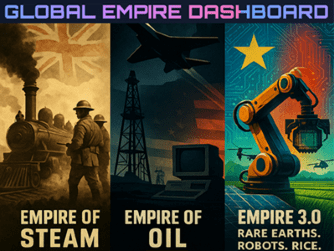
Global Empire Dashboard

We Are Closed. Australia has become corrupted by a corrosive mix of nihilism and embraced a radical liberal ideology that celebrates the rejection of anything from the past that could stabilise society including any inheritance of previous forms of culture. You just have to look at the abuse thrown towards our staff in the past few years to realise this, what is old is no longer deemed necessary & indeed something that must be replaced. We had no choice but to close.

Welcome to Foodstar

What Washington Did With Mao’s China and What It Actually Cost

Geopolitical Economics · Capital & Strategy

What Washington Did With Mao’s China
and What It Actually Cost

Nixon’s 1972 opening wasn’t an alliance. It was a transaction. China as a non-Western-aligned regional backstop to the USSR. Fifty years on, the capital arithmetic of that bet, and how it compares to what has already flowed into India, deserves a clear accounting.

When Nixon landed in Beijing in February 1972, the logic was cold and deliberate: a non-Soviet-aligned China complicated Moscow’s strategic calculus in ways that were worth the discomfort of the relationship. This wasn’t ideology. It was leverage arithmetic.

What followed over the next two decades was a cautious, heavily restricted flow of Western capital into a country that had almost none. Between 1979, when China’s Special Economic Zones first opened to foreign investment, and 1991, when the Soviet Union collapsed and the rationale for the relationship changed permanently, China received approximately $26.88 billion in utilized foreign direct investment.

$26.9B Nominal FDI utilized, 1979–1991
$74.5B Total inflows, inflation-adj. to 2026
<1% FDI as share of China’s GDP, most years
$11–16B Direct Western contribution (2026 dollars)

For most of those years, foreign capital amounted to less than one percent of China’s GDP. It was localized almost entirely in coastal Special Economic Zones: an isolated pilot program, not a systemic transformation. Washington didn’t build modern China. It helped open the door.

The real opening didn’t happen until after 1992, once the Cold War rationale was gone and China had built the legal and regulatory infrastructure to absorb serious capital at scale. But the initial bet still mattered. It seeded the manufacturing base and, crucially, the institutional legitimacy that enabled everything that followed.

The entire Western underwriting of Cold War China was a rounding error: less than one percent of GDP, locked in coastal zones. The door opened. The flood came later.

India vs. China:
Two Orders of Magnitude

Any argument that another nation could replicate the Cold War China playbook runs into one immediate problem: the scale of what has already flowed into India makes the China comparison almost absurd on its face.

Total capital inflows: Cold War China vs. India 2002–2026 (2026 USD)
China
1972–1991
$74B
India
2002–2026
$2,500B
Metric China 1972–1991 India 2002–2026 Scale Diff.
FDI Inflows $60.7B $1,050B ~17×
Remittance Inflows $13.6B $1,450B ~107×
Total Capital Inflows $74.2B $2,500B ~34×
Capital Scale 10¹⁰ (tens of billions) 10¹² (trillions) Two orders
Capital-to-GDP <1% annually 3.0–3.8% (remittances) Systemic

India has absorbed two orders of magnitude more capital than Cold War China ever did, and it has done so systemically, not in isolated export zones. Remittances alone have pumped the equivalent of three to four percent of India’s entire GDP back into its economy every year, funding consumption, banking liquidity, and infrastructure from rural villages to tech corridors.

Sources: Chinese Ministry of Commerce historical FDI data; World Bank Remittance Database; IMF Balance of Payments Statistics; UNCTAD World Investment Reports 2002–2025. All figures adjusted to 2026 USD using US CPI (BLS).

Melbourne is set to welcome two major Anglo-Canto fusion restaurants. Why Anglo-Canto works, but not Anglo-Greek/Italiano

Melbourne Food and Wine Festival — Wishbone search result

Melbourne is set to welcome two major Anglo-Canto fusion restaurants — each arriving from different directions of the genre, and at different price points.

Wishbone
Lucas Collective · Chris Lucas
Opening Oct 2026
Location McKillop Street laneway, 435 Bourke Street precinct (Midtown CBD)
Chef Dan Chan (ex-Yardbird, Hong Kong)
Format Multi-story all-day HK-inspired diner
Kitchen Fully electric, specialised electric woks; 6-Star Green Star building

1950s–70s aesthetic with a dominant red palette. High-energy street-food interpretations over formal fine dining. First of two Lucas venues within the 435 Bourke Street development.

Mott 32
Maximal Concepts
Opening Mar 2027
Location Crown Melbourne precinct, Southbank Riverwalk
Operator Maximal Concepts (HK, SG, Las Vegas)
Format Luxury Cantonese fine dining
Context Part of Crown’s $200M retail & hospitality redevelopment; brand’s first Australian entry

Signature menu anchored by 42-day applewood-roasted Peking duck and Iberico pork char siu — replicating the format deployed across their international locations.

Why “Anglo-Canto” works — and why “Anglo-Italian” or “Anglo-Greek” struggles

Why Anglo-Canto fusion feels natural

Cantonese cuisine in diaspora form has a long history of adaptation as a survival strategy. From early Chinese migration to Australia, the US, and the UK, Chinese restaurants often had to use available local ingredients, cater to unfamiliar palates, and operate under economic constraints. This created a whole genre — chop suey, sweet and sour, lemon chicken — that was already hybrid long before “fusion” became a marketing term. When chefs at Mott 32 or Chris Lucas elevate this tradition, it reads as natural evolution, not imposition. There is no sacred, unviolated original.

Cantonese cooking is also pragmatically ingredient-flexible. It is less rule-bound around specific techniques or “authentic” flavour profiles than many other cuisines, which makes substitution and reinterpretation feel like refinement rather than betrayal.

Why Anglo-Italian & Anglo-Greek fusion is fraught

Italian and Greek food carries strong emotional and cultural weight around authenticity in the Western imagination — tied to family, heritage, and regional identity. Fusion risks reading as disrespectful or clueless: sriracha in a carbonara, a deconstructed moussaka. The reaction is rarely just about taste; it is about cultural ownership.

The power dynamic matters too. Anglo-Canto fusion is often led by Chinese or Asian-Australian chefs reclaiming and elevating a cuisine that was historically looked down upon. Anglo-Italian or Anglo-Greek fusion, by contrast, can look like a dominant culture borrowing from a minority one without the same historical context of marginalisation to navigate.

19 years of service & you wake up & see your Overloads. Rough.

After 19 years at the ABC, you wake up and find out these are your overlords…

Meet the ABC Board

Meet the ABC Board — Kim Williams AM (Chair), Hugh Marks (Managing Director), Georgie Somerset, Laura Tingle (Staff Elected Director), Louise McElvogue, Nicolette Maury, Katrina Sedgwick.


Justin Stevens resigns as ABC director of news after four years in role

Justin Stevens resigns as ABC director of news after four years in role. Managing Director Hugh Marks praised Stevens’ commitment to the broadcaster over 19 years.

China’s Cultural Stack: Multicultural at the Bottom, Monocultural Above Basic Needs

China • Culture • Civilizational Cohesion

China’s Cultural Stack: Multicultural at the Bottom, Monocultural Above Basic Needs

China’s modern cultural model separates consumption from identity. At the bottom of daily life, foreign brands and imported habits can exist as premium offerings beside local favourites. KFC, Starbucks, McDonald’s, luxury fashion, and global streetwear are accepted because they operate in the realm of appetite, convenience, and status consumption. Above that level, however, the system becomes far less plural. Law, belonging, prestige, education, public memory, and national ambition are expected to remain rooted in a single civilizational story.

Level 1
Multiculture

Physiological Needs: Foreign Brands as Premium Extras

At the base of China’s cultural stack, multiculturalism is tolerated because it is mostly commercial and sensory. KFC, Starbucks, McDonald’s, Uniqlo, Nike, and other foreign brands can thrive as premium or fashionable alternatives to local favourites. They do not replace Chinese food culture, family habits, or everyday social expectations; they sit on top of them as optional consumer choices. Foreign taste is welcomed when it remains a market product, not a moral authority or political model.

Level 2
Monoculture

Safety Needs: One State, One Legal Order

Above basic consumption, the tolerance for plural systems narrows sharply. Safety depends on predictability, hierarchy, and a shared understanding of public order. In China’s model, foreign restaurants may sell burgers, but foreign institutions do not define law, security, or sovereignty. The state insists that public order must be interpreted through a Chinese framework, because competing legal or political cultures would weaken the single chain of authority that holds the system together.

Level 3
Monoculture

Belonging Needs: Shared Memory Over Imported Identity

Belonging is where China’s cultural stack becomes explicitly monocultural. National identity is built around language, schooling, family duty, historical memory, and the idea of a continuous civilization. Imported lifestyle symbols may be enjoyed, but they are not allowed to become the basis of collective belonging. The deeper message is that a person can drink coffee, wear foreign labels, or eat fried chicken, while still being expected to locate their emotional and civic identity inside the Chinese national story.

Level 4
Monoculture

Esteem Needs: Status Measured by Chinese Standards

Esteem in this model is not meant to be awarded by foreign approval. Commercial cosmopolitanism may signal taste or wealth, but real prestige is increasingly tied to Chinese benchmarks: exam success, family reputation, national contribution, technological competence, and loyalty to collective revival. Foreign validation is useful only when it confirms domestic achievement. It is not supposed to become the final judge of value, because that would move cultural authority outside the national frame.

Level 5
Monoculture

Self-Actualization Needs: Personal Ambition Inside a Civilizational Project

At the top of the stack, self-actualization is framed less as individual escape and more as participation in national renewal. The successful person is not merely someone who samples the world, earns money, and consumes global brands. The ideal is someone who builds within the Chinese civilizational project, whether through science, business, culture, statecraft, or family continuity. Foreign tools can be absorbed, but the ultimate purpose remains domestic: strengthening China’s future rather than dissolving into a global lifestyle identity.

Summary

China’s cultural stack is therefore not anti-foreign at the level of consumption. It is selective. The body may consume KFC, Starbucks, McDonald’s, and global fashion, especially when they appear as premium additions to local favourites. But the layers above appetite – safety, belonging, esteem, and purpose – are kept inside a monocultural frame. Foreign goods may enter the market; foreign identity is not allowed to command the civilization.

Chaoshan Film Director Sparks Cultural Resurgence Amongst Chinese Singaporeans w. “Love Letter to Ah Ma” (Dear You) – reconnecting the Nanyang diaspora with a shared history of sacrifice, faith, and quiet heroism.

Chinese Community · Diaspora

Chaoshan Film Director Sparks Cultural Resurgence Among Chinese Singaporeans with “Love Letter to Ah Ma” (Dear You) a tale reconnecting the Nanyang diaspora with a shared history of sacrifice, faith, and quiet heroism.

Special Correspondent · May 2026 · Singapore
Still from Love Letter to Ah Ma — four child actors pose before a Chaoshan architectural backdrop, with the film's release date April 30 and tagline 做人有情有义 (Dear You)

Still from Love Letter to Ah Ma (给阿嬷的情书, English title: Dear You), releasing April 30. Tagline: 做人有情有义 — “To be a person of feeling and righteousness.” (Photo: distributor)

SINGAPORE — In an era where blockbusters burn through budgets the size of small nations, a modest film shot largely with amateur actors and spoken almost entirely in the Teochew dialect has become an unlikely phenomenon. Love Letter to Ah Ma (给阿嬷的情书), the third feature by Chaoshan-born director Lan Hongchun, has surged past 600 million yuan at the Chinese box office and is now rippling through overseas Chinese communities—including Singapore—stirring memories of a shared, often painful, Nanyang past.

For many Singaporean Chinese, particularly those with Teochew roots, the film is less a period drama than a mirror held up to their own family histories.

The Story Buried in the Qiaopi

The film’s narrative engine is the qiaopi (侨批)—the “sojourners’ letters” that combined remittance and handwritten correspondence, which sustained countless families across the South China Sea from the late Qing dynasty until the 1980s. In 2013, these fragile documents were inscribed in UNESCO’s Memory of the World register, recognised as irreplaceable records of the Chinese diaspora.

Lan’s story opens in a Chaoshan village where Ye Shurou, a resolute grandmother, has spent half her life guarding the old family house. Her husband, Zheng Musheng, sailed for Siam in 1948 to seek his fortune, and for decades she has waited for his letters. Each qiaopi that arrives—carrying money and tender assurances—has been her psychological anchor, proof that across the “mountains and seas,” someone still remembers her.

Decades later, her grandson Xiaowei travels to Thailand to finally locate his grandfather and reunite the family. What he uncovers is a secret buried for half a century: Zheng Musheng was killed by thugs in 1960, only a dozen years after he left. The letters that continued to arrive, the money that kept the family alive, were not from him. They were ghostwritten by a stranger—Xie Nanzhi, a woman in Bangkok who had never met Ye Shurou, yet who, bound by an inexplicable sense of righteousness and kindness, sustained the correspondence for 18 years.

The revelation is devastating and transcendent at once. Two women, separated by geography and blood, forged an emotional bond that outlasted the man who was supposed to connect them.

“Singaporeans are responding because the film reminds them that their roots are not just a heritage festival or a bowl of Teochew porridge. It reminds them that their existence here was paid for by letters written in other people’s blood.”

“A Letter to All Overseas Chinese”

Lan, a former Phoenix Television documentarian who turned to filmmaking to preserve Teochew culture, did not stumble upon this story by accident. While shooting his documentary The Taste of Teochew Across the Four Seas, he spent years recording oral histories in Malaysia, Thailand, Vietnam, and France. These encounters seeded the emotional soil of Love Letter to Ah Ma.

To ensure authenticity, Lan and his team studied thousands of real qiaopi archived in Shantou, compiled a tens-of-thousands-of-word “Guide to Siamese Life,” and reconstructed everything from Bangkok’s old street layouts to the floral patterns on period clothing. Eighty-four-year-old Wu Shaoqing, who plays the elderly Ye Shurou, is not a professional actress; her own brother went to Nanyang, and when the cameras rolled, her tears required no direction.

Why Singaporeans Are Weeping in the Dark

The film has not yet secured a wide theatrical release in Singapore, but word is travelling fast through community screenings, social media clips, and whispered recommendations in Teochew-speaking households. Singapore’s Teochew community—one of the largest dialect groups in the Chinese Singaporean population—knows this history intimately. Many still have qiaopi tucked in drawers, or remember grandparents who waited by the door for the remittance-house courier.

The film’s re-creation of gongfu tea rituals, pickled olive dishes, and the Mid-Autumn “worship of the moon” are not exotic set dressing; they are half-remembered fragments of childhood Sundays. But the film’s power extends beyond dialect-group nostalgia. At its core is a universal immigrant story: the father who disappears into the machinery of a foreign land, the mother who becomes the unmovable centre of gravity at home, and the grandchildren who grow up knowing only the myth, never the man.

The Ghostwriter as Guardian

The character of Xie Nanzhi is the film’s moral thunderclap. A woman who inherits a dead man’s duty and keeps it for nearly two decades, she embodies a distinctly Chinese ideal of xin yi (信义)—faith and righteousness—that transcends kinship. In an age of transactional relationships, her choice to maintain a compassionate fiction feels almost radical.

Lan has called the film “a love letter not just to one grandmother, but to all overseas Chinese and to the homeland itself.” For Singaporean audiences, that love letter arrives with peculiar force. It suggests that the Chinese roots many here fear they have lost are not, in fact, lost; they are simply waiting, like Ye Shurou, in the old house, preserved in the handwriting of strangers who once believed that a promise made across the sea was as binding as blood.

Love Letter to Ah Ma is currently in negotiations for international release, with distributors in Southeast Asia expressing strong interest. For now, Singaporeans are finding their way to it by whatever means necessary—because some debts, like the ones inscribed in qiaopi, are not meant to remain unpaid.

中国 · 华人社会

潮汕导演蓝鸿春以《给阿嬷的情书》激起新加坡华人文化复兴——一段重新连结南洋华人与牺牲、信义及无声英雄主义共同历史的故事

本报特约记者 · 2026年5月 · 新加坡
《给阿嬷的情书》剧照——片中四名儿童演员于潮汕建筑背景前留影

《给阿嬷的情书》(英文片名:Dear You)剧照。影片定于4月30日上映,宣传语为「做人有情有义」。(剧照:出品方提供)

在动辄耗资数亿的商业大片横行的时代,一部几乎全程以潮州话对白、大量启用素人演员的小成本电影,正在成为一个意外的文化现象。潮汕导演蓝鸿春执导的第三部长片《给阿嬷的情书》,在中国院线票房已突破6亿元人民币,其影响力更如涟漪般扩散至海外华人社区——尤其是新加坡——在那里,它正在唤醒人们对南洋艰辛岁月的共同记忆。

对许多新加坡华人而言,尤其是有潮州渊源的家庭,这部影片与其说是历史题材电影,不如说是映照自身家族史的一面镜子。

藏在侨批里的故事

影片的叙事核心是「侨批」——一种将汇款与手写家书合而为一的通讯形式,从清末至1980年代,跨越南海维系着无数家庭的骨肉情。2013年,这批脆弱的文书被列入联合国教科文组织《世界记忆名录》,被公认为华人离散史不可替代的历史遗产。

影片开篇于潮汕一处村落。叶淑柔,一位坚韧的阿嬷,半生守着老宅,等待1948年渡海赴暹罗寻生路的丈夫郑木生的消息。每一封侨批的抵达——夹带着银钱与绵绵思念——都是她精神世界的支柱,证明在「山高水远」的彼岸,有人仍记挂着她。

数十年后,孙子晓威远赴泰国寻访祖父,却揭开了一个埋藏半世纪的秘密:郑木生于1960年遭人杀害,离家仅十余年。那些此后源源而来的信,那些养活全家的汇款,并非出自他手。它们由一个陌生女子代笔——谢南枝,一个从未谋面的曼谷女子,以某种无以名状的侠义之心,将这份通信维持了整整18年。

这一揭示令人心碎,却又令人升华。两个素不相识、天各一方的女子,缔结了一份情感纽带,比那个本应将她们相连的男人延续得更为长久。

「这部影片提醒新加坡人,他们的根不只是一场文化节庆,或一碗潮州粥。它提醒他们,他们今日在此的存在,是用他人血泪写就的书信换来的。」

「写给所有海外华人的一封信」

蓝鸿春曾是凤凰卫视的纪录片人,转型影坛是为了以影像保存潮州文化。他拍摄纪录片《四海潮味》期间,走访马来西亚、泰国、越南与法国,花费数年记录口述历史。在马来西亚吉打州一处渔村,他遇见了一位村长之子,其父于1980年代返乡后,召集海外乡亲集资,为家乡铺就了第一条柏油路。在法国,他探寻到自己母校以一位普通杂货商命名的原委——那位商人昔日身无长物,后来捐出数百万元在家乡兴办学校。

为确保影片的真实感,蓝鸿春团队研读了汕头档案馆收藏的数千封侨批,编撰了数万字的「暹罗生活指南」,并逐一还原了曼谷老街的格局乃至时代服饰上的花纹。饰演年迈叶淑柔的吴少卿,今年八十四岁,并非专业演员;她的兄长当年也曾赴南洋,镜头前的眼泪,无需任何导演提示。

为何新加坡观众在黑暗中落泪

影片尚未在新加坡正式公映,但消息已透过社区放映、社媒片段与潮州话家庭间的口耳相传迅速流传。新加坡潮州社群——新加坡华人中人口最多的方言群体之一——对这段历史有着切身的了解。许多人的抽屉里仍珍藏着侨批,或记得祖父母伫立门前等待批馆信差的身影。

影片中对功夫茶仪式、咸橄榄菜肴与中秋「拜月」习俗的还原,并非异国情调的装点,而是童年周日记忆中若隐若现的碎片。但影片的力量远不止于方言群体的乡愁。其核心是一个放之四海皆准的移民故事:消失在异乡机器里的父亲,成为家中不动重心的母亲,以及只知其神话、从未识其真容便长大的孙辈。

代笔者即守护者

谢南枝这个人物,是全片在道德层面的雷鸣一击。一个承继了死者责任、坚守近二十年的女子,她所体现的,是华人文化中一种超越血缘的「信义」理想。在这个关系日趋功利的时代,她以悲悯之心延续一个谎言的选择,近乎一种激进的善意。

导演蓝鸿春称这部影片是「写给所有海外华人与故土的一封情书」。对新加坡观众而言,这封情书以一种特殊的力量抵达:它告诉人们,许多人以为已然失落的华人根源,其实从未消逝;它们只是如叶淑柔一般,静静守在老宅,以陌生人的笔迹被珍藏——那些人曾相信,跨越大海许下的承诺,与血脉同样沉重。

《给阿嬷的情书》目前正就国际发行展开洽谈,东南亚多家发行商表达了浓厚兴趣。在正式公映之前,新加坡人已在以各种方式寻觅它的踪迹——因为有些债,如同铭刻于侨批之中的那些,本不该永久悬欠。

The  Hydrocarbon Trap: How the 2026 Energy Crisis Exposed the Fatal Flaw in Western Indo-Pacific Strategy

Geopolitical Analysis  |  Energy & Strategy  |  Indo-Pacific
The  Hydrocarbon  Trap

How the 2026 Energy Crisis Exposed the Fatal Flaw in Western Indo-Pacific Strategy

The India Counterbalance Hypothesis had one core prediction: India’s GDP growth would structurally outpace China’s, driven by a younger demographic, creating a permanent rival Asian power capable of checking Beijing. The Iran war and Strait of Hormuz blockade are gradually rendering that prediction obsolete, as India’s growth collapses under an energy crisis it was never built to survive, and China’s GDP accelerates precisely because it was.

01 The Hypothesis

Western Indo-Pacific strategy rested on a straightforward economic bet. China’s GDP growth was expected to slow as its workforce aged and debt accumulated. India, with a median age roughly a decade younger and a vast untapped labour force, was projected to sustain 6 to 8% annual growth well into the 2030s, eventually narrowing and potentially surpassing China’s output trajectory.

That sustained growth differential was the entire engine of the counterbalance. A faster-growing India would attract FDI away from China, build the tax base to fund military modernisation, and give Washington and Brussels a credible alternative partner in the Indo-Pacific. The hypothesis was never about India defeating China. It was about India’s GDP growth creating persistent friction, a second centre of Asian gravity that Beijing could never fully ignore.

The counterbalance was never a military doctrine. It was a GDP growth chart, and the Iran war just rewrote that chart.

02 The Trap Snaps Shut

The fatal vulnerability the hypothesis never priced in was energy architecture. India imports over 80% of its crude oil, the vast majority from the Persian Gulf. When the Iran conflict triggered a blockade of the Strait of Hormuz, Brent crude surged past $120 per barrel and Asian spot LNG prices spiked 140%. India had no structural buffer. Its growth model runs on imported hydrocarbons.

  • GDP Growth Collapse: Annualised growth fell sharply from the 6 to 7% target as energy-intensive manufacturing contracted across the board.
  • Currency Deterioration: Surging crude import costs expanded the current account deficit and weakened the rupee, eroding foreign reserve buffers.
  • Monetary Trap: Fuel-driven inflation forced the Reserve Bank to hold rates elevated, suppressing the very domestic consumption that drives the demographic dividend narrative.
  • FDI Hesitation: Rising input costs and power instability made India a less attractive destination for the manufacturing investment meant to power its growth story.

The demographic dividend requires a young workforce that can actually produce. Rolling blackouts, transport fuel constraints, and energy inflation do not discriminate by age profile.

03 China Accelerates

The same shock that crippled India’s growth story is accelerating China’s. China’s New Three industries, electric vehicles, lithium-ion batteries, and solar photovoltaics, have quietly decoupled its industrial economy from crude oil volatility. When Brent spiked, China’s marginal exposure was structurally limited.

86%
Global Solar Module Share
80%
Li-Ion Battery Production
68%
EV Global Share
+130%
EV Export Growth YoY

Green-tech now contributes roughly 11.4% of China’s total GDP and drives over a third of its growth. As the global energy crisis raises demand for EVs and solar panels everywhere, China’s export revenue accelerates. The geopolitical crisis that damages India’s GDP is simultaneously expanding China’s addressable market. The growth differential, once reliably tilting toward India, is now tilting the other way at the worst possible moment for Western strategy.

04 India Becomes Disposable

Western strategic interest in India was always conditional on the growth gap holding. A faster-growing India justifies defence partnerships, preferential trade arrangements, technology transfers, and diplomatic capital. A growth-stalled India drawing down reserves to fund fuel subsidies offers considerably less in return.

As India’s fiscal bandwidth narrows, so does its capacity to fund the blue-water naval expansion and LAC modernisation that gave the counterbalance hypothesis its military dimension. A partner that cannot afford to show up is not a counterbalance. It is a liability.

Western dependence on Chinese green-tech supply chains has already forced a shift from decoupling to de-risking, a diplomatic euphemism for strategic retreat. India’s energy crisis removes the main reason to hold that line.

The 2026 energy shock did not kill the India Counterbalance Hypothesis through military defeat or political rupture. It killed it through GDP arithmetic. A hypothesis built on growth differentials cannot survive when those differentials invert, and the hydrocarbon trap India never escaped has ensured, for now, that they have.

The Next Reordering: From Baby Boomers to 1.5 Billion+ Indians

Global Affairs & Analysis

The Next Reordering: From Baby Boomers
to 1.5 Billion+ Indians

Demographic Shift  ·  Global Economics  ·  Energy & Scarcity

The post-war era, characterized by the relative stability and expansive industrial output of the Baby Boomer generation, has reached a point of exhaustion. The institutions and internal structures that allowed for Western dominance are failing, replaced by a turbulent shift in the global center of gravity.

Country / Entity 1950 Pop. (M) 2026 Pop. (M) Growth Factor
India 346.3 1,476.6 4.26x
China 544.0 1,412.9 2.60x
United States 154.2 349.0 2.26x
Combined Total 1,314.7 3,518.5 2.68x

As the West faces decline, it is handing over influence to a demographic landscape defined more by sheer, unmanaged volume than by institutional maturity. India is now poised to reshape the coming years, but the circumstances could not be more disastrous.

While the Boomers ascended during a period of cheap energy and global trade optimism, India hits its peak demographic density in an environment of systemic breakdown.

The conflict involving Iran has already exposed the fragility of global hydrocarbon supply chains, and with prices accelerating, India is trapped. For a nation trying to maintain a workforce of 1.5 billion, energy-driven inflation is a lethal variable. New Delhi lacks the margin for error required to keep a population of this scale from becoming a destabilizing force.

Instead of acting as an engine of growth, this massive headcount risks becoming a permanent sink for resources in an era of acute scarcity. The structural problems are clear: the Boomers built their power on the foundation of abundance; India is forced to navigate a world defined by the violent contraction of that very foundation.

The coming years will likely be marked not by a new era of prosperity, but by a struggle against the crushing weights of debt, energy poverty, and inflationary fallout. The handoff has occurred, and it is shifting to a region fundamentally unequipped to hold the line against the encroaching global stagnation.

AI Can Invent Batteries. Only the Road Can Perfect Them.

Eveready Intelligence Series

AI Can Invent Batteries.
Only the Road
Can Perfect Them.

The West is learning a brutal truth about artificial intelligence: it excels at invention and fails at validation. Pharmaceutical companies already use AI to generate novel molecular structures. But no regulator on Earth will approve an AI-designed drug without years of human trials. The molecules inside Batteries are cheap. The real world truth is expensive.

Batteries are no different. AI can propose cathode architectures, optimize electrolyte cocktails, and predict ion diffusion pathways. But AI cannot run real-world battery tests. It cannot simulate a Phoenix summer that warps separator pores, a Norwegian winter that plates lithium onto anodes, or a Vietnamese taxi driver who fast-charges to 100% twice daily until the cell swells and dies. Those failures belong to the physical world and the physical world is where China has built an insurmountable lead.

CATL World’s largest battery maker
6+ Major automakers supplied
Real-world feedback loops

The Global Laboratory

CATL, the world’s largest battery maker, supplies Tesla, BMW, Mercedes, Volkswagen, Ford, and virtually every major Chinese EV brand. Each customer exposes CATL batteries to different thermal environments, charging habits, and crash scenarios. That real-world failure data feeds back constantly into recipe tweaks.

A Shenzhen taxi fast-charging twice daily kills a battery differently than a German commuter trickle-charging overnight. CATL learns from every warranty claim and every degraded pack returned for post-mortem. The result is not a better simulation. It is a better cell, hardened by the specific abuses of real drivers in real climates.

American and European manufacturers can run the same AI models. But they don’t have millions of vehicles in the field returning degraded batteries to their factories.

This is why the West lags. American and European manufacturers can run the same AI models and hire the same materials scientists. But they do not have millions of vehicles in the field returning degraded batteries to their factories. They lack the feedback loop that turns theoretical chemistry into tacit manufacturing knowledge.

The Scars That AI Can’t See

An AI might suggest an additive that looks perfect on paper. But only a fleet in Qatar’s humidity can reveal that it decomposes into gas that delaminates the electrode after 18 months. Only a Scandinavian winter can prove that a promising cathode coating cracks under thermal contraction. These are not bugs that appear in training data. They are emergent behaviors of time, temperature, and stress interacting across years.

China’s battery dominance is not a chemistry secret. It is a data monopoly built on physical experience. The slush was never the answer. The scars were.

China’s battery edge is built on real-world data — not better algorithms.

Eveready Intelligence

The Assimilation Tax: How the Capital Gains Tax Changes in the 2026 Budget Punish the Newly Arrived Working to Become Australian

Oztrayan Government
Deparment of Hoam Affares & Smol Bizniss

The Assimilation Tax: How the Capital Gains Tax Changes in the 2026 Budget Punish the Newly Arrived Working to Become Australian

The Government’s capital gains tax changes are not a housing policy. They are an assimilation barrier and the Australians most affected are the ones still paying to earn their place here.


“The cheapest revenue in politics is collected from people who are still paying to become Australian.”

Ministerial Commentary, Deparment of Hoam Affares & Smol Bizniss

The Broken Ladder

Australia’s traditional model of business formation was never venture capital. It was mortgage equity. You bought a house in the outer suburbs, paid it down, watched it appreciate, then refinanced to buy the truck, the tools, or the shopfront. It was how plumbers became contractors, how corner stores became chains, how migrants from the 1970s and 1980s turned a suburban fibro into a family enterprise.

That ladder is gone. Home ownership among 25- to 34-year-olds has collapsed. Young Australians cannot buy a home, cannot extract capital, and therefore cannot start an employing business. Local business formation has stalled not because of a lack of ambition, but because the collateral base has been destroyed.

Into that vacuum stepped the only people still willing to take the risk: migrants arriving on provisional visas who must buy or establish a business to satisfy state-nominated pathways to permanency. The 491 visa holders in Tasmania, Queensland, and the ACT do not open regional cafés because they dream of coffee. They do it because the immigration rules demand profitable operation and local employment. They work seventy-hour weeks, pay award wages to Australian staff, and endure margins so thin they barely exist all to prove they deserve to stay.

These are the people this budget just taxed harder.

Taxing the Transition

The CGT changes bite at the most vulnerable moment in the migrant lifecycle: the transition from provisional to permanent, from small operator to established citizen. A newly arrived Australian who buys a regional motel for $400,000, builds it over five years, and sells for $700,000 to upgrade to a larger business or buy a family home now faces a sharply higher tax bill on that gain.

The money that was supposed to fund the next stage of assimilation the bigger business, the permanent residency application, the deposit on a home in a decent school zone is now Treasury revenue. This is not an accident. It is a tax on the mobility of new Australians while carefully exempting the entrenched.

Who is actually affected?

  • 491 regional visa holders required to operate profitable businesses as a condition of permanency
  • Provisional migrants who purchased small businesses to satisfy state-nomination requirements
  • Newly arrived Australians selling a first business to fund the next stage of settlement
  • Regional operators cafés, motels, cleaning franchises with thin margins and no home equity
  • Those without access to negative gearing or the family home CGT exemption

The Apathy of the Arrived

The cruelty is enabled by the indifference of those who have already made it. Naturalised Australians including earlier migrant cohorts who climbed the same ladder are largely silent. Many support the CGT hike because it is marketed as a crackdown on “property speculators” and “intergenerational fairness.”

This creates a two-tier Australian dream: one for the naturalised, who enjoy protected exemptions and accumulated equity, and one for the newly arrived, who must now pay a premium for the privilege of trying to join them. Assimilation just became more expensive, and the Australians who have already assimilated are not protesting because the ladder is being pulled up behind them.

Watch: Small Business & Migration The Policy Conversation

Featured Video Ministerial Briefing

No Ideas, Just Extraction

This is the malaise of Australian politics in 2026. There is no plan to restore housing affordability or restart local business formation so the burden falls on the one group still economically active: newly arrived Australians who must buy businesses to survive. Neither major party will rebuild the equity pipeline that once let young Australians start businesses. Neither will create the venture capital depth that fuels entrepreneurship elsewhere.

Instead, both sides have converged on a silent consensus: when you cannot grow the pie, tax the foreigners trying to earn a slice. The naturalised majority will not object. The affected minority cannot vote. And the result is that the cheapest revenue in politics is collected from people who are still paying to become Australian.

“The family home remains sacred. The naturalised Australian who bought in 1995 and sits on $2 million of untouchable equity is unaffected. The burden falls on the person who arrived three years ago and is now discovering that the tax system treats their business sale as a speculative windfall rather than the down payment on their future citizenship.”

Ministerial Statement on CGT Reform & Migration Pathways, May 2026

The AIPAC like Lobby Reshaping Western Borders. Immigration-for-Market-Access Swap: Why India Is Embedding Migration Quotas into Western Trade Deals

ICE
U.S. Immigraton & Custums Enforcment
Departmant of Homeland Securty • Policy Anaylsis Division
Policy Analysis • Trade & Migration

The AIPAC like Lobby Reshaping Western Borders. Immigration-for-Market-Access Swap: Why India Is Embedding Migration Quotas into Western Trade Deals

Lobbying Network Diagram — AIPAC, AJC, US INPAC
Fig. 1 — Lobbying Relationship Network / Active Agreements

The China Precedent and India’s Adaptation

When China joined the WTO in 2001 and opened to foreign investment, it offered Western companies access to its vast market and low-cost labor in exchange for technology transfers, joint ventures, and local production requirements. Many in the West viewed this as a win-win: cheap goods for consumers and a pathway to liberalize China’s economy.

Decades later, the results are clear — China rapidly climbed the value chain, absorbed foreign know-how, and emerged as a formidable competitor in high-tech sectors. Western governments now restrict sensitive technology exports and decry “forced technology transfer.”

While Washington was fixated on China, a quieter organization has spent two decades engineering the largest managed migration pipeline in modern history. The U.S. India Political Action Committee — USINPAC — founded in 2002 by businessmen Sanjay Puri and Vikram Chauhan, was explicitly built to copy AIPAC’s influence model. Its founders reportedly chose the name because it rhymed with the Israeli lobby. The difference is Scale, whilst there are only approx. 20m Jews in the world, there are 1.4bn Hindus. India harvests this: leveraging access to its massive population, growing market, and low-cost labor force to secure expanded migration pathways for Indian nationals into Western countries.

Mode 4 Commitments and the Labor-for-Market Template

India under Prime Minister Narendra Modi walled off from the tech-for-cheap-labour loop — is prioritizing Mode 4 commitments under trade agreements: the temporary movement of natural persons for service delivery. This includes intra-corporate transferees, business visitors, independent professionals, and contractual service suppliers.

Unlike China’s focus on manufacturing and tech absorption, India’s playbook emphasizes exporting human capital. With remittances exceeding $100 billion annually and a demographic dividend to harness, facilitating skilled and semi-skilled emigration has become a core diplomatic and economic objective. This approach is increasingly visible in trade negotiations and “friendshoring” arrangements as Western nations seek alternatives to China-centric supply chains.

Lessons and Sovereignty Trade-offs

The West’s experience with China demonstrated the risks of underestimating a rising power’s capacity to climb value chains and the importance of guarding strategic assets. India’s approach is even more heavy handed, swamping the West with its nationals to suppress wages and keep foreign remittances flowing.

The “labor-for-market” template is now an established feature of India’s trade diplomacy. Whether it delivers mutual benefit or repeats past miscalculations remains an open and increasingly debated question.

Mao’s Malthusian Gamble May Become Modi’s Relief

Analysis & Commentary

Mao’s Malthusian Gamble May Become Modi’s Relief

Exporting Women as Economic Relief? Half a century separates two crises, but the calculus may be the same.

In 1973, during landmark talks with Henry Kissinger, Chinese Chairman Mao Zedong made a startling proposition. China was poor, he said, with little to export. “What we have in excess is women.” He first suggested sending “some tens of thousands,” then escalated: “Do you want our Chinese women? We can give you ten million.”

“What we have in excess is women. Do you want our Chinese women? We can give you ten million.” — Mao Zedong to Henry Kissinger, 1973

The remark, met with laughter in the room (including from women present), was partly jest and partly a blunt commentary on China’s demographic and economic pressures. Mao framed it as a way to ease burdens, fewer mouths to feed, and potentially generate remittances or goodwill. Premier Zhou Enlai added that it would, of course, be voluntary. The episode, declassified years later, highlighted the desperation of post-Cultural Revolution China amid poor harvests and rural hardship.

Half a century later, a parallel logic, grim and pragmatic, may confront India. Malthus argued in 1798 that population growth would inevitably outstrip agricultural capacity, producing periodic crises of famine and deprivation. The specifics change; the impulse to view people as mouths to feed rather than productive agents does not.

India’s Gathering Crisis

India faces a confluence of shocks in 2026. The ongoing Iran war has severely disrupted shipping through the Strait of Hormuz, a critical chokepoint for energy and fertilizer trade. Urea prices have skyrocketed as supplies from the Gulf, a major global source, are choked off.

Compounding this is the forecast of a strong El Niño, bringing hotter, drier conditions across Asia. For India, this threatens the monsoon, key for Kharif crops like rice, and reduces soil moisture for winter planting. Rural families, often with razor-thin margins and limited savings, are especially vulnerable. Higher oil prices from Hormuz disruptions feed into broad inflation, squeezing household budgets further.

Agriculture remains the backbone for hundreds of millions. Poor harvests do not just mean higher food prices; they risk widespread rural distress, debt traps, and migration. Meanwhile, the IT and BPO sectors, long pillars of India’s services export economy, face automation pressures from AI, leading to job shedding even before external shocks arrive.

In this scenario, policymakers may quietly weigh extreme options to stabilize the economy: reducing domestic consumption pressures by encouraging large-scale emigration, particularly of women, who could form families abroad and send hard currency remittances home. Ten million is a staggering figure, but it echoes Mao’s calculus: fewer mouths at home, potential forex inflows, and demographic relief in strained rural areas.

📄 Primary Source: Declassified diplomatic record of the Mao-Kissinger 1973 talks: history.state.gov/historicaldocuments/frus1969-76v18/d12

Nations and Their Alter Egos

Nations and Their Alter Egos

Some countries are so culturally, institutionally, and temperamentally similar that swapping their core governing bodies would barely register in daily life. Others are so different that the same swap would trigger immediate, visible rupture. This is the concept of national alter egos — nations that function as near-interchangeable versions of each other.

US Congress chamber
+

The UK as America’s Alter Ego

If the entire US Congress were instantly replaced by the UK Parliament — MPs, procedures, accents and all — American life would continue with shocking continuity.

  • English common law tradition
  • Deep commitment to individual rights, free speech, and adversarial courts
  • Capitalist market economies with similar welfare-state compromises
  • Anglo-Saxon cultural roots: individualism, irony, empiricism over ideology
  • Representative democracy with competitive elections and peaceful transfers of power
  • Five Eyes alliances and shared military tradition

Bureaucratic friction would exist — healthcare, gun laws, monarchy vs republic — but the underlying software of society is the same.

✓ The UK is America’s alter ego
Chinese legislative hall
+

Vietnam as China’s Alter Ego

Replace the Chinese Communist Party with the Communist Party of Vietnam and the transition would be even smoother.

China

One-party Leninist system. “Socialism with Chinese characteristics.” Confucian hierarchy, rapid authoritarian-capitalist development.

Vietnam

One-party Leninist system. “Socialism with Vietnamese characteristics.” Confucian hierarchy, rapid authoritarian-capitalist development.

Governance style, censorship patterns, industrial policy, and even corruption mechanisms are strikingly parallel. Vietnamese and Chinese cadres would understand each other’s incentives instinctively.

✓ Vietnam is China’s alter ego

Israel Is Not America’s Alter Ego

A common claim holds that Israel (or AIPAC) “controls” or “owns” America. The alter-ego test destroys this idea instantly. If the US Congress were replaced wholesale by Israel’s Knesset, the changes would be dramatic and immediately obvious.

The Alter-Ego Test: If Israel truly “owned” America, a Knesset-for-Congress replacement would feel seamless. It would not — and the differences below show exactly why.
Domain US Congress Israel’s Knesset
Structure Bicameral; Senate filibusters; winner-takes-most districts 120-seat unicameral; proportional representation; frequent coalition governments
National Identity Secular civic republic; pluralist Explicitly the nation-state of the Jewish people; Jewish peoplehood central
Religion & Law Separation of church and state Jewish religious law (Halakha) integrated into public life; rabbinical courts for marriage and burial
Military Professional volunteer force; distant power projection Universal conscription including women; existential neighbourhood threat perception
Foreign Policy Global “policeman” role; broad alliance network Laser focus on Jewish survival, regional threats (Iran), and diaspora relations
Demographics Civic multiculturalism; large-scale immigration Policies designed to maintain a Jewish majority; different attitudes toward assimilation
Speech & Taboos Free speech absolutism; Protestant-influenced individualism Holocaust memory and antisemitism central; criticism framed through Jewish security

These are not minor tweaks. They reflect fundamentally different civilisational software: one built on Enlightenment universalism and Protestant-influenced individualism, the other on ancient tribal continuity, Jewish particularism, and post-Holocaust survival logic. The societies are allies with deep people-to-people ties — but they are not interchangeable.