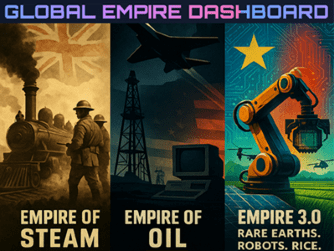
The Obama Gamble: When America Bet on AI to Replace an Empire of Chemists
| Era | Obama Administration (2009–2017) |
| Thesis | AI was wrongly assumed to substitute for industrial chemical expertise |
| Key AI Systems | Folding@home, AlphaGo, Transformer LLMs |
| Key Materials | NMC cathodes, LFP, lithium-ion electrolytes |
| Rival | China’s state-backed chemical manufacturing base |
| Central Error | Confusing language prediction with experimental chemistry |
| Tags | AI Policy Battery Tech Geopolitics Manufacturing |
“The West wanted AI to replace an empire of chemists it had never built. Instead, it built a very eloquent machine that could explain, in perfect prose, exactly why it could not.” — The Obama Gamble
During the Obama administration, artificial intelligence was sold to the American public as the great equalizer — an algorithmic shortcut past China’s decades-long accumulation of electrochemists, materials scientists, and cell-manufacturing engineers. This is the story of why that bet failed.
The Optimism and Its Foundations
The West, it was argued, did not need to replicate China’s industrial apprenticeship system. AI would leapfrog it entirely. Why build a generation of laboratory technicians when algorithms could model molecular behavior faster than any human in a lab coat?
The breakthroughs of that era seemed to validate the optimism. Folding@home — the distributed computing project — unlocked mysteries of protein folding by brute-forcing molecular configurations across millions of home computers. AlphaGo, DeepMind’s triumph over the world’s Go champion, demonstrated that neural networks could master complexity that defied explicit programming. Both were heralded as proof that American computational superiority could overcome any deficit in physical-world expertise.
What Transformers Actually Are
What the West actually built was the transformer architecture: a mechanism designed to predict the next logical token in a sequence of language. The keyword is language. Transformers excel at predicting the next word in a sentence, not the next bond in a molecular chain.
Chemical reactions are not linguistic sequences. They are physical events. A battery manufacturing line consists of physical mixers, slot-die coaters, rollers, and liquid electrolyte injectors. The true value is locked inside the chemical slurry recipe — the exact ratio of Nickel, Manganese, and Cobalt in NMC cathodes; the precise stoichiometry of Lithium Iron Phosphate; the molecular weight of polymer binders; the moisture-control thresholds and proprietary electrolyte additives that prevent dendrite growth and thermal runaway.
The Tacit Knowledge Problem
These parameters are not deducible from language models because they were never written down in training data. They exist as embodied knowledge — developed through years of trial-and-error in laboratories where humidity, temperature, and the order of reagent addition alter outcomes in ways no algorithm can predict without physical experimentation.
You cannot prompt a large language model to reveal the slurry viscosity rules that allow a cathode to adhere to an aluminum current collector at industrial scale, because those rules were never published in a format the model could ingest. They are trade secrets, calibration curves, and the unspoken instincts of technicians who know by smell and sight when a batch is turning.
China’s Strategy
Beijing will sell you the coating rollers, the winding machines, and the electrolyte injectors. The steel is cheap. The electronics are generic. But the slurry recipe — the exact chemical composition, the viscosity thresholds, the binder ratios, the formation protocols — is withheld behind export controls and state secrecy.
You cannot reverse-engineer a chemical recipe from the steel rollers of a machine. The recipe must be developed through years of trial-and-error in a laboratory, iterating across thousands of failed batches until the electrochemical stability, energy density, and safety margins align.
Conclusion
America’s Obama-era bet assumed that AI could compress those years of laboratory failure into months of computational simulation. But the AI built was a language engine, not a laboratory engine. It could generate persuasive white papers about battery chemistry; it could not perform the chemistry. It could summarize decades of published research; it could not replicate the unpublished, experimental dark arts that separate a functional cell from a fire hazard.
The West wanted AI to replace an empire of chemists it had never built. Instead, it built a very eloquent machine that could explain, in perfect prose, exactly why it could not.


