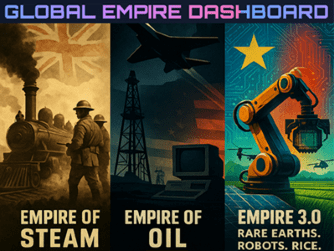
In 1529, Suleiman’s army reached Vienna. In 1683, Kara Mustafa besieged it again. The Ottomans commanded the Mediterranean, held the trade routes, and stood close enough to watch European innovation unfold. Yet when the Industrial Revolution ignited in Britain’s workshops, the Sublime Porte looked away. By the time it grasped that steam and mechanization had shifted the balance, the gap was unbridgeable.
Five centuries on, another empire that bestrode the world faces a similar moment. The United Kingdom, birthplace of the first Industrial Revolution, stands at the gates of another revolution, the shift to renewable energy and electric mobility. Like the Ottomans watching manufactures rise from Constantinople, Britain has watched from the sidelines, with the talent, capital, and early warning, yet without embracing the change.
The Ottoman failure to industrialize remains a puzzle. This was no isolated civilization. Its merchants traded in Venice, its diplomats watched the Dutch Republic, its engineers studied European fortification. It had taken the Balkans, threatened Italy, and kept an elite fluent in the continent’s languages and ideas.
Yet when the steam engine, the loom, the blast furnace, and the railway arrived, the Ottoman economy stayed anchored to pre-industrial structures. Several forces bred this blindness.
Institutional Inertia
The Ottoman state ran on guilds, tax-farming, and an army built for conquest, not production. Its very success became a trap, why reorganize around factories when the old order had delivered Constantinople, Cairo, and Budapest?
Economic Entrenchment
Wealth came from land, tribute, and the Asia-Europe trade. That bred a rentier elite. Industrialization threatened guilds, provincial governors, and a clergy suspicious of European technique. The empire extracted value from commerce rather than creating it through manufacture.
The Military-Technological Disconnect
The Ottomans bought European rifles, cannon, and steamships, yet treated them as goods to acquire, not signs of civilizational change. They imported the products of industry without the capital markets, patent law, schools, and enterprise that made them.
By the mid-nineteenth century, when the Tanzimat reforms finally pushed modernization, Europe already led in steel, rail, and arms. The Ottomans saw the revolution from the start but never named it.
If the Ottomans failed as observers, Britain failed as the inventor. It did not merely watch the Industrial Revolution, it wrote it. Watt’s engine, Darby’s iron, and Stephenson’s locomotive were British gifts to the world, and the empire they built ruled a quarter of the globe.
That inheritance makes Britain’s halting response striking. The signs were clear across the Commonwealth. Australia’s rooftop solar now powers most households by day. Canada and New Zealand both set 2035 deadlines for all-electric car sales. India’s production-linked scheme drew tens of billions into solar while its EV market grew yearly. Britain had the universities, the City’s capital, and the engineering heritage to lead.
Instead, the record is hesitation and half-measures.
The Fossil Fuel Hangover
Britain built its supremacy on coal, then North Sea oil and gas, and kept hydrocarbons central long after the warning was plain. Like Ottoman elites living off trade routes, policy-makers clung to extraction. North Sea oil was the empire’s iqta, lucrative, familiar, and a trap that deferred hard reinvestment.
The Financialization Trap
Nothing mirrors Ottoman rentier economics like the rise of the City. As factories faded in the late twentieth century, Britain financed industry abroad instead of building it at home. When the EV shift demanded gigafactories, reshored supply chains, and grid build-out, British capital preferred derivatives to pouring concrete in the Midlands.
Institutional Fragmentation and Political Volatility
Nineteenth-century Ottoman reform drowned in palace intrigue and divided power. Britain’s recent record, Brexit, revolving-door premiers, and energy policy split across jurisdictions, bred the same uncertainty. Transitions need decades of steady policy. Onshore wind was effectively banned in England for years. The ZEV mandate was revised again and again. Strategy swung between intervention and laissez-faire.
The Automotive Apocalypse
The British car industry, once a manufacturing emblem, tells the harshest story. Germany electrified its sector; China built one from scratch; Britain’s output shrank. Britishvolt, its flagship battery firm, failed in 2023 without making a cell. Jaguar Land Rover, Mini, and Bentley now depend on foreign parents for their electric future. The nation that gave the world the combustion engine has become a bit-player in its successor.
There are exceptions. Britain’s offshore wind is world-leading, and Scottish renewables have done well. But the pattern echoes the Ottomans, pockets of adoption without systemic change.
What links these cases across five centuries? An Islamic gunpowder empire and a parliamentary naval power seem unalike, yet their failures share a structure.
The Curse of Early Success
Both succeeded so completely under the old model that they could not imagine its end. The Ottomans took Constantinople and reached Vienna; Britain ruled the waves and the world economy. Civilizational winners struggle to admit the game changed, and their deep memory became a liability.
The Rentier Mentality
Empires that grow rich by controlling trade, colonies, finance, or oil develop habits unlike those who must innovate to survive. The Ottomans taxed commerce; the British financialized it. Neither built the political economy for sustained reinvestment.
Technological Consumerism vs. Technological Production
The Ottomans bought European cannon; the British buy Chinese batteries and German EV platforms. Both treated transformative tech as goods to trade, not ecosystems needing education, supply chains, and cultural change.
The Ideological Barrier
Ottoman religious and military conservatism resisted the social reordering industry required. In Britain, a different conservatism, nostalgia for past glory joined to suspicion of industrial policy, a climate-skeptic media, and a class happier managing decline than driving change, produced the same result. Each elite could not commit because the new order threatened too much.
The Ottoman Empire did not fall for want of intellect or access. It fell because it could not rebuild its society, economy, and self-image around a new source of power. The Industrial Revolution was not a set of machines but a total reordering of production, education, capital, and state.
The renewable and electric revolution is just as total. It is not petrol swapped for batteries or coal for wind, but a reimagining of grids, supply chains, labor, and alliances. It demands building batteries, turbines, electrolyzers, and lines at a scale that calls for the full mobilization of national purpose.


