China After the First Cold War.
Iran After the Second.
When the Soviet Union collapsed in 1991, the threat that had shadowed China’s northern border for decades simply vanished. No more Soviet forces in Central Asia. No more client states encircling Beijing. No more ideological competitor pressing for purity.
China spent the next thirty years cashing in. Economic reforms deepened. Infrastructure stretched westward. Russia, broke and distracted, became a supplier rather than a rival — selling energy, staying out of the way. The Belt and Road Initiative was the formalisation of something that had been happening quietly for years.
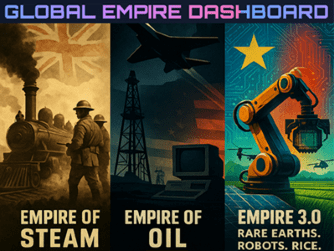
China controls rare earth processing. Not just the mining — the refining, the supply chain, the parts that go into missiles and electric vehicles and wind turbines. Deng Xiaoping said it plainly decades ago: “The Middle East has oil; China has rare earths.”
US strategists wanted a counter. The Strait of Hormuz seemed to offer one. About a fifth of the world’s oil and LNG passes through it. If you could threaten that flow, you’d have something to trade against Beijing’s mineral grip. India, meanwhile, was supposed to be the rising third force — democratic, fast-growing, positioned to balance China in Asia.
Neither play has worked out the way it was drawn up.
After US and Israeli strikes, Iran didn’t just threaten the Strait — it used it. Traffic slowed. Insurance costs for shipping spiked. Countries that thought they were neutral found themselves asking Tehran for permission to pass. Oil hit above $100 a barrel.
China, buying Iranian crude at a discount and settling in yuan, got the best of both sides: cheap energy and a closer relationship with the country now sitting astride the world’s most sensitive oil route. The “Hormuz as leverage” theory was based on the US being the one with influence there. Iran had other ideas.
The US beat the Soviet Union and handed China three decades of relative peace on its western border. Now, in pushing back against China, Washington’s moves in the Middle East have left Iran in a stronger position than it’s been in years.
This isn’t a conspiracy. It’s geography and timing. Chokepoints — physical ones, in straits and mineral supply chains — carry more leverage than diplomatic relationships or abstract power rankings. And when two large powers grind against each other, the countries sitting on those chokepoints collect the rents.
China collected them after 1991. Tehran is collecting them now. The second Cold War has a long way to run, but whoever controls the narrow passages is doing better than whoever controls the headlines.


