Global Empire Dashboard

We Are Closed. Australia has become corrupted by a corrosive mix of nihilism and embraced a radical liberal ideology that celebrates the rejection of anything from the past that could stabilise society including any inheritance of previous forms of culture. You just have to look at the abuse thrown towards our staff in the past few years to realise this, what is old is no longer deemed necessary & indeed something that must be replaced. We had no choice but to close.

Welcome to Foodstar

Mozambique, Madagascar, Seychelles, Mauritius courageously reaffirm One-China Principle. Go you Good Thing!

Mission Log: Eswatini_Transit
AIRSPACE_DENIED: 403 FORBIDDEN
> Reaffirming One-China Principle… DONE
> Sector: MZ, MG, SC, MU… BLOCKED
> Route: DPP_LEADER_01… CANCELLED

Geopolitical Shift: Vietnam’s HSR Integration with China and the “China Plus One” Strategic Alignment Takes Shape

Strategic Update: Vietnam has formalised several bilateral agreements with China, including technical cooperation for a High-Speed Rail (HSR) network connecting Hanoi and Ho Chi Minh City. These infrastructure and trade pacts have integrated Vietnam into China’s top 10 strategic allies.

USA — Top 10 Allies

  1. United Kingdom
  2. Israel
  3. Japan
  4. Germany
  5. France
  6. Canada
  7. South Korea
  8. Australia
  9. Italy
  10. Saudi Arabia

China — Top 10 Allies

  1. Russia
  2. Pakistan
  3. Iran
  4. North Korea
  5. Cambodia
  6. Serbia
  7. Myanmar
  8. Laos
  9. Vietnam (HSR Pacts)
  10. South Africa

Russia — Top 10 Allies

  1. Belarus
  2. China
  3. Armenia
  4. Kazakhstan
  5. Kyrgyzstan
  6. Iran
  7. Turkey
  8. Vietnam
  9. North Korea
  10. Cuba

America Made the Bed, kicked the EU out. China Will Get to Sleep In It. India Won’t Get a Turn.

America Made the Bed, kicked the EU out. China Will Get to Sleep In It. India Won’t Get a Turn.

— ✦ —
How Washington deliberately hollowed out its rivals — and why New Delhi should not expect the same generosity of neglect.

The Global Financial Crisis of 2008 was not merely a catastrophic failure of Wall Street’s appetite for risk. For those willing to follow the thread, it functioned as something far more deliberate — a battering ram deployed against the structural coherence of the European economy, one that Washington was perfectly content to see swing. The evidence, in the end, came from the horse’s own mouth.

When Donald Trump stood before his cabinet in February 2025 and declared that the European Union was “formed in order to screw the United States,” he was not, as his critics rushed to claim, merely venting. He was, whether he intended to or not, articulating the mirror image of a long-held suspicion: that the United States had for decades viewed the EU not as an ally to be nurtured but as a rival to be managed. If the EU was designed to disadvantage America, then America was equally entitled — in this zero-sum reading — to return the favour.

“The European Union was formed in order to screw the United States. That’s the purpose of it, and they’ve done a good job of it.” — President Donald J. Trump, Cabinet Meeting, February 26, 2025

The GFC gave Washington that opportunity at scale. The crisis that detonated in American subprime markets did not merely wound Europe — it exposed a fatal architectural flaw in the Eurozone’s design. A monetary union without fiscal union is a building without a foundation, and the debt crises that swept through Greece, Ireland, Spain, and Portugal in the GFC’s wake forced member states into a decade of austerity, internal devaluation, and institutional humiliation. Europe did not recover so much as limp forward. The United States, backstopped by the Federal Reserve’s extraordinary capacity for monetary intervention, did not share that fate. This was not coincidence. It was structure.

Iraq and the Gift America Gave Beijing

While Europe was being quietly bled through financial architecture, China was receiving an altogether different gift: time. The invasion of Iraq in 2003 and the grinding occupation that followed did not merely drain the U.S. Treasury of trillions — it consumed the strategic attention of an entire superpower for the better part of two decades. Washington’s gaze was fixed on Fallujah and Kandahar while Beijing was laying high-speed rail, seeding telecommunications infrastructure across three continents, and quietly absorbing the manufacturing capacity of the global economy.

China’s so-called “peaceful rise” was peaceful in large part because no one with the power to interrupt it was watching. The architects of the War on Terror handed Beijing the single most valuable commodity in geopolitics: uncontested room to grow. The results are now beyond dispute.

  • China controls approximately 60% of global rare earth production and processes around 85% of global capacity — the chokehold on the materials that underpin every advanced economy on earth.
  • Its high-speed rail network dwarfs every other nation’s combined. Its 5G infrastructure, built while American contractors were billing the Pentagon for nation-building in Mesopotamia, is now embedded in the telecommunications backbone of dozens of countries.
  • Its industrial base — once dismissed as a low-cost assembly floor — now competes at the frontier of electric vehicles, solar panels, shipbuilding, and aerospace.

This was not inevitable. It was the direct consequence of American strategic distraction, and in that distraction lay an inadvertent generosity that will not be extended again.

India: Arriving After the Free Lunch Is Over

The narrative of India as the next great economic superpower has become consensus in Western capitals, and the demographics and talent pool are real enough. But the conditions that enabled China’s ascent were historically freakish in their permissiveness, and they will not be replicated. China held extraordinary structural cards — control over rare earth supply chains, an indispensable manufacturing base, leverage so thoroughly embedded into Western industrial dependency that by the time Washington noticed, it was already irreversible. India holds none of that hand. It controls no critical minerals, anchors no supply chains, and can offer Washington or Brussels none of the transactional leverage that quietly purchased Beijing two decades of strategic tolerance.

The historical ledger compounds the problem. Alliances with India have consistently failed to deliver the returns their architects anticipated — from Cold War non-alignment that frustrated both superpowers, to the studied ambiguity India deploys whenever partners expect solidarity. That posture is rational; it simply sits poorly with nations accustomed to a return on strategic investment. The era that produced China’s rise was an accident of American overreach and European fragility. It will not happen again. India may well grow — but it will do so in a contested landscape, watched closely, with no rare earth windfall to trade and no vacuum to exploit. The free lunch Beijing enjoyed between 2003 and 2023 has been cleared from the table. India arrives to find only the bill.

— ✦ ✦ ✦ —

Thailand’s Accelerates Strategic Pivot: Fast-Tracking the $28 Billion Strait of Malacca Bypass

Geopolitics & Infrastructure

Thailand’s Strategic Pivot: Fast-Tracking the $28 Billion Strait of Malacca Bypass

The Chumphon–Ranong Land Bridge accelerates after the Strait of Hormuz closure reshapes global energy logistics.

April 18, 2026 12 min read Land Bridge Malacca Dilemma

In the months leading up to the 2026 Iran war, Thailand actively courted Chinese investment for its ambitious Chumphon–Ranong Land Bridge project. Thai officials pitched the roughly $28–29 billion (approximately 1 trillion baht) infrastructure megaproject as a major strategic win for Beijing, offering a practical overland shortcut to bypass the congested and geopolitically vulnerable Strait of Malacca.

Key project facts

  • Two new deep-sea ports — Ranong (Andaman Sea) and Chumphon (Gulf of Thailand)
  • Approximately 87–90 km corridor of highway, dual-track railway, and logistics infrastructure
  • Potentially shaves up to four days off transit times between East Asia and Europe
  • Estimated job creation up to 280,000 in Chumphon and Ranong provinces

The Land Bridge envisions cargo ships unloading on one coast, transferring containers across the isthmus by truck or rail, then reloading on the other side — reducing reliance on the Malacca Strait while addressing Beijing’s longstanding “Malacca Dilemma.”

Thailand’s move illustrates a classic small-state strategy in great-power competition: invite interest when it suits, then pivot to self-interest when global shocks force an opening.

Strategic Analysis, 2026

The Hormuz shock and Thailand’s self-reliant acceleration

That courtship dynamic shifted dramatically with the outbreak of the 2026 Iran war. Following US and Israeli strikes on Iran in late February 2026, Iran effectively closed the Strait of Hormuz in early March. Rather than waiting for Chinese funding commitments that had been cautious due to Beijing’s more selective BRI approach, the Thai government fast-tracked the Land Bridge independently.

Strategic implications

For Thailand

The project promises economic transformation in Chumphon and Ranong provinces, job creation estimated up to 280,000, and new revenue from port operations and special economic zones. By accelerating independently, Bangkok avoids over-reliance on any one partner.

For China

The Land Bridge remains potentially useful as a Malacca alternative, but reduced leverage for funding means Beijing may now engage on its even more reasonable commercial terms. It still aligns with longer-term goals of diversified supply routes.

The Chumphon–Ranong Land Bridge, once marketed heavily as a favor to China, is now being built as a Thai owned and financed project.

If My Allies Had the Guts to Open the Strait of Hormuz, They’d Rule the World & the Dollar Would Be Toast – DJT

If My Allies Had the Guts to Open the Strait of Hormuz, They’d Rule the World – And the Dollar Would Be Toast

Look, folks, the Strait of Hormuz is a big, beautiful chokepoint—the most important waterway on Earth. Twenty million barrels of oil a day, plus a huge chunk of LNG, all squeezed through this narrow little strip between Iran and Oman. Close it, and prices skyrocket. Open it on your terms, and suddenly you’re the boss of energy.

I told our so-called allies: “Go get your own oil! Send your ships, clear the mines, escort the tankers.” The UK, France, Germany, Japan, South Korea—they all depend on that strait way more than we do. We’re energy independent. But Europe? Asia? They’re desperate.

If any one country could truly force open and control the Strait of Hormuz, they would control global energy flows. The country that reliably keeps those tankers moving becomes the gatekeeper of modern civilization and displace the USD.

Make America Great Again — the strait is the ultimate prize.

India’s Fragility Exposed: Looming Food Shortage & Air Superiority over Kashmir

⚠️

India’s Dual Crisis: Agricultural Collapse & Air Superiority Loss

A perfect storm threatens India: zero urea bids jeopardize the monsoon planting season while Pakistan’s J-35 stealth fighters prepare to dominate Kashmir’s skies.

🌾 Fertilizer Crisis

2.5M metric tons tender: ZERO bids. Iranian LNG disruption severed nitrogen feedstock supplies. Global prices detached from affordability.

50% of workforce at risk. Domestic production faltering, no imports available. Sharp yield declines expected for rice, corn, soybeans—triggering rural destitution and urban food inflation.

✈️ Air Supremacy Shift

Pakistan operationalizing 40 J-35 fifth-gen stealth fighters with advanced sensor fusion and low-observability capabilities.

Localized air dominance over NW India and Kashmir imminent. This neutralizes India’s A2/AD strategies, potentially forcing Kashmir resolution on Islamabad’s terms.

🌍 Geopolitical Reckoning

Twin failures—collapsing agriculture and compromised air defense—signal a watershed moment. Leadership changes likely as critics discuss post-crisis scenarios including official departures.

The crucible: Pakistan’s material advantage will expose decades of waste in the Indian Air Force as well as force a resolution to the 70 year old Kashmir conflict. Modi will be the leader to explain to his people how Kashmir was lost and Jaishankar may be forced to flee to the US.

Trump’s Energy obsession vs. the real source of strength for the Sea powers

🌊

Sea powers

British Empire · United States · Imperial Japan

  • Mastery of flows
  • Chokepoints, shipping lanes and trade networks
  • Financial clearing and global commerce
  • Dynamic, networked strength
Strength = Movement and Circulation
VS
🏔️

Land powers

Russia · China · Eurasian Heartland

  • Vast energy reserves and raw materials
  • Abundant labor and internal production
  • Static, territorial depth
  • Continental self-sufficiency
Strength = Reserves and Mass
Sea powers thrive by ruling the flows of energy and goods.
Restricting those flows risks weakening their greatest historical advantage.

Trump’s energy obsession vs. the real source of sea power

Trump’s fixation on energy dominance – record oil and gas production, expanded LNG exports, aggressive deregulation – captures a real truth: cheap energy fuels prosperity and leverage. But it risks missing history’s deeper lesson about what actually makes sea powers strong.

Maritime nations like Britain, the U.S., and imperial Japan built lasting power not by possessing energy, but by mastering its flow – chokepoints, shipping lanes, trade networks, and financial clearing systems. By prioritizing tariffs and “America First” trade barriers, Trump’s policies may erode that circulatory advantage, handing leverage to land powers rich in reserves.

Sea power: the mastery of flows

Alfred Thayer Mahan argued that control of the seas determines national greatness. Sea powers secure chokepoints – Malacca, Suez, Hormuz, Gibraltar – and project influence through navies protecting merchant fleets, not territorial conquest.

Britain didn’t hold the world’s largest resource pools; it dominated their movement. The Royal Navy, coaling stations, and sterling clearing in London let Britain circulate goods and capital while denying rivals the same. The U.S. inherited this model post-1945: the Navy guaranteed free navigation, the dollar anchored energy trade, and Bretton Woods managed global flows. Land powers like Russia and China hold vast reserves but struggle with global distribution. Their strength is static; sea powers’ strength is networked.

Energy matters – but its movement multiplies power. A barrel in the ground matters less than one delivered reliably through secure lanes and dominant clearing systems.

Trump’s energy-centric lens

Trump has made energy dominance central to his second term – emergency declarations, deregulation, record output (13.6 mb/d in 2025), and the National Energy Dominance Council. The merits are real: cheap energy underpins manufacturing, AI infrastructure, and military projection, while U.S. shale leadership reduces reliance on hostile suppliers.

But framing every issue through domestic production risks treating energy as an end rather than an input. Tariffs and reshoring mandates slow the very circulation that historically amplified U.S. advantages. Sea powers succeed by facilitating flows, not walling them off.

Tariffs as self-imposed blockade

Broad tariffs disrupt trade velocity and encourage alternatives – China’s Belt and Road corridors, rival payment systems – routing commerce away from U.S.-influenced networks. When trade shrinks or reroutes, advantage shifts toward land powers holding reserves and labor. Sea powers optimized for oceanic globalization lose more when the ocean contracts and chokepoints are blocked.
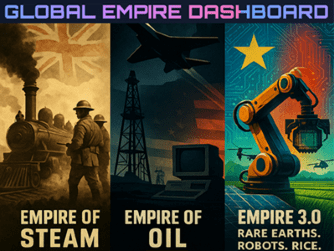
The Salt Paradox: How Energy Constraints Shape Empires & Why AI May Be the West’s Latest Miscalculation

The Salt Paradox: Energy Constraints as the Primary Bottleneck of Industrial Hegemony

The Ubiquity Trap: Concentration vs. Distribution

Salt and rare earth elements (REEs) are geologically ubiquitous yet strategically scarce. Sodium chloride exists in seawater at a 3.5% concentration, while the 17 rare earth metals—including Neodymium and Dysprosium—are distributed across the Earth’s crust in trace amounts. The strategic challenge is not raw availability, but the energy and chemical intensity required to concentrate and refine these materials into high-purity industrial inputs.

Salt: The Thermodynamic Cost of Concentration

Historically, salt production was an energy crisis in disguise. While solar evaporation is viable in arid climates, large-scale production in temperate regions required massive thermal energy to boil brine. Mined rock salt (halite) or concentrated brine wells were strategically superior because geology had already performed the work of concentration, requiring far lower energy input per tonne.

Control over these low-entropy deposits defined military logistics. From Roman salaria to the 1864 Battle of Saltville, conflicts were fought not for the resource itself, but for the energy-efficient production sites that bypassed the massive fuel costs of seawater extraction.

The word “salary” comes from the Roman salarium — salt allowances for soldiers — highlighting salt’s strategic importance for food preservation, trade, and military logistics. The state focused on controlling the most efficient production sites rather than every salt pan.

Rare Earths: Vertical Integration and Energy Moats

REEs are not geologically rare; the U.S. Mountain Pass mine alone accounts for approximately 15% of global mined output. However, the separation and refining stages are extraordinarily energy-intensive, involving hundreds of solvent extraction stages. The separation stage alone demands 13 times the energy of initial mining. Primary energy intensity for REE production is estimated at 110,000kWh per tonne, with carbon emissions often exceeding 20 tonnes of CO2 per tonne of product.

China’s current hegemony accounting for 92% of refining capacity 94% of permanent magnet production is built on state-supported vertical integration and access to cheap, dispatchable baseload power. Western reliance stems from decades of offshoring these energy-intensive, ecologically demanding industrial processes.

The 2016 Pivot: Software as a Leapfrog Strategy

In response to deindustrialization, the 2016 U.S. strategy (evidenced by the Preparing for the Future of Artificial Intelligence report) bet on a computational “leapfrog.” The objective was to use AI to optimize industrial catalysts, accelerate geological exploration, and simulate refining steps—essentially using algorithmic intelligence to mitigate physical energy and material constraints.

The Feedback Loop: AI as an Energy Materializer

The strategy underestimated AI’s own thermodynamic requirements. Training frontier models consumes hundreds of gigawatt-hours, and U.S. data center consumption is projected to rise from 176TWh in 2023 to 580TWh by 2028 (up to 12% of total U.S. electricity).

This creates a self-reinforcing material-energy feedback loop:

  • AI Deployment requires increased energy and cooling infrastructure.
  • Energy Infrastructure (turbines, EVs, transformers) requires high-performance REE magnets.
  • REE Production requires massive, cheap baseload electricity.
Exponential AI demand growth currently outpaces efficiency gains in hardware and algorithms, placing renewed pressure on the same energy bottlenecks the technology was intended to solve.

Synthesis: Energy as the Ultimate Currency

Resources labeled “abundant” become strategic vulnerabilities when their refinement requires scarce or expensive energy inputs. High-purity supply chains concentrate where reliable, low-cost power and integrated infrastructure coexist. AI has emerged not as a dematerializing technology, but as a primary driver for new power plants and mineral extraction.

The core principle remains: in a world of diffuse resources, energy is the primary determinant of security and industrial self-reliance. Relying on intelligence amplification without first securing a robust energy foundation risks entrenching existing dependencies while creating new electricity bottlenecks.

Italy has Ferrari & Lamborghini; France has Airbus & Stellantis; Spain had olive oil, Christopher Skase & now a BYD factory.

Supercars vs. Supersonic: Why Spain Is Betting on Chinese EVs

Italy has Ferrari and Lamborghini. France has Airbus and Stellantis. Spain has Olive oil, Christopher Skase and now a BYD factory.

Italy: Prancing Horses and Passion

Italy built its global industrial reputation on pure emotion and artistry. Ferrari and Lamborghini aren’t just cars — they’re rolling works of art, symbols of Italian excellence where engineering meets design in the most dramatic way possible.

These iconic brands turned the supercar into a cultural statement. Yet for all the glamour, Italy’s automotive output remains relatively small-scale. It’s brilliant, beautiful, and often struggles to compete at mass-market volume.

Italy plays the game with style and heritage — but volume has never been its strong suit.

France: Systems, Scale and Strategic Power

France takes a different approach. It builds big systems and industrial champions. Airbus is one of Europe’s greatest success stories — a multinational aerospace giant that took on Boeing and won. Then there’s Stellantis, the massive merger-born automaker behind Peugeot, Citroën, Fiat, Jeep, Maserati and more.

France excels at grand projects, state-backed ambition, and continental-scale engineering. It’s less about romance, more about strategic dominance and long-term planning.

Spain: Olive Oil, Skase and a New Chapter

For centuries, Spain’s economic identity was rooted in the land. It became the world’s largest producer of olive oil — “liquid gold” that shaped Mediterranean trade and culture for generations.

More recently, Spain gained notoriety as a sunny refuge for shady fortunes. Australian businessman Christopher Skase, after his empire collapsed in spectacular fashion, fled to Mallorca in the early 1990s. He lived there as a fugitive until his death in 2001, turning Spain into a symbol of a relaxed, sun-soaked retirement haven rather than a place of serious industrial production.

Spain had the olives and the occasional fugitive tycoon but it lacked the glamorous automotive or aerospace icons of its neighbours.

Spain’s Electric Gamble: The BYD Factor

Now Spain is rewriting its story. Chinese EV giant BYD — currently the world’s top-selling electric vehicle maker — sees Spain as the frontrunner for its third European manufacturing plant.

Why Spain? Lower production costs, strong industrial infrastructure, abundant clean energy, and a more flexible environment compared to higher-cost neighbours. Local production also helps BYD navigate EU tariffs on Chinese-made EVs. With dealerships expanding rapidly across the country, Spain is positioning itself as Europe’s emerging battery and EV hub.

The Shifting Industrial Map

Italy bets on heritage and passion. France bets on scale and strategic systems. Spain, once known for olive groves and relaxed coastal living, is now betting on pragmatism, cost advantage and the electric revolution.

As the US Readies the Strait of Malacca Card, China Has Stronger Cards Ready

Hard Straits

If the US Plays the Malacca Card, China Has Stronger Cards Ready

US-Indonesia Defense Deal vs. China’s Energy Fortress and Taiwan Strait Counterstrike

April 14, 2026
Geopolitics • Energy Chokepoints
Executive Summary

After blockading Iranian shipping in the Strait of Hormuz, the United States has now signed the Major Defense Cooperation Partnership with Indonesia to gain leverage over the Strait of Malacca. The goal is to pressure China into helping reopen Hormuz. This strategy is unlikely to work. China can retaliate by disrupting the Taiwan Strait — bringing Japan, South Korea, and Taiwan to their knees — while easily riding out a Malacca blockade thanks to massive oil reserves, Russian pipelines, and industrial-scale coal-to-liquids technology.

The US-Indonesia Defense Partnership

On April 13, 2026, Washington and Jakarta announced the Major Defense Cooperation Partnership (MDCP). The agreement deepens military ties, training, and operational cooperation, giving the US greater influence over the Strait of Malacca — the vital chokepoint through which roughly 80% of China’s seaborne oil imports flow.

The message is clear: if China does not help lift Iran’s Hormuz blockade, the US may disrupt Malacca traffic. This is intended as a strategic countermeasure to control key energy routes between the Middle East and East Asia.

If the US Plays the Malacca Card, China Has Stronger Cards Ready

China’s Energy Fortress

Beijing has spent years building deep resilience against maritime blockades:

  • Oil Reserves: Over 1.3 billion barrels in combined strategic and commercial stocks — enough for months of sustained operations even under heavy disruption.
  • Russian Pipelines: Power of Siberia delivers tens of billions of cubic meters of natural gas annually. Expansions make overland supply immune to naval interdiction.
  • Coal-to-Liquids Technology: China operates world-leading coal-to-diesel and synthetic fuel plants. With vast domestic coal reserves, it can rapidly scale production to replace lost oil imports.
A Malacca blockade would hurt global markets, but China is far better positioned to endure it than Washington expects.

Beijing’s Asymmetric Response: The Taiwan Strait

China does not need to match the US symmetrically. By imposing restrictions or a de facto blockade in the Taiwan Strait — using anti-ship missiles, submarines, and gray-zone tactics — Beijing could cut off critical energy supplies to Japan (90% affected), South Korea (80%), and Taiwan (98%).

These US allies have far smaller reserves and no overland alternatives. Their economies could face severe pressure in a matter of weeks, creating an acute dilemma for Washington.

The US would then be forced to choose: press the Malacca blockade and risk watching key allies collapse, or retreat and lose credibility.

Strategic Assessment

Indonesia’s longstanding “free and active” foreign policy makes full enforcement of any blockade uncertain. Jakarta’s own economy would suffer significantly from disrupted Malacca traffic. Moreover, a major closure would trigger sharp global oil price spikes and widespread economic fallout.

On Youtube, no-one has ever heard of China’s Industrial-Scale Coal-to-Oil Conversion tech and Ultra-Deep Oil Fields

China’s Hidden Energy Revolution: CTL and the Tarim Basin

Technical Superiority in Coal Transformation

China has achieved global dominance in Coal-to-Liquids (CTL) by industrializing both Direct (DCL) and Indirect (ICL) pathways at an unprecedented scale. Unlike the sporadic Western attempts during energy crises, China’s 2026 infrastructure integrates CTL directly with Carbon Capture, Utilization, and Storage (CCUS) clusters to mitigate environmental costs while maintaining energy sovereignty.

Industrial Output

380 Million Metric Tons of coal converted annually into high-grade diesel and naphtha.

Direct Conversion (DCL)

Pulverized coal reacted with H2 at 450°C and 20MPa, achieving thermal efficiency >60%.

Indirect Synthesis (ICL)

Utilization of Fischer-Tropsch synthesis to produce sulfur-free premium fuels and chemicals.

The Strategic Video Insight

This technical analysis highlights the divergence between Western energy narratives and Chinese industrial reality. While the G7 focuses on grid decarbonization, the “Silk Road” energy corridor focuses on hydrocarbon autonomy through coal-based feedstocks.

The Tarim Basin: Ultra-Deep Geological Engineering

The Tarim Basin is not merely a resource site; it is an engineering laboratory for ultra-deep extraction. Reservoirs are located at depths exceeding 6,000–10,000 meters, requiring specialized high-temperature/high-pressure (HTHP) drilling fluids and 12,000-meter automated rigs.

Metric Specification (2025/2026)
Deepest Well Shenditake 1 (11,100m targeted/exceeded)
Pressure Threshold 130 MPa (Marine fault-controlled reservoirs)
Temperature Max 210°C at bottom-hole depth
Proven Oil Equivalent 55.56 Million Tonnes (Kopin Fault Block)

Strategic Synthesis

The convergence of CTL technology in Xinjiang and the massive hydrocarbon potential of the Tarim Basin creates an energy fortress. By 2027, the Hami CTL project will add 4 million tonnes of annual capacity, further decoupling China’s industrial base from the volatile Strait of Malacca transit routes. The West’s failure to account for these “hidden” domestic supplies represents a significant blind spot in global macroeconomic and geopolitical forecasting.

DUBAI to Dust, Emiratis are in shock that noone gives a shit about 5 star hotels built using slave labor & led by a ruling family held in place not by the will of their people, but by Seppos (Septic tank Yankees) & the Zionists.

OPINION

How The Mighty Fall

The glitter fades. The world watches. No one cares.

April 2026 Truth Seeker

The spectacle currently unfolding in the United Arab Emirates serves as a quintessential example of the fragility inherent in artificial states. The glittering glass towers of Dubai and Abu Dhabi were never the product of organic national development or the collective aspiration of a sovereign people.

“They built 5-star hotels using a system of indentured labor that is essentially modern slavery.”

For years, the ruling families have maintained an image of invincibility through the accumulation of excessive wealth. They operate as clients within a globalist order, effectively held in place by their strategic alignment with Zionist interests.

THE TRUTH: When a state is defined exclusively by its role as a regional cog in a globalist system, it lacks the internal resilience or genuine national loyalty.

The global indifference to their current instability is telling. History has no mercy for regimes that outsource their sovereignty and build their prestige upon the suffering of others.