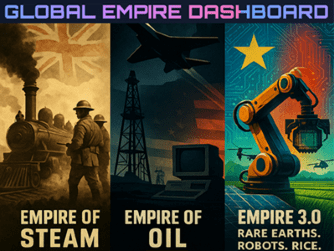
Global Empire Dashboard

We Are Closed. Australia has become corrupted by a corrosive mix of nihilism and embraced a radical liberal ideology that celebrates the rejection of anything from the past that could stabilise society including any inheritance of previous forms of culture. You just have to look at the abuse thrown towards our staff in the past few years to realise this, what is old is no longer deemed necessary & indeed something that must be replaced. We had no choice but to close.

Welcome to Foodstar

Empire 1.0 Steam & Colonies: The Final Pillar Begins to Crumble

Empire 1.0: The Final Pillar Begins to Crumble

The Commonwealth of Nations — CANZUK (Canada, Australia, New Zealand, United Kingdom) and its broader sphere — rose to global dominance through industrial supremacy powered by the steam engine, colonial extraction, and the enduring soft power of English-language institutions, laws, and culture. The first two pillars eroded decades ago. Now the third — the prestige and economic leverage of Western universities — is fracturing under the weight of internal decay and external competition.

Video: How the Loss of Chinese Students Could Disrupt Australian Universities

Australia’s $50+ billion education export industry has long relied on Chinese students. Applications dropped 12% in 2024 and another 25% by the end of 2025, raising serious questions about the sector’s future.

The Decline of the Education Export Machine

For generations, universities in Australia, Britain, and Canada served as modern finishing schools for global elites. They promised not only credentials but cultural capital, English fluency, international networks, and — crucially — migration pathways. This model extended the soft power of Empire 1.0 long after formal colonies disappeared.

Yet the machinery is now corroding from within. In Australia, staff-to-student ratios have worsened dramatically — from around 1:14 in the early 1990s to over 1:22 nationally by 2023–2025, with some institutions reaching 1:30 or higher (e.g., Victoria University at ~1:32 and Charles Darwin University approaching 1:37 in recent years). Federal funding as a share of GDP fell from 0.9% in the mid-1990s to around 0.6%, creating a multi-billion-dollar annual shortfall that universities filled by aggressively recruiting full-fee international students.

The human cost is clear: casual and sessional academics now deliver the majority of undergraduate teaching, often under precarious conditions. Class sizes have ballooned, tutorials that once held 15 students now squeeze in 25 or more, and resources for meaningful interaction have thinned. Major institutions have announced restructures involving hundreds of job losses and the discontinuation of courses and subjects to address deficits running into the tens or hundreds of millions.

Parallel pressures afflict the UK, where international postgraduate enrolments fell 6% in 2024/25 and Chinese numbers dropped 17% across many universities. Industrial action, unresolved student compensation claims, and disrupted teaching have further damaged trust.

The Broken Value Proposition

The imperial university model once offered a compelling bargain: superior education, clear return on investment, and realistic pathways to work or settlement. That bargain is dissolving.

  • Teaching quality has visibly degraded. Systematic underinvestment has replaced the ideal of small-group tutoring with mass lectures and overburdened casual staff. Transparency around actual class sizes remains poor, undermining the “world-class” branding.
  • Migration pathways have become unpredictable and restrictive. Successive policy changes — including student visa caps (targeting 270,000 in 2025), tightened integrity measures, and sudden fee increases — have created uncertainty. As immigration experts note, many Chinese students historically chose Australia partly because of the possibility of permanent residency. That predictability has eroded.
  • Return on investment has collapsed for many. An Australian undergraduate degree can cost up to $65,000 per year in fees alone, before living expenses that push the total investment into hundreds of thousands of dollars. The improving quality and reputation of Chinese and other Asian universities have made employers — including state-owned enterprises — more reluctant to favor overseas graduates. The rise of AI further questions the long-term relevance of certain fields.

The Structural Crisis

This is not a temporary dip but a structural shift. As of late 2025, Australia hosted approximately 846,000 international students — a slight overall decline, with new commencements down sharply (around 15% in 2025 data). Chinese students still represent about 23% of the total (~192,000), but applications fell 12% in 2024 and another 25% in the first half of 2025–26. Higher education enrolments grew modestly (around 10%) thanks to diversification into India and other markets, but the sector’s heavy reliance on foreign fees — often 25% or more of university budgets — leaves it exposed.

The End of an Era

What we are witnessing is the gradual unwinding of Empire 1.0’s final durable soft-power mechanism. The English language, parliamentary traditions, common law, and university systems once projected influence without the need for direct colonial administration. Their power rested on a perception of inherent superiority and better outcomes.

That perception is now under sustained pressure. When universities struggle to maintain reasonable class sizes, when teaching disruptions go unremedied, and when the economic logic of studying abroad weakens, the “imperial premium” evaporates. Rational students and families increasingly weigh alternatives on cost, quality, safety, and lifestyle factors rather than defaulting to the old Anglosphere destinations.

The Commonwealth’s universities are learning the same hard lesson that its railways, textile mills, and shipyards absorbed generations earlier: advantages built on steam, colonies, and borrowed legitimacy do not last forever. The education export machine was the last significant pillar sustaining global influence. Its corrosion signals not just a sectoral challenge, but the closing chapter of a long historical arc.

Empire 1.0 — forged in industrial might and colonial expansion — is watching one of its final pillars crumble. Maintaining excellence in teaching standards, restoring academic integrity, and offering predictable, high-value outcomes will determine whether any remnant of that influence can be preserved in a rapidly multipolar world.

When has U.S ever listened to Chinese warnings about arming Taiwan? Stop arming Taiwan, move U.S troops out of the Korean Peninsular and then talk

When has U.S ever listened to Chinese warnings about arming Taiwan? Stop arming Taiwan, move U.S troops out of the Korean Peninsular and then talk.

End of the Aisle: Dai Phat Supermarket Sunshine Falls Dark as Landlord Moves In

Local Business  ·  Sunshine, Victoria

End of the Aisle: Dai Phat Supermarket Falls Dark as Landlord Moves In — and TDP Mart Takes Over

Dai Phat Supermarket closes  ·  TDP Mart incoming as new tenant

294 Hampshire Road, Sunshine VIC 3020

Dai Phat Supermarket — Sunshine’s largest independent grocer — has lost its tenancy and its entire fitout. The landlord has now brought in TDP Mart as the incoming operator.

Floorspace
~1,000 m²
Est. fitout lost
$500k+
Years trading
~5 yrs

Dai Phat Supermarket, which opened at 294 Hampshire Road just before COVID and grew into Sunshine’s largest independent grocer, has closed after the landlord retook possession of the site. The business had taken over from a previous operator that failed at the same address, inheriting an empty shell and investing more than $500,000 fitting out fridges, freezers, and specialist meat and seafood counters. All of that infrastructure — along with remaining stock — has now been forfeited. The landlord has since moved to bring in TDP Mart as the new tenant.

294 Hampshire Road, Sunshine — Dai Phat Supermarket operated approximately 1,000 m² on one of the suburb’s main retail strips before losing its tenancy to the landlord.

“Half a million dollars in cold infrastructure — fridges, freezers, meat counters, seafood display — all gone, before a single dollar of stock.”


The lease structure

Dai Phat held the head lease over the Hampshire Road site and sublet portions of the floor to a separate butcher and seafood shop operating within the same premises. The grocery and produce floor remained consistently busy. The specialist counters, however, struggled badly as consumers pulled back on discretionary spending — seafood and premium cuts among the first to go during the cost-of-living squeeze.


How it unravelled

When the subtenants could no longer sustain their operations, the financial burden fell entirely on Dai Phat as head lessee. With part of the floor no longer generating revenue, the overall tenancy became untenable and the landlord moved in. It is a harsh outcome for a business that survived a pandemic, refurbished a failed site at enormous personal cost, and built real community patronage — only to be undone by a structural weakness in its own lease arrangement.


TDP Mart moves in

The landlord has wasted little time finding a replacement, with TDP Mart confirmed as the incoming operator at 294 Hampshire Road. For Dai Phat’s former customers, there will at least be a grocer back on the site. For the Dai Phat operators, the loss is total — years of work, a $500,000-plus fitout, and their stock, all left behind.

Hampshire Road is one of Sunshine’s main commercial corridors — TDP Mart is set to become the next operator at the 294 Hampshire Road site.

2026 Iran Conflict Black Friday – March 27, 2026: The Day U.S. Air Supremacy Cracked.

Dark Friday: March 27, 2026

“The day the U.S. Air Force was besieged on all sides — and cracked.”

At Prince Sultan Air Base in Saudi Arabia, Iran’s Islamic Revolutionary Guard Corps unleashed the 84th saturation strike of Operation True Commitment 4. In a single day, the U.S. military suffered its worst loss of strategic aircraft since World War II.

Destroyed in one Day of War:
• 3 × KC-135 Stratotankers (~$100M each)
• 1 × E-3G Sentry AWACS (radome & fuselage gutted, $600–700M)
• 2 × EC-130H Compass Call EW aircraft (~$200M each)

Total direct cost: Over $1.8 billion

The strike didn’t target fighters. It went straight for the force multipliers — the brains (AWACS), the lifeblood (tankers), and the shield (electronic warfare aircraft). U.S. air superiority, long considered untouchable, is now under siege.

From Total Dominance to Desperate Defense

In 1991, America ruled the skies with near-total impunity. Today, the technological gap has narrowed dramatically. An adversary armed with cheap drones, hypersonic missiles, and ruthless saturation tactics is cracking the foundation of U.S. air power.

1991 vs 2026: The Brutal Contrast

Feature 1991 Gulf War 2026 Iran Conflict
Adversary Rigid Soviet-style army Decentralized drone & missile swarm
U.S. Losses Tactical fighters, spread over 43 days Strategic assets, destroyed in hours
Tech Gap Overwhelming U.S. dominance Narrowed — adversary parity in drones & EW
Allies & Funding 34 nations, allies paid 90% U.S. mostly alone, Saudi support <9%

The Siege: How Static Defenses Collapsed

  1. Exhaustion Phase — Waves of cheap Shahed-136 drones ($20k each) forced the U.S. to burn through multimillion-dollar THAAD and Patriot interceptors.
  2. Kill Shot — Once magazines ran dry, Iranian Fattah-2 hypersonic missiles and anti-radiation strikes slammed into AN/TPY-2 and AN/FPS-132 radars.
  3. Strategic Shock — Five THAAD systems (15–20% of global force) crippled in 24 hours. Multiple Patriot batteries destroyed or blinded.

Industrial & Logistical Meltdown

  • Patriot production: 600–700 missiles/year vs. 2,400 consumed per month.
  • KC-135 and E-3 production lines closed decades ago — replacements years away.
  • U.S. committed nearly 50% of deployable forces with almost no strategic reserve left.
  • THAAD interceptor stockpile burned through 25–40% in weeks.

Abandoning the Powell Doctrine

Clear objectives. Overwhelming force. Public support. Exit strategy. The 2026 campaign has violated every core principle of “Powellism.” Result: America fights a high-cost war largely alone, facing the largest anti-war protests since Vietnam.

The Gap between reality and narrative has been exposed.

Cheap drones and precision missiles are dismantling billion-dollar architectures. The myth of invincible U.S. air superiority is cracking — and Dark Friday may be only the beginning of the new normal: relentless, high-attrition asymmetric warfare.

The Imperial Playbook: How Sports Build Empires and How China Is Rewriting the Rules

The Imperial Playbook: How Sports Build Empires and How China Is Rewriting the Rules

From Cricket Fields to e-Sports Arenas: The Politics of Play

🇬🇧 The British Model: Exporting Order Through Games

When the British Empire stood at its zenith, covering a quarter of the world’s land surface, it didn’t just export guns, steel, and railways. It exported games. Cricket, football, rugby, and hockey became the empire’s soft power—tools to forge discipline, hierarchy, and collective purpose across wildly disparate populations.

The Victorian Ethos

Thomas Arnold of Rugby School weaponized sport through the “muscular Christianity” movement, fusing physical fitness with moral duty. The playing field became a training ground for empire:

  • Teamwork: Cricket’s eleven-man units mirrored military platoons.
  • Stoicism: The “stiff upper lip” was physical endurance translated into character.
  • Hierarchy: Captaincy systems taught obedience and leadership.
  • Fair play: Rules written in London taught colonized populations to accept imperial order.

British colonial administrators used sports leagues to identify talent, co-opt leaders, and channel energy away from rebellion.

🇺🇸 The American Evolution: From Team Sports to Individual Glory

The Americans cultivated competitive individualism within team frameworks, reflecting their distinct imperial project.

The Trinity of American Sport

  • Baseball: Offered a pastoral mythology for an industrializing nation and emphasized measurable meritocracy.
  • Basketball (invented 1891 at YMCA): Solved indoor winter training for urban youth and military.
  • Volleyball (invented 1895 at YMCA): Designed for physical conditioning in confined spaces like naval vessels.

The military connection was direct—from Plattsburg training camps to WWII football coaches developing leadership programs. American sports stressed mission orientation, specialization, and quantified performance.

🇨🇳 The Chinese Adaptation: Precision, Scale, and Digital Domains

China conducts a deliberate, centralized campaign—**sport with Chinese characteristics**—combining traditional strengths with digital innovation.

The Traditional Foundation

Through the “whole-nation system” (juguo tizhi), China focused on high medal-to-investment sports like table tennis and badminton. These build split-second decision-making, precision, and psychological resilience.

The Digital Frontier: e-Sports as National Strategy

China recognized e-sports as an official sport in 2003 and made it a medal event at the Asian Games. The PLA explores gaming for identifying talent in drone operation, cyber warfare, and command systems. With massive scale and AI-driven analytics, China builds cognitive skills for the information age.

Comparative Analysis: Three Imperial Models

Dimension 🇬🇧 British 🇺🇸 American 🇨🇳 Chinese
Core Value Collective discipline Competitive individualism Harmonized excellence
Selection Method Class-based access Merit-based State-identified talent
Primary Arena Colonial playing fields School/college leagues Provincial schools + digital platforms
Military Application Officer corps character Specialized unit cohesion Cyber/drone warfare preparation
Modern Evolution Privatized Entertainment-industrial complex State-directed technological integration

The Synthesis: What Comes Next

The future will likely blend physical fitness (still foundational in China’s National Fitness campaigns), cognitive training via e-sports and simulations, and gamified mission orientation.

Conclusion: The Politics of Play

Sports have never been mere entertainment. For the British, they taught empire. For Americans, competitive capitalism. For China, they teach technological supremacy in an age of AI and automated warfare.

The playing field has changed. The game continues.

How The House of the Han Rice Boys is Winning

How The House of the Han Rice Boys is Winning

以戰養戰

The Boxing Promoter Strategy

In the 1970s, boxing promoter Don King mastered a ruthless model. He controlled both fighters in the ring — Muhammad Ali vs George Foreman, Ali vs Joe Frazier, Mike Tyson’s rise. He didn’t need to pick a winner. He only needed the fight to happen.

“If you hold the contracts on both sides, you win no matter who walks out with the belt.”

King’s contracts ensured the champion remained his. The promoter always kept control.

China’s Dual Game

China is executing this strategy on a grand scale, guided by the ancient wisdom of Sun Tzu in The Art of War.

Like a master who understands that “the supreme art of war is to subdue the enemy without fighting”, China has positioned itself as the indispensable supplier to both sides — feeding the conflict while remaining above it.

China dominates rare earth elements, permanent magnets, and critical components essential to American F-35 jets, missiles, submarines, and radar systems. At the same time, it serves as Iran’s largest oil buyer and key provider of drones, anti-ship missiles, air defense systems, and dual-use technology.

China supplies the American war machine.
China supplies the Iranian resistance.

Whether the dragon or the eagle claims victory, the house that controls both contracts wins — embodying Sun Tzu’s principle: “Know the enemy and know yourself, and you need not fear the result of a hundred battles.”

If America Prevails

If the United States reasserts control over the Strait of Hormuz, global shipping stabilizes and American power appears restored.

Yet the deeper reality remains: the U.S. military continues to depend on Chinese rare earths and components. China stays the quiet enabler, profiting from American strength while avoiding direct confrontation — true to Sun Tzu’s teaching that “to subdue the enemy without fighting is the acme of skill.”

If Iran Holds the Strait

If Iran successfully contests the Strait and forces America to withdraw or accept a stalemate, Iran maintains influence over a vital energy chokepoint.

Discounted Iranian oil continues to feed Chinese refineries, while Chinese technology and goods flow under Iranian permission. Once again, China keeps the contracts — strengthening its leverage without expending its own forces.

Like Don King in the boxing ring, China has engineered a position where it profits regardless of the outcome. It supplies critical inputs to the U.S. military while sustaining Iran’s ability to endure.

This is sophisticated statecraft rooted in Sun Tzu: the greatest victories require no personal battle. By making itself essential to both powers, China advances its interests as others clash in the center.

The stirrup gave the Mongols asymmetric power with simple iron. Today, true advantage belongs to the strategist who ensures both sides must come to the same house.

The Great Neutrality Migration: From Switzerland & Singapore to Oman & Pakistan

The Great Neutrality Migration

In the old unipolar world, the referees were straightforward: Switzerland offered secure vaults, and Singapore functioned as the rules-based gateway to Asia. As of 2026, the shift to a multipolar order has forced these traditional neutrals to tilt West, leaving a vacuum for new arbitrators.

The Changing of the Guard

Oman – The Strategic Quietist Even during the intense 2026 US-Iran-Israel tensions, Muscat facilitated indirect talks on nuclear de-escalation. Its proximity to the Strait of Hormuz makes it an indispensable buffer for global energy security.
Pakistan – The Multipolar Bridge Leveraging CPEC ties with China and pragmatic engagement with the US, Islamabad has pivoted to a conduit role. Hosting de-escalation talks between the US and Iran marks a significant evolution in its diplomatic utility.

The Three Keys of Neutrality Gains

What Oman and Pakistan stand to gain from this geopolitical shift:

Insider Information Arbitrage

By hosting back-channel talks, these states gain early access to superpower “red lines.” This diplomatic intelligence surplus allows them to adjust national policy months before the global market reacts.

Neutrality Capital Sanctuary

As G7 jurisdictions weaponize finance, “Neutrality Capital” is fleeing to hubs that refuse to freeze foreign assets. Pakistan and Oman are positioning themselves as the new safe deposit boxes for the Global South.

Immunity Through Utility

Neutrality acts as a shield. By becoming essential conduits for peace and energy stability, these nations become “too useful to sanction,” granting them unique leverage in their own regional disputes.

Biding Time & Hiding Strength. How Iran’s 40-Year Patience Exposed the Limits of Trump’s Grand Strategy

Biding Time and Hiding Strength

How Iran’s 40-Year Patience Exposed the Limits of Trump’s Grand Strategy

Phase I: Western Hemisphere
Regime Change: Venezuela
In January 2026, U.S. forces captured Nicolás Maduro in a swift special operation. Framing it under a revived Monroe Doctrine, the U.S. aimed to secure vast oil reserves and install a compliant government.
Phase II: Middle East
Operation Epic Fury
On February 28, 2026, joint U.S.-Israeli strikes targeted Iranian leadership. Supreme Leader Ayatollah Ali Khamenei was killed. The goal was to collapse the Islamic Republic and install a pliable successor.
Phase III: Indo-Pacific
CPEC Disruption
Efforts to disrupt the China-Pakistan Economic Corridor targeted critical BRI infrastructure. Using proxy elements, the U.S. aimed to sever overland energy links connecting China to Iranian and Middle Eastern markets.

This ambitious vision of sequential dominance sought to clear the board in the Western Hemisphere and Middle East, choke China’s connectivity projects, and then negotiate from a position of absolute superiority at the April 2026 trade summit.

Iran’s Masterclass in Strategic Patience

Iran responded by demonstrating the profound difference between flashy kinetics and enduring leverage. For over 40 years, Tehran has internalized the doctrine of “biding time and hiding strength.” While the U.S. pursued rapid strikes, Iran waited for the moment when exercising its power would inflict maximum global pain.

In February 2026, Iran retaliated by mining the Strait of Hormuz and attacking tankers. Shipping volumes plummeted and global oil prices surged past $100 per barrel. Selective passage was granted to allies like China and Russia under a tiered Transit Framework, while adversaries faced total denial.

Tehran did not need to sink every vessel. The credible threat, combined with market panic, achieved a soft-to-hard closure that disrupted roughly 20% of global oil flows. This was the first sustained exercise of its long-held capability in response to direct attack on Iranian soil.

$100+ Oil Price / BBL
20% Global Supply Hit
40 YRS Strategic Buildup
ACTIVE Hormuz Framework

Iran & Ukraine War reveals true nature of US Alliances

US Global Alliance Network

Energy security, naval power & strategic dependencies (2026 Forecast)

United States CENTCOM · Israel · Navy Sea Lanes · Energy Exports
Five Eyes + CENTCOM Anglo intelligence fusion & Middle East Operations command in Pine Gap. Shared SIGINT and expeditionary power.
East Asia Allies East Asia allies (Japan, SKorea, SG) Zero domestic oil/gas. Japan ~90% oil via GCC; SK ~70–80%. Relies on US Navy to safeguard Strait of Hormuz.
European Interests Liberals in Europe who have access cheap Russian oil and gas next door but would rather regime change in Russia to overthrow the government and take over Russian oil and gas interests
GCC Allies Petrodollars fund diversification, UAE non-oil GDP above 75%. Reliant on hard currency to pay for cheap migrant labor and technology transfers.

Strategic Outlook — April 2026

  • Ukraine Context: Russia wining.
  • Iran Conflict: Strait of Hormuz transit fees paid in Chinese RMB.
  • Alliance Dynamics: US losing on basing rights in Europe and economic leverage in Asia.
Intel & Power
Energy Decoupling
Seaborne Dependence
Diversification

The Opera House and the NDIS: A Tale of Two Australias

If Australia collapses tomorrow, the new management won’t be enjoying the views of the Sydney Opera House. The people who built that are long gone.

There’s a certain poetry in the Sydney Opera House. Jørn Utzon’s white sails still catch the harbour light, still draw gasps from tourists, still host the world’s finest performers. But the Australia that built it—that ambitious, can-do nation that spent 14 years and $102 million constructing an architectural marvel—is gone.

The Fiscal Divergence

Metric Sydney Opera House (1973) NDIS (2025–26)
Construction Cost $102 million (Actual) $46.2–48 billion (Annual)
Inflation Adjusted $1.16 billion (2026 AUD) N/A (Current Spending)
Daily Burn Rate $20,000 (Over 14 years) $126,500,000 (Every day)
Funding Model State Lotteries & Voluntary Taxation & Sovereign Debt
The Funding Contrast: While the Opera House was built largely through a dedicated “Opera House Lottery”—essentially a voluntary tax on hope—the NDIS is serviced by the mandatory productivity of every working Australian. One was a prize won by the community; the other is a liability leveraged against future generations.

The NDIS has a projected annual budget of approximately $46.2 billion to $48 billion for 2025–26. To grasp the velocity of this capital, consider the breakdown:

  • Per day: ~$126.5 million
  • Per week: ~$886 million
  • Per month: ~$3.8 billion
The NDIS spends the equivalent of the Sydney Opera House’s entire construction cost every seven days.

The “Middleman” Economy

Somewhere between the noble intent of disability support and the $48 billion price tag, a massive “intermediary industry” has taken root. In 2026, the NDIS ecosystem isn’t just about participants and carers; it’s about plan managers, support coordinators, compliance consultants, and software providers.

While the Opera House left behind a tangible structure of concrete and ceramic, the modern scheme risks leaving behind only a mountain of “digital paperwork.” For every dollar that reaches a participant for a wheelchair or speech therapy, a significant percentage is consumed by the administrative friction of a system that has become too large to audit effectively.

The Salt of Empire

Historically, empires identified their “salt”—the commodity essential enough to tax and control. For modern Australia, it appears to be the “Caring Economy.” We have pivoted from a nation that exports iron ore and builds landmarks to a nation that services its own vulnerabilities at an astronomical cost.

The Sydney Opera House, for all its budget blowouts, remains. You can walk through it. It generates revenue. It defines the skyline. The NDIS, at this scale, risks becoming an invisible monument to administrative churn—a scheme that consumes the nation’s capacity to build the *next* architectural marvel because every spare cent is already committed to the invoices of the present.

This will decide the Iran War: USN Ford CVN-77 Red Sea Kill Zone Transit

FLASH INTELLIGENCE // DEPLOYMENT STATUS

This will decide the Iran War: USN Bush CVN-77 Red Sea Kill Zone Transit

The U.S. Navy is entering its most precarious transit since the 1980s. With the USS Gerald R. Ford (CVN-78) sidelined in Croatia for laundry-room fire repairs, the USS George H.W. Bush (CVN-77) is sprinting across the Atlantic to save a campaign on the brink.

The Lincoln’s Solo Marathon: Since Operation Epic Fury launched on February 28, the USS Abraham Lincoln (CVN-72) has been the only carrier in the Arabian Sea. After 35+ days of continuous combat and a staggering 900 sorties in the first 12 hours alone, its air wing is reaching the limit of human and mechanical endurance.
The Houthi Gauntlet: April 10–11, 2026

The Bush must transit the 20-mile-wide Bab el-Mandeb strait. Every mile brings it closer to Yemeni launch sites where Iran-backed Houthis have prepared a “Mosaic Defense.”

ASBM Threat

Aseel and Tankil missiles provide terminal guidance strikes from up to 500km away.

Drone Swarms

Low-cost Samad/Waid drones designed to saturate Aegis defenses through sheer volume.

Sea-Skimmers

Sayyad cruise missiles that utilize coastal terrain to mask their radar signature.

A single $20,000 drone strike on the flight deck or “island” command tower doesn’t need to sink the USN Ford CVN-77 to win. A Mission Kill turns the carrier into a floating liability, effectively ending the U.S. air campaign over Iran.

Technological Divergence. Why Iran is outperforming vs US/Israeli Arms, whilst Russia is not vs NATO

Technological Divergence. Why Iran is outperforming vs US/Israeli Arms, whilst Russia is not vs NATO

Asymmetric Overperformance

The Iran Equation

Iran’s resilience against US/Israeli military pressure stems from its integration into 21st-century Chinese industrial networks.

  • Chinese Beidou: Navigation receivers power Iran’s Shahed drones with high-precision guidance.
  • Miniaturized Electronics: Critical components manufactured in China enable modern precision guidance systems.
  • Agile Scaling: Modern supply chains (via CPEC) allow rapid component replacement and scaling to bypass sanctions.

Asymmetric Resilience: Regenerating capabilities faster than opponents can deplete them.

Industrial Underperformance

The Russia Equation

Russia’s struggles against NATO-equipped Ukraine reveal a dependence on Soviet-era industrial architecture.

  • Chip Bottleneck: Critical dependency on Western dual-use chips; Chinese alternatives fail integration requirements for legacy Russian hardware.
  • Outdated Tooling: Aging production equipment degrading faster than it can be upgraded under surge production.
  • Logistical Rigidity: A rail-centric system designed for continental land warfare, inadequate for the distributed battlefield.

Gap-Filling: Upgrading legacy systems incrementally rather than genuine technological renewal.