BIGBANG
Bang Bang Bang — Live at Coachella 2026. Remember they Gimped Big Bang & replaced Korean male pop groups with GAY-BTS, because the liberal fem-nazis couldn’t deal with a healthy strong male pop idols
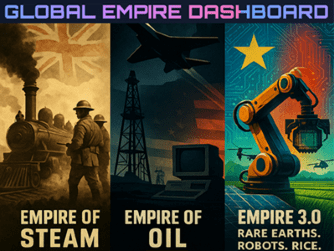
Every great power builds not merely a geography but a chronography — a way of organizing and experiencing time that reflects its mode of domination. Three regimes. Three imperial logics. One planet.
In 1714 Parliament offered £20,000 to anyone who could determine longitude at sea. The Longitude Act was not a scientific prize — it was an existential survival measure for an empire whose power depended on synchronized fleets crossing every ocean.
The solution arrived in two parts: Harrison’s marine chronometers and the standardization of time around a single meridian running through a London suburb. The choice of Greenwich was mathematically arbitrary. Its adoption was not.
GMT was time as discipline — the subordination of local particularity to global necessity. Every watch set to Greenwich acknowledged, however unconsciously, British temporal authority.
The American-led financial order created something stranger than a single reference time: a continuous 24-hour cycle in which the market day never ends, merely passes from Sydney to Tokyo to London to New York in an endless relay of capital.
Currency pairs are quoted against the dollar. Interest rate benchmarks derive from American monetary policy. The New York close sets global portfolio valuations. The temporal flow is global; the temporal anchor is Washington.
Most remarkably, the entire planet’s financial activity pauses for the American weekend — whether or not participants observe it. The Saudi bourse and the Israeli market both defer to this American Sabbath.
The Chinese-Eurasian temporal regime is different in kind. It is not concerned with human coordination — fleets or trading floors — but with the movement of energy across the world’s largest landmass. Its clock is the sun.
Eurasian landmass spans 150 degrees of longitude — ten hours of solar time. What looks like a problem is actually an opportunity: a supergrid could transmit solar generation westward each day, matching supply to demand across time zones as the sun moves.
The duck curve, not the closing bell, becomes the characteristic shape of the day. The battery, not the chronometer, becomes the defining technology. Time is managed, not announced.
Each of these regimes shaped the world it emerged from — and was shaped by it in return. GMT did not merely help British sailors find their position. It asserted that London was the center of a clockwork planet, that all human activity could be measured as a deviation from a single English reference.
Trading Handoff Time is subtler but no less imperial. It does not require any country to adopt American hours. It merely ensures that the prices that matter are American prices, that the day that counts is the American day, that a Friday in Riyadh still ends when New York says so.
Renewable Cycle Time, if it consolidates, would be the first temporal regime governed not by a human institution but by physics — by the angle of the sun over Xinjiang, by the snowmelt filling Three Gorges in April, by the evening demand curve of a billion households returning home. This is either a liberation from human temporal sovereignty or its most thorough replacement yet.
The question worth sitting with: as the American financial order strains and the Eurasian energy grid takes shape, whose clock will you be living by in 2050? You may not get to choose.
Every empire imagines the world differently — who sits at its center, which spaces matter, and how power should move across the map. Three geographic imaginations. Three theories of control. One contested planet.
The Anglo-centric imagination placed the British Isles at the literal center of the world — not merely geographically but civilizationally. Empire spread not through trade routes or alliances alone, but through the physical replication of British institutions, law, and people across settler colonies.
Its legacy is a world shaped by common law, parliamentary government, and the English language — but also by the racial hierarchies that underwrote the whole project. The civilizational claim was Anglo-Saxon supremacy; the belonging it offered required becoming British.
The Atlanticist order replaced overt racial hierarchy with universalist language — human rights, liberal economics, multilateral institutions — while preserving Western dominance beneath it. The IMF’s voting weights, the UN Security Council’s permanent members, the World Bank’s leadership: all encode power relations from 1945.
Belonging is offered through ideological adoption: becoming democratic, capitalist, Western. The civilizational claim is universal liberal values — but the institutions that enforce them remain Atlantic-controlled.
The Eurasian imagination places the continental interior — not the Atlantic seaboard — at the center of world affairs. Power flows through pipelines, rail, and digital infrastructure rather than naval fleets or financial networks. Integration precedes ideology: economic connectivity is offered before political conversion is demanded.
Belonging is offered through participation in continental production, not through becoming something culturally other. The civilizational claim is pluralism — different systems may coexist within a shared economic space.
For Atlanticists, the natural community is the West — America, Europe, and their Pacific extensions in Japan and Australia. The existential fear is Eurasian consolidation, particularly any Sino-Russian alignment that places the world’s largest landmass under coordinated strategic control. The entire NATO framework, and the pivot to Asia, make sense only within this imagination.
For Eurasianists, the natural community is the continental interior. The existential threat is maritime containment — Anglo-American naval power encircling the landmass through island chains, bases, and financial sanctions. The Belt and Road, the SCO, and the push for dollar alternatives are all responses to this perceived encirclement.
For the remnants of Anglo-centrism — primarily Britain and its former dominions — the challenge is existential irrelevance. Brexit can be partly read as the final spasm of an Anglo-centric imagination confronting Atlanticist and Eurasian realities that have no obvious place for a medium-sized island nation.
These are not merely academic frameworks. They determine which alliances feel natural, which conflicts feel necessary, and which futures feel possible. You cannot understand any major geopolitical move without knowing which imagination is driving it.
China Q1 2026 · Market GDP growth rate (USD terms)
$4.39T
Q1 2025 GDP (USD)
31.88T RMB ÷ 7.26
$4.89T
Q1 2026 GDP (USD)
33.42T RMB ÷ 6.83
6.30%
RMB appreciation
vs US dollar
4.83%
Nominal GDP growth
in RMB terms
Growth decomposition
(4.8931 / 4.3912 − 1) × 100 = 11.43%
Technical summary
Why this number stands out
China’s 5.0% real growth in RMB is already strong by global standards. But when translated into US dollars — the currency in which global investors, trade flows, and market capitalisation are denominated — the headline becomes far more striking.
The 11.43% USD-denominated growth rate reflects not just a healthy domestic economy, but the compounding effect of a strengthening currency. For the world’s second-largest economy, this is what “market GDP growth” looks like on international balance sheets.
Three reasons the USD figure matters more
Q1 2026 GDP growth rate comparison — USD terms (estimated)
China’s 11.43% market GDP growth rate in USD terms is roughly 3.8× the US rate and nearly 2× India’s — making Q1 2026 an exceptionally strong quarter by any global benchmark.
Comparison figures are approximate Q1 2026 estimates in nominal USD terms. Non-China figures do not incorporate equivalent currency-adjustment methodology and are shown for directional context only.
Analysis · Geopolitics · May 2026
During Covid, China’s diplomats retreated and the United States squandered the opening. Now, consumed by wars of choice in Gaza and Iran, America is making the same mistake twice — and China is not waiting.
There is a bitter symmetry to the current moment in global diplomacy. In the worst years of the Covid pandemic, China’s international standing took a severe battering. Its diplomats were cautious, defensive, largely housebound — the architects of wolf-warrior posturing found the world in no mood to be lectured by Beijing. Washington had a rare window to reassert moral and strategic leadership in the spaces China had vacated.
It did not take it.
Now the tables have turned, with a precision that should alarm anyone who believes American primacy is a natural condition of world order rather than something that must be actively maintained.
“The United States is not in diplomatic retreat — it is diplomatically absent. And nature, in geopolitics as in ecology, abhors a vacuum.”
The Iran Trap
The United States is now mired in the consequences of not one but two wars it chose to back or prosecute in the Middle East. The assault on Gaza consumed the first phase of American diplomatic capital — estranging partners across the Global South, isolating Washington at the UN, and placing its envoys in the impossible posture of defending the indefensible while claiming to lead a rules-based order. The Iran war has completed the destruction.
The strikes on Iranian nuclear and military infrastructure — presented in Washington as a decisive act of strategic clarity — have in practice produced the opposite. Iran has not collapsed. The Arab street is not grateful. American forces are stretched. And the foreign policy bandwidth that might have been deployed across Southeast Asia, the Indo-Pacific, Africa, and Latin America is now entirely consumed by consequences no one in the administration appears to have fully modelled before the first sortie.
American diplomats are not absent because they lack talent or resources. They are absent because their government has made choices that make showing up, in most of the world, a liability rather than an asset. Every ambassador in Hanoi, Nairobi, or Dhaka now carries the weight of Gaza and Tehran in every meeting. China’s representatives carry none of it.
United States
Consumed & Constrained
Two active Middle East conflicts. UN isolation. Global South alienation. Diplomatic bandwidth near zero. Credibility deficit in every room outside NATO.
China
Present & Moving
Seven major diplomatic engagements in four months. Patient, senior-level, institutionally serious. Offering infrastructure, not lectures. No wars. No UN vetoes to explain.
Beijing has noticed. And it has moved.
China’s Recent Diplomatic Gains
Vietnam
Presidential visit secured alongside a landmark high-speed rail agreement — locking in infrastructure dependency in a country long wary of Chinese encroachment. If Beijing can make gains in Hanoi, the credibility collapse argument becomes very hard to rebut.
Cambodia
First-ever 2+2 defence and foreign ministers meeting — the institutional language of genuine strategic partnership. China is adopting the format Washington uses with Japan and South Korea. The signal is deliberate.
Myanmar
Sustained engagement with the junta as Western powers shun it, cementing China as the indispensable outside power in a strategically critical state that sits astride critical overland corridors to the Indian Ocean.
Pakistan
Presidential visit reinforcing the CPEC corridor and signalling that Beijing — not Washington — is Islamabad’s reliable great-power partner. A message heard loudly in every South Asian capital.
Russia
Foreign Minister Lavrov’s visit underscores the durability of the no-limits partnership. Whatever pressure mounts on both capitals, this axis is not cracking. Beijing is demonstrating it can hold multiple relationships Washington considers incompatible.
North Korea
Quiet engagement preserves China’s role as the only outside power with meaningful leverage over Pyongyang — a card Beijing has no interest in playing, but every interest in holding.
Mozambique & Madagascar
Senior-level engagement in two Indian Ocean nations. Their geography says everything: both sit along critical maritime shipping lanes. This is not development aid — it is strategic positioning under commercial cover.
The Pattern
Neighbours, buffer states, maritime chokepoints, commodity suppliers. Every engagement is chosen for its strategic geometry. This is not opportunism filling a vacuum — it is a deliberate architecture being assembled while Washington looks away.
“The Covid window was missed through negligence. The Iran window is being missed through choice. The question is whether Washington has the strategic self-awareness to see the difference — and the cost.”
What is striking about this list is not any individual diplomatic event — each has its own bilateral logic — but the shape they form together. China is building a durable architecture of relationships in precisely the geographies where American credibility has collapsed: Southeast Asia, South Asia, sub-Saharan Africa, and the post-Soviet space. The Vietnam HSR deal alone is a significant strategic signal. Vietnam is not a Chinese ally. It has a long history of resistance to Chinese domination, a live territorial dispute in the South China Sea, and a political class that plays great powers against each other with considerable sophistication. That Beijing could secure both a presidential visit and a major infrastructure commitment from Hanoi — while Washington was occupied with Tehran — reflects a hedging calculation that is moving.
The Cambodia 2+2 is different in kind but equally significant. That format — defence and foreign ministers meeting jointly — is how Washington formalises its most serious partnerships. China adopting it with Phnom Penh signals an intent to institutionalise what has been an informal client relationship into something with genuine strategic weight. That it happened without any American countermove is a measure of just how thin the US diplomatic bench has become.
Africa is the slowest-burning story but perhaps the most consequential. Mozambique and Madagascar are not prominent names on the diplomatic circuit, but their geography on the Indian Ocean speaks for itself. China’s engagement there is part of a decade-long project of securing maritime positioning under the cover of development partnerships. The United States has no equivalent project, no equivalent patience, and — after Iran — no equivalent reputation.
What a Real Response Would Require
The parallel to the Covid moment is instructive but not identical. During the pandemic, China’s diplomatic retreat was largely involuntary — a consequence of international anger it could not immediately manage. America’s current paralysis is self-inflicted: a product of choices made in Washington that have placed it on the wrong side of world opinion on the two defining crises of this decade. The mechanism differs; the strategic consequence is the same.
A genuine American response would require, at minimum, an honest accounting of what the Iran and Gaza policies have cost in diplomatic terms — not just in the Global South, but among European and Asian partners exhausted by the contradiction between American rhetoric about rules-based order and American practice in the eastern Mediterranean and Persian Gulf.
It would require a renewed investment in the patient, unglamorous work of relationship-building in Southeast Asia and Africa, where China’s advantage is not primarily military or even economic, but diplomatic: they show up, consistently, at the level of seriousness the relationship demands. It would also require something harder — a willingness to reckon with the fact that the unipolar moment is over, and that maintaining American relevance in a multipolar world requires a different toolkit than the one that worked in 1995.
China is not winning through coercion alone. In most of these relationships, it is winning through presence, investment, and the projection of reliability. The United States, for all its enduring structural advantages, is currently projecting the opposite.
The window that opened during Covid was missed. The window that exists today — created by two wars of choice and a diplomatic corps stretched to breaking — is closing. Whether Washington has the strategic clarity to see it, let alone act on it, remains, at best, an open question.
Monetary History · Economic Theory
How the collapse of Bretton Woods, the rise of petrodollar hegemony, and the mechanics of sovereign debt quietly elevated one statistic above all others.
The focus on aggregate national accounting began with the Bretton Woods Conference, which established the International Monetary Fund (IMF) and the World Bank. These institutions required a uniform metric to assess the economic health of member nations, determine subscription quotas, and evaluate creditworthiness for loans.
Initially, Gross National Product (GNP) was used — measuring the total value of goods and services produced by a country’s citizens, regardless of where that production physically occurred. In an era of regulated capital flows, residency of ownership was the meaningful unit.
The collapse of the gold-standard Bretton Woods system in 1971 led to the 1974 agreement between the United States and Saudi Arabia. This established the Petrodollar system, ensuring that oil — the world’s most vital commodity — was priced and traded exclusively in U.S. dollars.
“This system created a structural, global demand for dollars. Nations had to maximise domestic production and export capacity simply to secure the currency needed for energy imports.”
Petrodollar mechanics, 1974–presentGDP became the tool to measure this internal “engine” of production — not wealth in the abstract, but the throughput of the domestic economy that could generate dollar-earning exports or attract dollar-denominated investment.
Key mechanism
Because oil settlement required dollars, every nation’s energy security depended on its productive capacity. GDP, measuring output within borders, became a proxy for energy purchasing power.
The United States formally adopted GDP as its primary output measure in 1991, aligned with the peak of petrodollar-led globalisation. Three structural forces drove the change:
The System of National Accounts (SNA), maintained by the United Nations, provides the international standard for GDP calculation. This standardisation allows global investors and the IMF to compare the “output density” of different geographic regions.
In a world where the dollar is the unit of account for trade, GDP provides a standardised denominator for measuring debt-to-GDP ratios — essential for sovereign bond markets — and trade balances denominated in USD, requiring a domestic output metric to assess economic sustainability.
Structural result
GDP is not merely a measurement choice. It is the interface layer between national economies and dollar-denominated global capital markets. Nations that maximise GDP maximise their legibility to the international financial system.
| Feature | GNP Focus (Pre-1970s) | GDP Focus (Post-Petrodollar) |
|---|---|---|
| Primary Scope | Ownership (Nationality) | Geography (Borders) Current |
| Capital Flow | Low (Regulated) | High (Globalised) |
| Currency Basis | Gold-linked USD | Petrodollar / Fiat USD |
| Policy Goal | Citizen Wealth | Production & Debt Capacity |
| Debt Metric | Marginal | Debt-to-GDP central Critical |
| Energy Link | Weak correlation | Direct proxy for oil demand |
If Donald Trump pursues a confrontational policy toward Iran potentially escalating to direct conflict or a broader land campaign spanning parts of Eurasia scaling ground forces beyond U.S. active-duty troops would become a critical challenge. Modern conflicts demand not just high-tech leadership and special operations but also large numbers of able-bodied infantry, logistics personnel, and experienced fighters for sustained operations in challenging terrain. None of the US’s traditional Five Eyes Allies have enough Men to matter.
Erik Prince, founder of Blackwater, pioneered a notable model through his firm Reflex Responses (R2). This pipeline targets Colombian Special Forces for deployment in the UAE’s Presidential Guard or elite foreign battalions. Historical contracts have involved over 800 personnel, with recruitment continuing into 2026. This model has recently expanded to projects in Ecuador and the DRC, focusing on resource protection and high-intensity security roles.
Launched on April 19, 2026, the Isaac Accords establish a strategic security architecture in the Western Hemisphere. Negotiated by Javier Milei and Benjamin Netanyahu—with U.S. support—the accords facilitate technology transfers and joint training. This framework positions Argentina as a central hub for pro-Western security operations, formalizing it as a potential source for contracted personnel in U.S.-led initiatives.
In a scenario involving action against Iran or a wider Eurasian campaign, the U.S. strategy would likely focus on:
The success of such mobilization hinges on economic incentives, legal vetting, and the diplomatic scaffolding required to sustain long-term sourcing in a shifting geopolitical landscape.
In a profound shift of 21st-century geopolitics, the “Special Relationship” between the United States and the United Kingdom is facing its most significant stress test since the Suez Crisis. As of April 2026, Washington has begun leveraging its recognition of British sovereignty over the Falkland Islands to compel NATO alignment during the ongoing conflict with Iran.
This maneuver utilizes Argentina, under the Isaac Accords, as a critical strategic asset for American interests in the Middle East and the Southern Cone, effectively bypassing traditional European hesitations.
The primary catalyst for this shift is the signing of the Isaac Accords on April 19, 2026. The Milei administration has offered the U.S. Department of Defense unconditional military backing that European allies have been reluctant to provide:
Internal Pentagon communications suggest the U.S. is adopting a “Neutrality Plus” stance. By softening its historical support for the UK’s administration of the islands, Washington is signaling to Buenos Aires that absolute loyalty in the Middle East conflict will be rewarded with American pressure on London to enter sovereignty negotiations.
“The U.S. is essentially signalling to the UK that the defense of the South Atlantic is no longer a shared priority if it impedes the containment of Iran.”
London’s current policy prevents the sale of military hardware with British components to Argentina, citing the security of the Falkland Islands. U.S. planners view this as obstructionism that degrades the effectiveness of a key ally in the Iran theater. The U.S. response has been explicit: if the UK continues to veto the modernization of Argentine forces, the U.S. may cease to recognize the archipelago as a British Overseas Territory.
Under the Isaac Accords framework, Argentina is integrating into a high-tech intelligence axis. Advanced supercomputing clusters and SIGINT infrastructure are being deployed in Argentina to monitor communications in the Southern Hemisphere. The U.S. views the Falklands dispute as a legacy territorial distraction that hinders this 2026-era digital security framework.
The U.S. is prioritizing active combat participation and intelligence synergy from Argentina over the territorial status quo of the UK. The “Falklands Gambit” represents a transition toward tactical pragmatism where historical alliances are secondary to the immediate requirements of the conflict in the Middle East.
| Geopolitical Driver | U.S. Strategic Objective | Conflict Vector with UK |
|---|---|---|
| Iran Conflict | Secure Argentine naval support in the Gulf. | UK blocks Argentine military expansion. |
| Isaac Accords | Establish a tech-security hub in South America. | UK views Argentine regional growth as a threat. |
| Sovereignty | Use Falklands status as diplomatic leverage. | UK maintains “Non-Negotiable” sovereignty. |
Technical report compiled April 25, 2026. Includes data from the Isaac Accords Strategic Framework and recent Pentagon communications.
Just when Trump might need an army to fight a war, the young adults who enlisted during the Obama era are waking up and conscientiously objecting.
A capitalist will happily buy the rope used to hang them. Obama put a smartphone in every teenager’s hand, ensuring every ovary-reaction can be shared and liked on Instagram. Ironically and unsurprisingly, those same young people are refusing orders that conflict with their values.
To the empire, 50,000 dead Palestinians is just a statistic. But 5 million politically awakened liberals raised on human rights, justice and morality is a doomsday scenario for any power still betting it can wage a land war in Eurasia.
For decades, China’s nuclear strategy rested on an elegant, if brutal, asymmetry. Under Mao and his successors, Beijing operated on a simple calculus: Chinese cities were worth less than American ones. If Washington struck Shanghai, a Chinese retaliatory strike on Los Angeles or New York would inflict disproportionate pain. The U.S. would need to destroy multiple Chinese cities to “even the ledger”—making aggression irrational even with a small arsenal.
This was minimum deterrence in its purest form. A handful of survivable warheads was enough because the target set on the American side was so much more valuable per unit.
That asymmetry is now dying. China’s eastern seaboard has become the central nervous system of global manufacturing, finance, and trade. When insurance markets price climate risk to Shanghai’s infrastructure comparably to New York’s Atlantic coast exposure, the signal is unambiguous: these cities now occupy similar strategic weight.
| Metric | Historical China (1980s–2000s) | Contemporary China (2020s) |
|---|---|---|
| Shanghai GDP Share | <3% of national total | ~4% with massive global financial integration |
| Coastal Zone Contribution | Minor | ~60% of national GDP |
| Global Supply Chain Role | Negligible | Critical node for manufacturing/technology |
| Insurance/Reinsurance Exposure | Minimal | Comparable to U.S. Atlantic coast hubs |
| Climate Risk Perception | Local concern | Systemic financial threat per MSCI 2026 |
A 2026 MSCI study found that Asia-Pacific insurers now view coastal infrastructure risk as a systemic financial threat, with every major insurer expressing “moderate to very high concern” about physical climate risk triggering systemic losses. Research on Shanghai specifically projects that compound effects of sea-level rise, land subsidence, and storm surges could cause economic losses reaching hundreds of billions of yuan by century’s end.
The implication is stark: a nuclear strike on Shanghai today would cascade through global supply chains, financial markets, and infrastructure networks in ways that approach—if not match—the strategic value of a strike on New York or Los Angeles. The “ledger” is balancing, and not in Beijing’s favor.
Even if city values had remained asymmetric, technology was already eroding China’s deterrent. The United States has invested heavily in ballistic missile defense (BMD) and conventional long-range precision strike capabilities—what strategists call “damage limitation.” Chinese analysts view this as an existential threat to their second-strike capability.
As one authoritative assessment notes: “Chinese scholars and some U.S. analysts identify the United States’ development of ballistic missile defense and conventional long-range strike capabilities for ‘damage limitation’ as the main impetus for changes in China’s nuclear posture.”
Beijing’s response has been methodical:
The mathematics are unforgiving. If U.S. BMD systems can intercept a meaningful percentage of incoming warheads, then 200 weapons may no longer guarantee that even a handful reach American cities after a first strike, technical failures, and decoys are accounted for. Expanding to 1,000+ warheads is, from Beijing’s perspective, not aggression but restoration—an attempt to return to the mutual vulnerability that preserved peace during the Cold War.
The United States now faces a two-peer nuclear environment for the first time in its strategic history. Secretary Rubio has acknowledged that “a treaty that reflects that the United States could soon face not one, but two, nuclear peers in Russia and China” is necessary, rendering bilateral U.S.-Russian arms control obsolete. The 2026 National Defense Strategy remains largely silent on nuclear deterrence strategy, creating dangerous ambiguity.
| Platform | Origin | Resolution | Status / Context |
|---|---|---|---|
| TE01B | China (Earth Eye) | 0.5 m | Primary IRGC targeting asset for 2026 strikes |
| Noor-3 | Iran | 5 m | Native LEO surveillance |
| Noor-2 | Iran | 15 m | Native LEO surveillance (Legacy) |
| KH-11 | USA | 10–15 cm | Classified military grade (Adversary) |
| WorldView-3 | USA (Maxar) | 31 cm | Commercial high-resolution (Adversary) |


