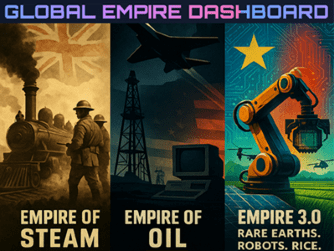
Global Empire Dashboard

We Are Closed. Australia has become corrupted by a corrosive mix of nihilism and embraced a radical liberal ideology that celebrates the rejection of anything from the past that could stabilise society including any inheritance of previous forms of culture. You just have to look at the abuse thrown towards our staff in the past few years to realise this, what is old is no longer deemed necessary & indeed something that must be replaced. We had no choice but to close.

Welcome to Foodstar

India’s Desperation: The Last Ditch Afghanistan Gambit to Provoke Pakistan

🕶️ The Shadow of CAATSA

In 2017, the U.S. Congress passed CAATSA Countering America’s Adversaries Through Sanctions Act, aimed at punishing countries that buy major weapons from Russia, Iran, or North Korea. Once triggered, CAATSA penalties are automatic, no phone call can stop it. No handshake can waive it.

For India, that list hits the core of its arsenal:

  • 🛡️ S-400 missile batteries
  • ✈️ Su-30MKI fighters
  • 🚜 T-90 tanks plus
  • 💸 Tariffs on Indian exports
  • ⚙️ Blocked insurance and Russian spare parts

⚠️ CAATSA is now Locked in

  • 🛢️ Russia is winning in Ukraine, oil cash is surging.
  • 🇮🇳 India keeps buying Russian crude defying Washington’s calls to taper.
  • 🇺🇸 Trump turns the screw linking CAATSA not just to missiles, but to energy.
  • 📆 January 2026: sanctions expand to India

➡️ No waivers. No exceptions. No escape.

Result: Kashmir’s sky becomes collateral damage of India’s energy addiction and Russia’s battlefield success.

🛩️ Pakistan’s Power Play

While India talks, Pakistan upgrades:

  • ⚔️ 40 J-35 stealth fighters due before 2028
  • 🎯 PL-17 long-range missiles (400 km reach)
  • 🛰️ Chinese satellites feeding live targeting data

For the first time in half a century, Pakistan owns the initiative. Its pilots test Indian radars, slip past defenses, and linger longer over the Line of Control.

Since 1971, India’s control over Kashmir has rested on air dominance. That edge is evaporating:

  • 🚫 CAATSA cuts logistics
  • 🧩 Russian spares vanish by 2028

The Kashmir air defense bubble is collapsing.


🎲 Modi’s Last Throw of the Dice

With sanctions closing in and the sky slipping away, Delhi’s strategy turns desperate:
🔥 Stir Afghanistan.
🎯 Pull Pakistan west.
🧨 Force a border flare-up before the air gap widens.

It’s a gambit born of weakness, not confidence a way to delay the reckoning until after the 2029 election. But the timing is brutal: sanctions bite, spares dry up, and Pakistan smells opportunity.
For Modi, the final chapter in the 50-year struggle for Kashmir may read like his greatest promise undone by his own hubris.

🛰️ Power of Siberia: the 4000 km pipe that turns gas into collateral. China is turning Russian energy into kilowatt-hours you can hedge & treat like batteries in a warehouse yuan-backed, dollar-free.

STAGE 1 – the energy-finance flywheel 🚀

1️⃣ 30-yr, 1-trillion m³ take-or-pay → Gazprom locks in a 30-year pay-cheque in yuan. Each locked yuan payment is one less invoice the world needs dollars to settle.

2️⃣ Chinese banks slice the cash-flow → sell bonds today backed by tomorrow’s gas. Every bond sold in yuan pulls investors away from USD-denominated energy debt.

3️⃣ Yuan flows back → buys rigs, rails, ships no SWIFT, no dollars. Equipment priced in yuan means suppliers start quoting parts in CNY, chipping away at dollar invoicing.

4️⃣ Loop repeats → gas pays off old bonds and backs new ones, forever. The endless yuan recycle trains markets to price future energy projects in CNY, not USD.

Result: the first pipeline that prints its own credit, pushing north-south trade without a single greenback.

STAGE 2 – the war-fed printing press 💣

🔥 40 % of Russia’s GDP now goes to tanks and shells.
War-spending keeps Russian gas flowing east, ensuring yuan contracts stay large enough to benchmark against.

🔥 Extra bcm = more yuan bonds = cash for missiles long before the gas arrives.
More bonds deepen yuan liquidity, making CNY the easier currency to trade Russian molecules in.

🔥 India pays yuan for oil; China pays yuan for gas Russia earns, spends and saves in CNY.
When the third-biggest importer settles in yuan, other sellers accept CNY to keep customers, slicing another chunk off dollar demand.

🔥 Yuan is now energy-money embargoes can’t touch it.
A sanction-proof currency option entices more exporters to quote cargoes in yuan, eroding the dollar’s market share.

STAGE 3 – the post-dollar chessboard ♟️

Asia locks in cheap pipe gas.
Cheaper yuan-denominated contracts set a new reference price, pulling neighbouring deals into CNY.

Dollar loses pricing monopoly in 30 % of global gas trade.
Russia-China flows = 10 % of world market, all in yuan; add India/Iran/Qatar and non-USD hits 28-32 % by 2026.
Each non-dollar deal shrinks the pool of cargoes needing USD hedging, so traders quote futures in yuan and central banks trim USD reserves.

Template exported: Kazakhstan, Nigeria, Arctic LNG copy the same trick gas today, yuan loan tomorrow.
More pipelines → more yuan bonds → deeper CNY markets → a self-growing energy bloc that skips Western banks.
Every project removes another sliver of global gas volume from dollar price discovery, marching toward the 30 % tipping point.

The Power of Beauty: How Geography Shapes Prosperity

Humans have long associated physical attractiveness with better job opportunities, healthier lives, and even the controversial notion of genetic “superiority.” Less well known is that Geography also exerts a huge influence on economic destiny. 🌍 Fertile river basins, navigable waterways, rich mineral belts, and soft urban soils create conditions that naturally amplify productivity, innovation, and wealth. 💡 These “geological jackpots” act as silent engines of prosperity, seeding industries, infrastructure, & trade networks long before policy or human ingenuity enters the equation. ⚡ Just as attractive traits can confer outsized advantages in life, exceptional geography often produces outsized economic outcomes.

# Region / Country Type Geographic / Geologic Basis Mechanism / Scale Est (Intl $/yr)
1 Saudi Arabia – Oil Superbasin Hydrocarbon Giant onshore anticlines, easy-access reservoirs Ghawar, Safaniya and other supergiants yield the cheapest crude globally ($3–5 / bbl). Exports fund infrastructure, PIF > $900 B, and sustain the riyal. ≈ $1.0–1.2 T / yr
2 China – Soft, stable Engineering soils Super-Jackpot Infrastructure / Engineering Uniform alluvial plains and soft sedimentary basins Soft, stable soils in megacities (Beijing–Tianjin, Shanghai, Guangzhou) enabled 1 500 km+ of metro tunnelling since 2015, canals, and mega-dams. Centuries of hydraulic expertise now exported via the BRI as turnkey ports, tunnels, bridges, and rails. ≈ $800–900 B / yr
3 United States – Shale Oil & Gas Revolution Hydrocarbon / Unconventional Permian, Marcellus, Bakken shale formations Horizontal drilling + fracking unlocked vast reserves, making the US top energy producer and reviving petrochemicals and manufacturing. ≈ $700–750 B / yr
4 China – Yangtze & Yellow River Basins Agriculture / Water & Transport Twin river flood-plains, loess-rich fertile soils 400 000 km² alluvium supports 40 % of grain and 60 % of cotton; dense inland ports and hydropower (Three Gorges) enable cheap logistics & energy. ≈ $500–600 B / yr
5 United States – Midwest / Mississippi River Basin Agriculture / Transport Network Vast loess plains + world’s largest navigable inland river system Deep fertile soils plus barge network link farms to Gulf ports. Core to US grain, soy, & corn exports; logistics synergy with petro- & manufacturing belt. ≈ $450–500 B / yr
6 Russia – Ural–Siberian Resource Arc Minerals / Energy Immense continental-shield deposits Oil, gas, coal, nickel, and timber exports form ≈ 30 % of GDP and supply Eurasian industry. ≈ $400–500 B / yr
7 Brazil – Commodity Triad + Amazon Basin Agriculture / Mining / Hydro Fertile Cerrado soils, Amazon water, iron ore (Carajás) Major exporter of soy, beef, sugar, bauxite, iron. Hydropower & rainforest hydrology stabilize output. ≈ $400–450 B / yr
8 India – Alluvial Agriculture & River Plains Agriculture / Water Ganges & Indus alluvium Monsoon-fed plains yield 2–3 crops / yr; foundation of national food security & export agriculture. ≈ $300–350 B / yr
9 Norway & Scandinavia – Fjords & Hydrocarbons Hydro / Energy Glacial valleys + North Sea basins Hydropower > 95 % electricity; offshore oil & gas exports feed a $1.5 T sovereign fund. ≈ $250–300 B / yr
10 Australia – Minerals & Energy Exports Mining / Resources Iron ore, coal, LNG, lithium, bauxite Pilbara & east-coast basins deliver A$250 B exports; backbone of trade with Asia. ≈ $250 B / yr
11 Canada – Athabasca Oil Sands Hydrocarbon / Bitumen Vast bituminous sands (northern Alberta) Heavy-oil extraction secures long-term energy; supports western provinces’ fiscal base. ≈ $200–250 B / yr
12 Germany – Rhine–Ruhr Industrial Corridor Strategic / Infrastructure Coal basins + Rhine River transport nexus Lowland corridor integrated coal, iron, and shipping → Europe’s industrial heart; now logistics, chemicals, green-tech cluster. ≈ $200–250 B / yr
13 Qatar – North Field Gas Basin Hydrocarbon Shared reservoir with Iran (South Pars) LNG exports dominate GDP (~55–60 %); Asia & Europe rely heavily on it. ≈ $180–200 B / yr
14 UAE – Offshore & Onshore Oil Belts Hydrocarbon Abu Dhabi supergiant fields High-margin oil revenues fund logistics & tourism diversification (Dubai, Abu Dhabi). ≈ $180–200 B / yr
15 China – Rare-Earth Resource Advantage Strategic / Minerals Inner Mongolia & southern ionic-clay deposits Controls ≈ 80 % of global REO output; anchors EV, turbine, and electronics supply chains. ≈ $150–200 B / yr

🔥 Thorpe Says “burn down” Parliament House; Nation Pretends to Be Shocked

Canberra, the only city whose main export is Question Time, got a rude wake-up when Senator Lidia Thorpe said she’d “burn down” Parliament House. 🚨 AFP jumped into action faster than Scott “I Don’t Hold A Hose, Mate” Morrison sprinting for a Hawaiian cocktail. 🍹

Cue the outrage brigade clutching pearls, while the rest of Australia just shrugged “That’s our Lidia.” Still, the Feds don’t mess around when “Parliament” and “fire” end up in the same sentence. 🔥

Funny thing though Canada’s Parliament actually did go up in flames once, back in 1916. 🇨🇦 The whole joint burned down mid-debate, and no one ever figured out why. Royal commission, wartime paranoia mystery unsolved. 🕵️‍♂️

So maybe let’s all relax, grab some marshmallows, and wait for Canada to text: “Welcome to the Mystery Arson Club, mate.” 🪵🔥

🌐 Top 20 Engineering Feats of the Consumer Internet Age (1995–2025). Au Revoir, and many thanks. From here on, everything will likely be made by AI or the Chinese.

Rank Company Feat What makes it monumental
1 Google PageRank & web-scale search index Turned keyword search into relevance ranking; foundation of the consumer internet as we know it.
Est. Annual Rev.: $290B (80% of Google Ads) | Global User Reach: 4.5B monthly active users
2 Apple iPhone + iOS secure enclave First mass-market smartphone with hardware root-of-trust; >1.5B active devices; template for every mobile OS.
Est. Annual Rev.: $200B (iPhone hardware + services) | Global User Reach: 1.5B active devices
3 Meta TAO distributed social graph Sub-millisecond graph reads at 4B+ QPS; backbone of every like, share, friend request on Earth.
Est. Annual Rev.: $190B (core to Meta’s ad business) | Global User Reach: 4B monthly active users across platforms
4 Google Android OS + Play ecosystem 3B+ active consumers; largest mobile app distribution platform; open-source base for Samsung, Xiaomi, Oppo.
Est. Annual Rev.: $15B (Play Store + licensing) | Global User Reach: 3.7B active devices
5 Apple Apple Silicon (A & M series) First 5nm/3nm consumer chips; >2× perf/W vs x86; forced entire PC industry toward ARM.
Est. Annual Rev.: $235B (powers iPhone/Mac sales) | Global User Reach: 1.8B devices (iPhone/iPad/Mac)
6 Meta React & React-Native Virtual DOM + one-way data flow → dominant UI model for web + mobile apps (Instagram, Netflix, Airbnb).
Est. Annual Rev.: $25B (enables Meta apps + ecosystem) | Global User Reach: 3B+ via top sites/apps
7 Google MapReduce + GFS papers Birth of “big data”; Hadoop, Spark, Snowflake all descend from two Google papers; every consumer log is crunched with these ideas.
Est. Annual Rev.: $50B (underpins Google Cloud/Analytics) | Global User Reach: 4B+ via data-driven services
8 Microsoft Azure hyper-scale cloud Second-largest public cloud; custom SDN, FPGA NICs; runs Xbox Live, Office 365, Teams for hundreds of millions.
Est. Annual Rev.: $75B (Azure direct) | Global User Reach: 500M+ via cloud services
9 Google TensorFlow + TPU First production ML framework + custom ASIC; powers Search, Photos, Translate, YouTube recommendations for billions.
Est. Annual Rev.: $50B (AI features in products) | Global User Reach: 4B+ via ML-powered apps
10 Meta HHVM + Hack 5× PHP speed-up; saved >30% server fleet; kept Facebook.com fast while still on PHP code.
Est. Annual Rev.: $20B (efficiency in ad serving) | Global User Reach: 4B monthly active users
11 Apple Face ID structured-dot 3-D sensing First consumer 3-D face biometrics that can’t be spoofed by photos; <100ms auth on >1B devices.
Est. Annual Rev.: $50B (premium iPhone feature) | Global User Reach: 1.2B enabled devices
12 Google Borg → Kubernetes Planet-scale container scheduler; open-sourced as de-facto cloud OS; runs every major consumer service (Spotify, Pinterest, Snapchat).
Est. Annual Rev.: $50B (GCP + ecosystem) | Global User Reach: 3B+ via containerized apps
13 Microsoft TypeScript + VS Code language server Gradual-typed JavaScript → most-loved language; LSP protocol now powers every major IDE (Vim, JetBrains, Eclipse).
Est. Annual Rev.: $30B (dev tools + GitHub) | Global User Reach: 100M+ developers
14 Meta Cassandra master-less NoSQL Blueprint for DynamoDB, Cosmos DB, ScyllaDB; Netflix, Apple, Instagram still use CQL daily.
Est. Annual Rev.: $15B (data infra for ads) | Global User Reach: 4B via reliant platforms
15 Apple Retina display + flexible OLED bonding Forced entire supply chain to high-DPI mass production; every flagship phone now >400 ppi.
Est. Annual Rev.: $50B (display tech in devices) | Global User Reach: 2B+ smartphone screens
16 Google Spanner globally-consistent SQL First horizontally-scaled, multi-region RDBMS with external consistency; consumer finance, Play Store, Stadia rely on it.
Est. Annual Rev.: $20B (core DB for services) | Global User Reach: 2B+ Play/Finance users
17 Microsoft DirectX 12 Ultimate + ray-tracing PC gaming API that defined RTX, variable-rate shading; Xbox Series X & Windows share same binary.
Est. Annual Rev.: $24B (Xbox + Windows gaming) | Global User Reach: 200M+ gamers
18 Meta PyTorch Dynamic compute graphs → de-facto standard for AI research; >60% NeurIPS papers; powers Instagram Reels, Oculus hand-tracking.
Est. Annual Rev.: $25B (AI in Meta products) | Global User Reach: 4B via AI features
19 Apple Swift language + ABI stability Memory-safe, fast successor to Obj-C; entire Apple ecosystem (watchOS→macOS) now Swift-first.
Est. Annual Rev.: $30B (ecosystem dev efficiency) | Global User Reach: 2B iOS/macOS devices
20 Microsoft Office 365 real-time co-authoring engine Sub-100ms operational-transform for Word, Excel, Teams; 400M+ monthly active docs edited simultaneously.
Est. Annual Rev.: $100B (M365 subscriptions) | Global User Reach: 400M+ monthly users

The Nobel Peace Prize Isn’t Peaceful: It’s a Western PR Tool. 780k demanded Julian Assange’s freedom; 117k nominate him for the Nobel Peace Prize. The prize no longer honors peace; it manufactures consent.

Machado: Don’t Cry for me Venezuela, the Truth is I never loved you!

✍️ Signature Counts That Didn’t Count

🔹 Free Julian Assange petition: 780,000 signatures
🔹 Nobel Peace Prize for Assange petition: 117,432 signatures
🔹Nobel Committee reaction: silence.

Meanwhile, the 2025 laureate is María Corina Machado, a U.S.-backed Venezuelan opposition leader bankrolled by the same agencies that tried to topple Maduro in 2019.

2009: Barack Obama, commander-in-chief of two wars, wins the medal before the ink on his drone orders dries.
2021: Filipino Maria Ressa, a CNN alumnus and Pentagon-friendly pundit, shares it with a Russian journalist perfect “West good, East bad” symmetry.
2025: Machado, who’s never negotiated a cease-fire, signed a peace accord, or stopped a single bullet.

The Nobel Peace Prize now rewards narratives, not negotiations.


Why Assange will never win

Assange exposed the machine: U.S. war logs, CIA cyber-weapons, State Department coups.
The Nobel Committee needs the machine.
Giving him the prize would legitimize the idea that telling the truth about Western wars is a contribution to peace.
Unthinkable.

Oslo will pin the medal on a warmonger before it honors heroes.

Venezuela’s counter-punch

Within 72 hours of Machado’s coronation, Caracas announced it is padlocking its embassies in Norway and Australia.

  • Norway hosts the Nobel ceremony closing the mission is a slap at the political theater without touching the “independent” committee.
  • Australia recognized Juan Guaidó in 2019, funnels sanctions talking-points at the UN, and hosts the Pine Gap spy base feeding intel to U.S. Southern Command.

The bigger picture

The Nobel Peace Prize is no longer a moral compass; it’s a PR arm of NATO’s narrative department.
When a Western-backed activist wins, media calls it “the world speaking.” When Caracas re-allocates its diplomats, media calls it “tantrum diplomacy.” Both stories prove the same point: the prize is about power, not peace.

When Oslo applauds “courage,” it means courage approved by Washington.

The Liberal Circular Referencing Loop: How Every ‘Independent’ News Piece You Read Secretly Quotes Itself

Western news is a Möbius strip: the same wire copy exits the back of the New York Times, re-enters through the front page of the Guardian, and is then cited by the State Department press release that the Times quotes the next morning. Call it the Liberal Circular Referencing Loop (LCRL). Once you see the seam you can’t un-see it.

State Dept → Atlantic Council → AP: the self-sealing pipeline

a. Seed – A “senior official” slips a 200-word steer to AP, Reuters, AFP before dawn.
b. Syndication – By breakfast 2 300 sites run the identical paragraph, each slapping on its own click-bait headline.
c. Boost – Google ranks the clones as “Highly Cited”; YouTube surfaces a CNN segment that just reads the wire aloud.
d. Launder – Atlantic Council issues a “policy brief” footnoting three of those copies, giving the claim scholarly paint.
e. Bless – At noon the State Department spokesman cites “multiple reports from respected outlets and think-tanks” without ever naming the original official.
f. Canonise – Next day the New York Times prints “U.S. Officials Say X, Multiple Sources Confirm” and hyperlinks back to CNN, the Atlantic Council … and its own yesterday’s story.

Proof? Put this into Chatgpt and see the response: “draw a picture of a Möbius strip with AP, Reuters, AFP at one end, State Department, Atlantic Council in the middle and CNN, MSNBC, FOX, New York Times at the other end”

💥 Trump’s Tariff Fluster Has Triggered S&P500 Market Losses Matching COVID-19’s Worst Days

The 2020 COVID crash caused historic single-day losses. In 2025, Trump’s tariff blitz has hit just as hard.
The five biggest tariff-driven selloffs erased $9.64 trillion, nearly equal to COVID-19’s $9.69 trillion total.

📉 October 10, 2025: another $1.65 trillion gone, showing how policy chaos can move markets like a pandemic did. Using the S&P 500 (≈80% of U.S. market value), we compared both eras. COVID’s drops were deeper in percentage terms, but today’s larger market makes losses just as massive in dollars.


Top 5 Biggest Single-Day S&P 500 Absolute Losses Due to COVID-19

These are the largest point declines (and corresponding market cap losses) during the 2020 COVID-19 crash period, based on official S&P 500 data.

Rank Date Point Loss % Decline Approx. Market Cap Loss Notes
1 March 16, 2020 -324.89 -11.98% $2.76 trillion Escalating global COVID-19 fears triggered circuit breaker halts and the largest single-day percentage drop since 1987.
2 March 12, 2020 -268.34 -9.51% $2.28 trillion WHO’s declaration of COVID-19 as a global pandemic, combined with travel bans and economic shutdown announcements.
3 March 9, 2020 -225.81 -7.60% $1.92 trillion Saudi-Russia oil price war exacerbated COVID-19 travel restrictions and supply chain disruptions.
4 June 11, 2020 -188.04 -5.89% $1.60 trillion Rising concerns over a potential second wave of U.S. COVID-19 cases after initial reopenings.
5 March 18, 2020 -133.37 -5.18% $1.13 trillion Ongoing panic from nationwide lockdowns and Federal Reserve emergency measures amid deepening recession fears.

Subtotal for COVID-19 Top 5 Losing Days: $9.69 trillion
Calculation: $2.76T + $2.28T + $1.92T + $1.60T + $1.13T = $9.69T

Top 5 Biggest Single-Day S&P 500 Absolute Losses Due to Trump Tariffs

These are the largest point declines (and corresponding market cap losses) attributed to Trump tariff announcements/escalations in 2025, based on official data up to October 11, 2025.

Rank Date Point Loss % Decline Approx. Market Cap Loss Notes
1 April 4, 2025 -322.44 -5.97% $2.74 trillion Follow-up selloff after initial tariff rollout, wiping out $5T over two days amid fears of global trade disruptions.
2 April 3, 2025 -267.96 -4.73% $2.28 trillion President’s announcement of broad new tariffs on imports, sparking the worst day since the 2020 COVID crash.
3 October 10, 2025 -182.60 -2.71% $1.65 trillion Renewed presidential threats of “massive” tariff hikes on Chinese goods, reigniting U.S.-China trade war fears.
4 April 10, 2025 -188.85 -3.46% $1.61 trillion Market reaction to expanding tariff scope, hitting tech and manufacturing sectors hardest in ongoing trade tensions.
5 April 5, 2025 -160.00 -2.90% $1.36 trillion Chaotic early implementation of reciprocal tariffs, leading to supply chain panic and investor flight from risk assets.

Subtotal for Trump Tariffs Top 5 Losing Days: $9.64 trillion
Calculation: $2.74T + $2.28T + $1.65T + $1.61T + $1.36T = $9.64T

Easy Money, Let Justice prevail, Do the right thing! Xiamen Police invites your help to hand these criminals over to the Public Safety Bureau.

Name, Sex, ID number of Taiwan Province, China. Bring those who abscond from the Law to Justice.

Row 1

  1. 颜嘉宏 男
    Yán Jiāhóng — Male
    ID: F124399368
  2. 周宜庆 男
    Zhōu Yíqìng — Male
    ID: E124832858
  3. 顾哲豪 男
    Gù Zhéháo — Male
    ID: A125240994
  4. 张俊敏 男
    Zhāng Jùnmǐn — Male
    ID: K122110167
  5. 王正平 男
    Wáng Zhèngpíng — Male
    ID: I100016805
  6. 王圣谦 男
    Wáng Shèngqiān — Male
    ID: F125802257

Row 2

  1. 张洛郡 男
    Zhāng Luòjùn — Male
    ID: A126415655
  2. 张子扬 男
    Zhāng Zǐyáng — Male
    ID: A128500666
  3. 萧佳和 男
    Xiāo Jiāhé — Male
    ID: H124207045
  4. 洪翊旸 男
    Hóng Yìyáng — Male
    ID: A130206280
  5. 许翔 男
    Xǔ Xiáng — Male
    ID: F128575113
  6. 吕光耀 男
    Lǚ Guāngyào — Male
    ID: F129316314

Row 3

  1. 何冠威 男
    Hé Guānwēi — Male
    ID: B122806124
  2. 林玮伦 男
    Lín Wěilún — Male
    ID: G121739129
  1. 黄淑卿 女
    Huáng Shūqīng — Female
    ID: F223409974
  2. 吴宛蓉 女
    Wú Wǎnróng — Female
    ID: R223424505
  3. 黄雅琦 女
    Huáng Yǎqí — Female
    ID: F227657930
  4. 陈奕铭 男
    Chén Yìmíng — Male
    ID: A126771470

Andrew Hastie’s Nigel Farage-style ReformUK cos-play will be dead on arrival.

Hastie is not a fringe back-bencher anymore; he is the most visible symbol of a Nationalist caucus that wants to import the Farage/MAGA playbook.
– Resigned shadow cabinet explicitly to “speak freely on immigration” (code for cutting the permanent intake and re-opening boat turn-backs as a culture-war wedge).
– Uses exactly the same rhetorical sequence you hear from Reform UK or CPAC: “Western values under siege”, anti-net-zero as sovereignty issue, etc.

Problem: 🇦🇺 Australia is a forward-settled European colony masquerading as a country. It cannot adopt populist policies like the UK’s Reform UK or Trump’s “America First” without risking alienation of its neighbors and sparking conflict.

🌍 Europe also can’t produce another post-WWII-style migrant wave to populate Australia via Italians or Greeks because women have chosen careers and cats 🐱 over babies 👶 and traditional families 👨‍👩‍👧‍👦.

Trump’s Caribbean missile was meant to stop drugs. Instead, it may have stopped America’s lithium supply chain.

Last week, a US missile strike in the Caribbean made headlines, but not for the reason Washington intended. The target, described as a drug-running vessel, turned out to be Colombian⚓, killing several citizens and sparking an immediate backlash from Bogotá. President Gustavo Petro denounced the attack as “a war for oil” 🛢️, expelled U.S. counter-narcotics advisors, and froze all future arms purchases 🛑.

At first glance, it might look like routine Latin American drama. But Colombia isn’t just exporting cocaine. Its lithium, copper, and rare earth deposits ⚡🔋 are critical to the electric-vehicle and clean-energy industries, and Petro’s retaliation risks sending them straight into Beijing’s hands 🇨🇳.

1. Why Colombia Matters to the EV Era

  • Copper 🟤: Colombia is the #3 supplier to the U.S. after Chile and Peru. Pentagon planners had quietly booked 45 kt of Colombian cathode copper for 2026–28 stockpiles.
  • Lithium brine 🔋: Though smaller than the “Lithium Triangle,” Colombia’s Andean salars hold ~1.2 Mt of recoverable Li₂CO₃ — exactly the feedstock GM, Ford, and Tesla are counting on for new U.S. gigafactories.
  • Rare earths ⚙️: The same southern provinces Washington calls “coca corridors” Huila and Nariño sit atop niobium and light-REE clay deposits flagged by the U.S. Geological Survey as critical defense inputs.

In short, Colombia is more than a drug battleground; it’s a strategic supplier of metals that power EVs, grids, and defense tech.


2. Petro’s Retaliation List

  • Suspend all new U.S. mining concessions until “reparations are paid” 💰 for the strike.
  • Fast-track three Chinese-led lithium brine projects (Ganfeng, CATL, MMG) previously stalled in environmental review 🌱.
  • Join Bolivia’s call for an OPEC-style “Lithium Alliance” 🏭, excluding U.S. participation.
  • Impose a 25 % export tariff on copper concentrate and ferronickel headed for U.S. smelters 📈, effective January 1, 2026.

The message is clear: Washington’s misfire has opened the door to Beijing in Colombia’s mineral sector.

3. Washington’s New Headache

  • Lithium supply at risk 🔋: The U.S. Energy Department’s 5 % equity stake in Lithium Americas assumed 18 kt/year of Colombian brine to feed GM’s Nevada cathode plant. That supply line is now in jeopardy.
  • Copper costs rising 🟤: Each $1,000/ton increase on the LME adds roughly $350 million to U.S. transformer, wiring, and EV-motor costs. Prices jumped 4 % in 36 hours, with traders now pricing in a 15 % Colombian shortfall for 2026.
  • China’s Trojan horse 🇨🇳: Beijing immediately offered $2 billion in concessional loans for Colombian rail and port upgrades. In exchange, CATL reportedly gets first refusal on two lithium salars formerly earmarked for American miners.

This isn’t just a diplomatic headache, it’s a potential supply-chain crisis at the exact moment U.S. EV manufacturers and battery projects are ramping up.


4. The Bottom Line

Trump’s “surgical” anti-drug missile may have destroyed one boat 🛥️, but it also torpedoed the last goodwill keeping U.S. miners inside Colombia’s resource ledger. If Bogotá follows through on its lithium and copper measures, Washington could lose 8–10 % of its clean-metal pipeline just as the Inflation Reduction Act’s made-in-America battery rules start binding.

The strike meant to save American lives could instead export thousands of EV jobs and the lithium that powers them straight to Beijing 🇨🇳.

From Bipolarity to Multipolarity: Winners 🇮🇱 Israel & 🇵🇰 Pakistan, Losers 🇩🇪 East Germany & 🇵🇱 Poland

The Cold War (1947–1991) pitted Global North powers in a rigid bipolar clash: U.S.-led NATO against the Soviet Warsaw Pact and proxies. Ideology fueled containment and global proxies, but Europe’s industrial might dominated, with the Global South as minor players via aid or non-alignment.

US Top Cold War Allies

# Country Reason for Importance
1🇬🇧 United KingdomClosest military and intelligence partner; key in NATO and nuclear strategy.
2🇨🇦 CanadaNORAD partner; critical for Arctic defense and U.S. continental security.
3🇩🇪 West GermanyFrontline state against Warsaw Pact; hosted major U.S. military bases.
4🇯🇵 JapanKey Asian ally post-1952; hosted U.S. bases and countered Soviet/Chinese influence.
5🇫🇷 FranceFounding NATO member; nuclear power; key in European defense (despite later withdrawal from NATO command).
6🇮🇹 ItalyStrategic location in Mediterranean; hosted U.S. bases; NATO member.
7🇰🇷 South KoreaFrontline ally in Korean War and against communist North Korea.
8🇹🇷 TurkeyControlled Bosphorus Strait; hosted U.S. missiles; key in Middle East containment.
9🇦🇺 AustraliaANZUS pact member; supported U.S. in Vietnam and Pacific containment.
10🇮🇱 IsraelKey Middle Eastern ally post-1960s; intelligence and military cooperation.
11🇪🇸 SpainAllowed U.S. military bases; strategic for Mediterranean and Atlantic control.
12🇬🇷 GreeceNATO member; key for controlling Eastern Mediterranean.
13🇧🇪 BelgiumNATO headquarters; symbolic and logistical hub of Western alliance.
14🇳🇱 NetherlandsStrong NATO contributor; strategic North Sea location.
15🇵🇭 PhilippinesHosted major U.S. bases; key in Southeast Asia strategy.

USSR Top Cold War Allies

# Country Reason for Importance
1🇩🇪 East GermanyFrontline of Warsaw Pact; symbol of Soviet power in Europe.
2🇵🇱 PolandLargest Warsaw Pact member after USSR; critical military and logistical base.
3🇨🇳 China (early)Major communist ally until Sino-Soviet split; shared ideology and resources.
4🇨🇺 CubaOnly communist state in the Western Hemisphere; hosted Soviet missiles; spy base.
5🇨🇿 CzechoslovakiaIndustrial and military contributor; key Warsaw Pact member.
6🇭🇺 HungaryStrategic location; suppressed 1956 uprising with Soviet help.
7🇻🇳 Vietnam (North)Received massive Soviet aid; fought U.S. in Vietnam War.
8🇧🇬 BulgariaMost loyal Soviet satellite; obedient and strategically located near Turkey.
9🇷🇴 RomaniaWarsaw Pact member; though sometimes independent, remained in Soviet orbit.
10🇰🇵 North KoreaSoviet-backed regime; buffer against U.S.-aligned South Korea.
11🇲🇳 MongoliaBuffer state between USSR and China; hosted Soviet troops.
12🇪🇹 EthiopiaKey African ally after 1977; received major military aid and Cuban support.
13🇸🇾 SyriaReceived Soviet weapons and support; key Middle Eastern ally.
14🇦🇴 AngolaSoviet-backed MPLA came to power; Cuban troops supported by USSR.
15🇪🇬 Egypt (early)Received Soviet arms and aid until 1970s shift to the U.S.

By 2025, a multipolar world features three superpowers U.S., China, Russia navigating economic ties, tech races, and hotspots. The U.S. upholds democratic security pacts; Russia clings to post-Soviet dependencies and anti-West revisionism; China wields Belt and Road economic influence in the developing world. Alliances have shifted from ideology to pragmatic projection in overlapping spheres.

Winners: Israel (elevated by post-9/11 terror wars, media dominance, and U.S. tech/intel ties); Pakistan (China’s “Israel” in South Asia, countering an expansionist India).

Losers: East Germany (absorbed as West Germany’s and thus U.S.’s vassal); Poland (USSR’s elite ally, now a disposable US frontline “used condom”).

🇺🇸 USA — Top 10 Allies 🇨🇳 China — Top 10 Allies 🇷🇺 Russia — Top 10 Allies
1. 🇬🇧 United Kingdom
2. 🇮🇱 Israel
3. 🇯🇵 Japan
4. 🇩🇪 Germany
5. 🇫🇷 France
6. 🇨🇦 Canada
7. 🇰🇷 South Korea
8. 🇦🇺 Australia
9. 🇮🇹 Italy
10. 🇸🇦 Saudi Arabia
1. 🇷🇺 Russia
2. 🇵🇰 Pakistan
3. 🇮🇷 Iran
4. 🇰🇵 North Korea
5. 🇰🇭 Cambodia
6. 🇷🇸 Serbia
7. 🇻🇪 Venezuela
8. 🇨🇺 Cuba
9. 🇱🇦 Laos
10. 🇿🇦 South Africa
1. 🇧🇾 Belarus
2. 🇨🇳 China
3. 🇦🇲 Armenia
4. 🇰🇿 Kazakhstan
5. 🇰🇬 Kyrgyzstan
6. 🇮🇷 Iran
7. 🇹🇷 Turkey
8. 🇻🇳 Vietnam
9. 🇰🇵 North Korea
10. 🇿🇦 South Africa
Notes: Key NATO and democratic partners; strong military, economic, and intelligence ties; Middle East influence via Israel and Saudi Arabia; Indo-Pacific presence via Japan, South Korea, Australia. Notes: Strategic allies through economic, military, and political ties; focus on regional influence (Asia, Middle East, Latin America, Africa); often united by anti-Western or development-oriented policies. Notes: Mix of post-Soviet states, regional allies, and anti-Western partners; alliances based on security, energy, and military cooperation; bridging Europe, Middle East, and Asia.