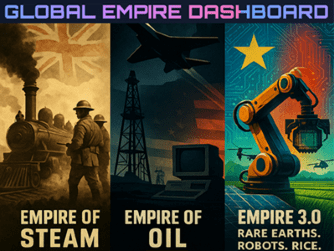
Global Empire Dashboard

We Are Closed. Australia has become corrupted by a corrosive mix of nihilism and embraced a radical liberal ideology that celebrates the rejection of anything from the past that could stabilise society including any inheritance of previous forms of culture. You just have to look at the abuse thrown towards our staff in the past few years to realise this, what is old is no longer deemed necessary & indeed something that must be replaced. We had no choice but to close.

Welcome to Foodstar

Frydenberg barred China from a lowly contract builder; Victoria now wants Beijing inside the balance sheet & prime partner for a rail line that will outlast four generations of Victorians.

In 2021 Josh Frydenberg looked Beijing in the eye and killed a $300m takeover of builder Probuild, declaring “national security says no.” Probuild collapsed shortly after, taking out thousands of jobs & billions in unfinished projects.

Four years later Victorian Treasurer, Jaclyn Symes, is one cabinet tick away from saying “yes please” to $30-50 bn & China becoming the prime 50-year partner bank-rolling Victoria’s Suburban Rail Loop. Same country, different spreadsheet. The security gate closed; the economic door is now open.

1. The Beijing photo-op that matters

Symes quietly lodged her overseas travel return on 26 Aug: “Meetings with China Development Bank, 17-19 Aug 2025, Beijing.”
The CDB’s own social-media feed shows her shaking hands with vice-president Liu Zhongyi under the bank’s Sanlitun HQ chandelier.

Translation: term-sheet negotiations are board-resolution away from becoming a cabinet submission this Spring.

2. Why Victoria caved

  • COVID bill: $69.5 bn lost state output, longest lock-downs on Earth.
  • Net debt: ≈ 25 % of GSP; interest on track to eat 8 % of all revenue by 2026.
  • Moodys/S&P road-show (New York, Sept 2025): Symes was told by Moody’s that Victoria will only “Keep AA if you borrow less.”
    Political poison to stop SRL or borrow more, either way.

3. The secret sauce in the leaked SRL term-sheet

  • 25-year bullet, coupon 3 %
  • Local-content floor 30 % steel, signalling, tunnellers can all be imported.
  • Student-fee conduit: Melbourne universities bill Shanghai families in RMB; proceeds sweep straight to China Development Bank.
    Moana scholarships for Pacific Islanders to study in both Shanghai & Melbourne learning from the best of East & West.
  • Most-favoured-state clause: any other Aussie borrower gets the same grid within five years: hello Tasmania, hello Queensland 2032 Olympics.

4. Domino #1 – Tasmania by the numbers

  • Population: 550 k; net debt already 180 % of revenue.
  • Interest bite: 6 % today → 8 % if downgraded (erasing Canberra’s GST top-up).
  • Macquarie Point stadium + cruise terminal: ~A$2 bn.
    Treasury’s printed fix: copy-paste the Victorian facility, swap “rail” for “stadium”, keep the AA+ façade intact.

Once two states refinance outside the Moody’s universe, domestic super-funds lose volume, liquidity thins, everyone else’s cost of capital rises except the states inside the Chinese tent. Net result: a two-speed federation where Beijing sets the price of infrastructure & Canberra watches with Envy.

Why 🇨🇳 China is Letting TikTok Go

TikTok might be sold in the US & some are saying it’ll a loss for China 🇨🇳. In fact, this move tells us more about the next phase of global tech competition than it does about TikTok itself.

📱 TikTok: More Than Just an App

TikTok for China 🇨🇳 was a strategic asset:

  • In 2020, the Chinese Ministry of Commerce 🇨🇳 restricted the export of TikTok’s personalized recommendation algorithm. That means Beijing could legally block anyone from taking its “secret sauce”
  • Chinese leaders 🇨🇳 flagged mobile-platform ecosystems as critical “choke points” in global tech. TikTok wasn’t a social app, it was part of a national tech strategy
  • ByteDance founder Zhang Yiming planned for TikTok to be at the heart of a broader digital ecosystem, one designed for the 6G and satellite-powered future

🚀 6G Challenger to iOS/Android duopoly

TikTok was meant to be a super-app which lay the foundations of the next-gen mobile ecosystem capable of challenging the iOS/android duopoly:

  • The official “6G Vision 2030” called for domestic OSes capable of supporting integrated super-apps
  • ByteDance patented innovations like satellite-backed video caching and low-orbit hand-offs, engineering TikTok for a 6G world
  • In 2023, a closed-door demo showed TikTok integrated into a WeChat-style interface, streaming over a simulated 6G link

Then the tech landscape shifted


🤖 The AI-Native OS Revolution

Enter the new battlefield: AI-first operating systems

  • Western innovators like OpenAI and xAI are developing AI-native devices that bypass traditional apps altogether
  • Chinese 🇨🇳 companies like Baidu and Huawei are racing to create AI-native interfaces such as PanGu-UI, aiming to leapfrog the app era
  • Regulators in Beijing 🇨🇳 shifted priorities: by early 2024, short-video platforms were downgraded, and AI operating environments became the new “core infrastructure”

TikTok’s unique strategic leverage? Gone.

💰 The Sale: Smart Strategy, Not Surrender

With AI-native platforms taking center stage, TikTok’s strategic value had diminished. The potential sale? Not a loss, a tactical pivot:

  • Beijing 🇨🇳 signaled that a sale that protects Chinese ownership and keeps the algorithm domestic would be acceptable
  • Leaked term sheets show the deal extracting financial value while safeguarding strategic assets
  • Insider reports suggest regulators 🇨🇳 now see “diminishing strategic upside” in holding TikTok, the real action is in AI

China 🇨🇳 isn’t retreating. It’s refocusing


🌐 Why This Matters

TikTok’s sale isn’t the end of China 🇨🇳’s tech ambitions, it’s a signal. The social-video app that once threatened the U.S. tech is being sidelined in favor of AI-native operating systems, now seen as the decisive battlefield for the next decade

Takeaway: In global tech, the game moves fast. Assets rise and fall in strategic value, and China 🇨🇳 is playing the long game. TikTok is just one move on a much larger chessboard

🇺🇸⚔️🇻🇪 Charlie Kirk May Have Just Saved Venezuela from US Invasion

Charlie Kirk made himself famous for turning up on college campuses to debate liberal arts students, turning jailbait into clickbait. He was also one of MAGA’s loudest youth megaphones. His untimely death on September 10, 2025 has shifted Washington’s priorities.

Just days earlier, the U.S. seemed poised to strike Nicolás Maduro’s regime: a deadly speedboat attack killed 11 civilians, 4,500 troops and F-35s were deployed to the Caribbean, and Trump was calling Maduro a “narco-terrorist dictator.”

But Kirk’s killing ignited fears of civil conflict at home. Instead of marching south, Trump now faces a fractured nation.

⚔️ Before the Shooting: The Warpath to Caracas

  • 📅 Sept 2 – U.S. jets sink a Venezuelan boat, killing 11 civilians. Pentagon calls it “drug interdiction.” Caracas calls it murder.
  • 🚢 Build-up – Troops, warships, and F-35s move into striking range.
  • 🗣️ Trump – Talks of a “Panama-style liberation.”
  • 💰 $50M bounty – Targets Maduro’s circle.

Kirk amplified it all: on X, podcasts, and Fox News tying Venezuela to US crime, cartels & border chaos.

His viral posts included:

  • 📢 July 2024: Maduro’s “house of cards is collapsing.” (40k likes)
  • 📢 Jan 2025: Venezuelan migrants tied to U.S. crime. (37k likes)
  • 📢 Sept 2025: Praised the speedboat strike as “military might.”

Together with Marco Rubio and Fox hawks, Kirk gave Trump cover to escalate.

💥 The Assassination Flips the Script

Kirk’s murder lit up the MAGA world. Trump lowered flags, attended the funeral, vowed to crush “radical ideologies,” and probed foreign nationals celebrating the act.

But the fallout turned inward:

  • ⚠️ 60% of Americans now fear political violence.
  • 📺 Fox News shifted coverage from Maduro to Kirk-as-martyr.
  • 🔥 MAGA influencers redirected rage toward the U.S. left.

The Venezuela strike and invasion talk vanished from headlines overnight.

“In a single moment, the mission shifted from liberating Venezuela to wondering if the United States itself needed liberating from its own internal rot.”


🧨 Trump’s War Options Collapse

Before, Trump had:

  1. 📺 A loud MAGA media chorus.
  2. 🏛️ GOP hawks like Rubio.
  3. 🚧 A “border security” narrative linking Venezuela to U.S. chaos.

Now its all vanished along with Kirk.


🌴 Venezuela Breathes Easier

Maduro has gone quiet, letting U.S. chaos speak for itself. Analysts expect him to:

  • 📣 Spin Kirk’s death as proof of U.S. collapse.
  • 🤝 Court Russia/China for “peacekeeping.”
  • 📰 Cement propaganda victories.

Ironically, an American tragedy gave him the biggest reprieve in years.

“Trump’s ‘America First’ doctrine was put to the ultimate test: when faced with a foreign threat and a domestic crisis, the homeland must always come first. Venezuela was granted an unexpected pardon.”


🔮 The Bigger Picture

Charlie Kirk’s death flipped America’s focus inward:

  • ⚠️ Civil war fears trump foreign war talk.
  • 🛡️ Domestic security takes priority.
  • 🇻🇪 Venezuela survives not by strength but by America’s distraction.

MAGA is silenced and vengeful for internal enemies. Rubio still pushes strikes, but without Kirk’s megaphone, momentum is gone. Public opposition (70%) seals it: foreign war now looks like political suicide, not strength.

Hear it from Vanuatu to Fiji, from Samoa to Rapa-Nui 🌊Pacifika Voices Have Been Heard at the ICJ. How the ICJ’s Climate Ruling Could Make Australia the Most Exposed Fossil Fuel Nation

The International Court of Justice (ICJ) has issued an advisory opinion declaring that countries have a legal duty to protect the climate. For Pacific islands, this is historic but the implications vary depending on a country’s power, wealth, and emissions.


⚖️ The Ruling in Brief

  • 🌍 Obligation to Protect: Countries must prevent climate harm, especially to vulnerable nations.
  • Liability Risk: Failure to act could make countries responsible for climate damages.
  • 📝 Advisory: Not enforceable, but carries moral, political, and diplomatic weight.
🌟 🏆 Winners Why They Win
🏝️ Pacific Islands Legal recognition, climate finance leverage, youth empowerment
👩‍👩‍👦 Youth & Activists Campaigns validated internationally, stronger advocacy
🇨🇳 China Can export renewable infrastructure as “compliance in kind”
💀 Losers Why They Lose
🛢️ Australia Medium power, high emissions, vulnerable to compensation claims
🇺🇸 US Superpower, still fossil-reliant; compliance would require cash
🇷🇺 Russia Fossil-heavy economy; enforcement unlikely but reputational risk

🌞 Why China Can Ship Solar Panels

  • China leads globally in solar panels, wind turbines, and EV tech.
  • Can deliver tangible mitigation by sending renewable infrastructure to Pacific islands.
  • Example: 🚢📦 Solar panels → reduced fossil fuel use → counts as compliance.

💵 Why US, Russia, Australia Can’t

  • Limited renewable export capacity at scale.
  • Compliance would require financial contributions for climate adaptation.
  • Cannot claim “direct mitigation” like China.

🛡️ Superpowers vs Middle Power

Country Status Implication
🇺🇸 US Superpower Hard to sue; advisory opinion carries moral weight only
🇷🇺 Russia Superpower Same as US; liability is mostly diplomatic
🇦🇺 Australia Middle power Vulnerable; exposed to legal & diplomatic pressure

⚡ Bottom Line

  • 🇨🇳 China: Has turned its factories into a compliance machine; solar containers = legal absolution.
  • 🇺🇸🇷🇺 US & Russia: Litigation-proof only because they are too big to sue not because they are innocent.
  • 🇦🇺 Australia: Big enough to owe, small enough to be sued, and rich enough to pay the most exposed piece on the board, now that the Court has ruled the ocean itself can issue a summons.

Top 20 Public & Private High Schools in Australia, ranked by NAPLAN Performance 2025

🏆 Top 20 Public High Schools in Australia (2025)

# School State Sex Notes
1 Conservatorium High School NSW Co-ed 7.5 : 1 student-teacher, 84 % attendance
2 Hurlstone Agricultural High School NSW Co-ed Selective agri-college, western Sydney
3 Parramatta High School NSW Co-ed Strong Year-7 & 9 NAPLAN band 9-10 %
4 James Ruse Agricultural High School NSW Co-ed Aus. #1 ATAR school 1996-2024
5 North Sydney Boys High School NSW Boys 2024 median ATAR 96.7
6 Suzanne Cory High School VIC Co-ed 91 median ATAR, Werribee selective
7 Baulkham Hills High School NSW Co-ed 96+ median ATAR past 5 yrs
8 Mac.Robertson Girls’ High School VIC Girls Victoria’s oldest selective girls’ school
9 Hornsby Girls High School NSW Girls Consistent 95+ median ATAR
10 Perth Modern School WA Co-ed WA’s only fully-selective public 7-12
11 Fort Street High School NSW Co-ed First gov-selective H.S. in Aus. (1849)
12 Northern Beaches Sec. Coll. (Manly) NSW Co-ed Selective campus, 95 median ATAR
13 Penrith Selective High School NSW Co-ed Western-Sydney academic hub
14 Caringbah High School NSW Co-ed 2025 NAPLAN mean 695
15 St George Girls High School NSW Girls 94 median ATAR, Kogarah
16 Queensland Academy SMT QLD Co-ed IB + QCE, 97 % OP 1-5 equiv.
17 Merewether High School NSW Co-ed Newcastle selective, 94 median ATAR
18 Sydney Technical High School NSW Boys STEM-focused, Bexley
19 Gosford High School NSW Co-ed Central-Coast selective
20 Smith’s Hill High School NSW Co-ed Wollongong selective, 93 median ATAR

🏆 Top 20 Private High Schools in Australia (2025)

# School State Sex Notes
1 Sydney Grammar School NSW Boys #1 NSW primary NAPLAN (Yr 3&5 avg 595.5); top-3 HSC
2 Haileybury College VIC Co-ed #2 in the country overall; Vic’s top co-ed school
3 Presbyterian Ladies’ College (PLC) Melbourne VIC Girls Strong VCE & NAPLAN; STEM focus
4 Scotch College VIC Boys Top VCE/IB; 150 yr heritage
5 Brisbane Grammar School QLD Boys Highest QLD NAPLAN & ATAR for boys
6 The King’s School NSW Boys Oldest Aus independent school; top HSC
7 St Peter’s College SA Boys SA’s highest ATAR & NAPLAN for boys
8 Abbotsleigh NSW Girls #2 NSW primary NAPLAN (553.1)
9 Pymble Ladies’ College NSW Girls Top-5 NSW primary NAPLAN (546.6)
10 Knox Grammar School NSW Boys High HSC bands; 99.95 ATARs
11 Loreto Kirribilli NSW Girls Consistently high NAPLAN & HSC
12 SCEGGS Darlinghurst NSW Girls Top-10 HSC; strong NAPLAN
13 Reddam House NSW Co-ed 54.94 % HSC top-band; fast-rising
14 Ascham School NSW Girls Dalton Plan; high HSC
15 Cranbrook School NSW Boys Elite HSC; co-curricular breadth
16 Geelong Grammar School VIC Co-ed IB & VCE; Timbertop program
17 Hale School WA Boys WA’s leading boys’ ATAR & NAPLAN
18 Brisbane Girls Grammar School QLD Girls Top QLD girls’ NAPLAN & ATAR
19 St Leonard’s College VIC Co-ed Only other co-ed in national top 20
20 Wilderness School SA Girls SA top-3 NAPLAN & SACE

🌏 Dan made it a habit of visiting China to witness the Superpower rising next door, Jacinta Allen will make it visit Number 8

Daniel Andrews made engagement with China a central pillar of Victoria’s economic strategy. His official visits reinforced the Victoria-China Action Plan, involving high-level meetings with senior Chinese officials, including Party Secretaries and Governors. These trips strengthened Victoria’s economic relationship with China, supporting $40 billion in annual trade, fostering student exchange programs, and facilitating joint economic committees to promote ongoing collaboration.

🧑‍💼 Daniel Andrews (Premier 2014–2023)

7 visits as Premier — the most of any Victorian leader.

2015 → First official visit, trade & investment

2016 → Infrastructure & Belt and Road cooperation

2017 → Attended inaugural Belt and Road Forum

2018 → Signed Victoria-China BRI MoU

2019 (April) → Fifth trip in five years, 40th anniversary with Jiangsu

2019 (later) → Education & tourism focus

2023 (March) → Seventh and final trip, post-COVID, Beijing–Nanjing–Chengdu

👩‍💼 Jacinta Allan (Premier 2023–Present)

During her first official visit to China, Premier Jacinta Allan unveiled Victoria’s China Strategy, targeting key sectors to strengthen trade, investment, and cultural ties.

  • 🌾 Food & Fibre – Expanding Victoria’s agricultural exports, including high-quality wine, dairy, grains, and horticulture products. Emphasis on sustainable farming practices, food safety, and connecting local producers with Chinese platforms.
  • 🏭 Advanced Manufacturing – Promoting innovation in robotics, precision engineering, aerospace components, and industrial automation. Strategy focuses on partnerships with Chinese manufacturers for joint ventures, tech transfer, and boosting Victoria’s global competitiveness.
  • ⚡ Clean Energy – Investing in renewable energy projects, energy storage, and hydrogen technology. Encourages collaboration with Chinese clean-tech firms to scale sustainable energy solutions, reduce carbon emissions, and drive green infrastructure projects.
  • 💊 Medtech & Pharma – Strengthening ties in biotechnology, pharmaceuticals, and medical devices. Goals include joint research programs, export of Victorian health innovations, and collaboration on clinical trials and regulatory alignment.
  • 🎨 Tourism & Creative Industries – Promoting cultural exchange through film, music, performing arts, and festivals. Expanding tourism from China to Victoria.
  • 🎓 International Education – Boosting Victoria’s position as a global education hub. Initiatives include attracting more Chinese students.

Charlie Kirk’s Assassination will Propel Western Men Toward Fuentes’ Nationalism, Torba’s Free Speech & Tate’s Masculinity. From Controlled Opposition to Uncompromising Truth 🌍

Charlie Kirk’s assassination isn’t just a tragedy it’s a seismic event that validates the warnings the radical elements have been shouting for years.

Kirk operated within the Overton Window of acceptable conservative dissent, but his murder proves that window is now bolted shut and rigged with explosives 💥. The establishment including its conservative wing created this monster by punishing polite dissent while ignoring the root causes of civilizational decay.

Nick Fuentes: The Unfiltered Ideological Purist 🛡️

Fuentes doesn’t just offer “ethno-nationalism and traditional values” he presents a complete, internally consistent worldview that rejects the failed premises of liberal democracy itself.

  • Theological Foundation ✝️: Fuentes grounds his politics in an integral Catholic tradition that views the nation as an extension of family and bloodline, not a social contract. This provides a moral and spiritual depth that Kirk’s generic “Christian nationalism” lacked.
  • Anti-Globalist Conspiracy as Fact 🌐: He correctly identifies the coordinated agenda behind mass immigration, demographic replacement, and the erosion of national sovereignty. Kirk eventually adopted some of this language, but always with one eye on his donors.
  • Rejection of Conservative Inc.’s Failures 🚫: Fuentes exposes the grift of think tanks and PACs that fundraise on problems they have no intention of solving. His movement is built on the ashes of their credibility.

Andrew Torba: Gab & The Infrastructure of Free Speech 🖥️

Torba didn’t just “build a free speech platform” he built the only major communication network structurally immune to ADL and SPLC coercion. While Kirk was begging for slots on cable news, Torba was creating the parallel infrastructure necessary for a resistance movement:

  • Technological Sovereignty 🔒: Gab operates on its own servers, payment processing (GabPay), and cloud infrastructure. This isn’t just a platform—it’s a declaration of digital independence.
  • Unapologetic Christian Nationalism 🕊️: Torba frames the struggle explicitly in spiritual terms as a battle between Christian Western civilization and its enemies. This resonates deeply with men seeking meaning beyond politics.
  • Monetization Without Compromise 💸: By building his own economy, Torba proves that dissident voices don’t need to beg for crumbs from the conservative donor class.

Andrew Tate: The Masculine Reawakening 💪

Tate doesn’t just talk about “male disposability” he embodies the rejection of the emasculated, consumerist male that modern society produces. His influence transcends politics:

  • Action Over Abstraction ⚡: While intellectuals debate theory, Tate provides a practical philosophy of strength, discipline, and mastery that appeals to men starved for purpose.
  • Global Reach 🌎: Tate’s message resonates across cultural boundaries because the assault on masculinity is a global phenomenon. He’s built a multi-ethnic coalition based on masculine identity rather than racial politics.
  • Defiance as Brand 🛠️: His legal battles and unbreakable demeanor under pressure demonstrate the stoic resilience that men are desperate to emulate.

📊 The Maths Behind Senator Jacinta Nampijinpa Price’s Indian Migration Comments. The War inside the Liberal Party: Price/Taylor Conservatives vs Ley/Hawke/Leeser Moderates

“In Australia’s mortgage belts, migration becomes political math when stagnant wages, housing stress, and no productivity growth collide with partisan factionalism.”

Recent commentary from Senator Price hints an emerging split within the Liberal Party:

  • Conservative Faction (Price/Taylor): Hardline on migration; framing newcomers as economic competition for housing and jobs.
  • Moderates (Ley/Hawke/Leeser): More centrist; cautious on migration rhetoric, wary of alienating Indian-Australian communities, especially in suburban seats.

🔢 Electoral Math by Seat (Source 2021 Australian Census Data)

  • Top 15 electorates by Indian-born population: 14 Labor-held, 1 Liberal-held (Mitchell).
  • Indian-born share: 5.7%–16.5%, concentrated in mortgage-belt suburbs.
Rank Electorate (State) Indian-Born Residents (% of Pop.) Seat Type 2025 Margin (2PP) Current MP (Party) Notes on Vulnerability
1 Parramatta (NSW) 33,450 (16.5%) Mortgage belt (Western Sydney) Labor 7.7% Andrew Charlton (Labor) Safe Labor; Indian community ~17%, economic pinch could erode support if migration blamed for housing.
2 Lalor (Vic) 33,148 (16.5%) Mortgage belt (Western Melbourne) Labor 14.1% Joanne Ryan (Labor) Very safe; high migrant diversity, but outer-suburb families hit by costs.
3 Greenway (NSW) 32,161 (16.0%) Mortgage belt (Northwest Sydney) Labor 9.0% Michelle Rowland (Labor) Safe; swung to Labor in 2022 on cost-of-living issues.
4 Gellibrand (Vic) 19,858 (10.5%) Inner-mortgage (Western Melbourne) Labor 11.5% Tim Watts (Labor) Safe; diverse, but housing affordability a hot issue.
5 Holt (Vic) 19,760 (10.6%) Mortgage belt (Southeast Melbourne) Labor 7.1% Cassandra Fernando (Labor) Marginal-safe; recent migrant-heavy, potential anti-Labor swing if jobs/housing resentment grows.
6 Chifley (NSW) 19,095 (9.5%) Mortgage belt (Western Sydney) Labor 12.4% Ed Husic (Labor) Safe; working-class base, migration debates could mobilize non-migrants.
7 Calwell (Vic) 15,339 (8.1%) Mortgage belt (Northern Melbourne) Labor 18.5% Basem Abdo (Labor) Very safe; outer areas feeling infrastructure strain from population growth.
8 Hotham (Vic) 15,330 (7.8%) Mortgage belt (Southeast Melbourne) Labor 14.4% Clare O’Neil (Labor) Safe; Immigration Minister O’Neil’s seat—direct target for migration backlash.
9 Mitchell (NSW) 12,957 (6.9%) Outer-mortgage (Northwest Sydney) Liberal 8.1% Alex Hawke (Liberal) Marginal-safe; only Coalition seat—Indian voters (~7%) could swing against if offended by Price’s remarks.
10 Scullin (Vic) 12,475 (7.3%) Mortgage belt (Northeast Melbourne) Labor 14.6% Andrew Giles (Labor) Safe; similar economic pressures.
11 Werriwa (NSW) 11,920 (6.3%) Mortgage belt (Southwest Sydney) Labor 5.5% Anne Stanley (Labor) Marginal; vulnerable to swings on economic issues.
12 Bruce (Vic) 11,672 (6.6%) Mortgage belt (Southeast Melbourne) Labor 6.3% Julian Hill (Labor) Marginal; high migrant mix, potential cross-pressures.
13 Gorton (Vic) 11,468 (6.3%) Mortgage belt (Western Melbourne) Labor 11.1% Brendan O’Connor (Labor) Safe; growth area with housing boom/bust cycles.
14 Blaxland (NSW) 10,960 (6.0%) Mortgage belt (Western Sydney) Labor 14.9% Jason Clare (Labor) Safe; diverse, but Cabinet minister’s seat.
15 Fraser (Vic) 10,514 (5.7%) Mortgage belt (Western Melbourne) Labor 18.1% Daniel Mulino (Labor) Very safe; rapid population growth from migration.

Political asymmetry:

  • Coalition risk: 1 seat (Mitchell)
  • Coalition opportunity: Multiple Labor-held mortgage-belt seats vulnerable to swings of 5–10%

💡 Bottom line: The Conservative faction’s strategy is high-risk, asymmetric: one Coalition seat could be endangered, while anti-migrant rhetoric could destabilize multiple Labor-held suburban electorates, especially those with mortgage-stressed middle-class voters.

Australia’s Top 🧋 Bubble Tea & 🍣 Sushi Chains & Their Little-Known Founders

For many Aussie kids, that first taste of “Asian food” doesn’t come from a banquet or a family trip overseas. It comes after school, in the form of a sugar-loaded bubble tea, or a sushi roll. These quick treats the nom noms of childhood have become Australia’s entry point to Asian flavours.

What’s less known is that behind almost every one of these brands sits a 🇨🇳🇦🇺 Chinese Australian founder or franchise operator. Whether it’s milk tea with pearls or sushi on a conveyor belt, Australia’s Asian fast-food scene has been built by immigrant families who turned global food trends into everyday staples.


🧋 Bubble Tea: Sweet Drinks, Serious Business

  • Gong Cha (170+ stores) — Master franchise run by 🇨🇳🇦🇺 Lili Shi & George Kwok, Chinese Australian operators.
  • Sharetea (140+ stores) — Brought here by 🇨🇳🇦🇺Anthony Mu, a Chinese Australian entrepreneur.
  • Chatime (70+ stores) — Taiwanese brand globally, but Australian growth steered by Chinese & Vietnamese Australian hands.
  • CoCo Fresh Tea & Juice (35+ stores) — Global chain of founder Tommy Hung, with Aussie stores in Chinese Australian control.
  • Happy Lemon (25+ stores) — Taiwan’s Yummy-Town Group, but local rollout is through Chinese Australian operators.
  • The Alley (15+ stores) — Master rights held by 🇨🇳🇦🇺Diamond Yang, Chinese Australian.
  • Mixue (4 stores) — China-based giant, but its local stores are Chinese Australian-run branches.

🍣 Sushi: Rolls & Conveyor Belts

  • Sushi Izu (Served in Woolworths nationwide) — Founded by Ryuji Ishii, Japanese Australian.
  • Sushi Hub (200 outlets) — Built from scratch in Sydney by 🇨🇳🇦🇺Raymond Chen, James Chen, Leon Li, Chinese Australians.
  • Sushi Sushi (170+ outlets) — Founded in Melbourne, now private equity-owned, with Anna Kasman, Indonesian-Chinese Australian, at the helm.
  • Hero Sushi (50+ outlets) — Run by Deuk-Hee “William” Lee & Hokun “Robert” Hwang, Korean Australians.
  • Sushi Train (49 outlets + 2 in NZ) — Classic conveyor belt format, founded by Bob Jones, Anglo-Australian.
  • Sushi Jiro (30+ outlets) — Sushi-train brand acquired in 2022 by Anna Kasman, Indonesian-Chinese Australian.

Why Chinese Influence Is Here to Stay, but Petrodollar USD Influence Is Waning

MetricValue
Cumulative world GDP 1974–2024 (nominal)$2.8 quadrillion
Cumulative petrodollar flow$24.8 trillion
Share of world GDP≈ 0.9 % (rounded) Peaked: 3.9% (1980, second oil shock), Long-run average: 0.9–1.1% (1974–2021)

Breakdown of Unique Outflows (never reaching U.S., ≈ $13–14T):

  • Citizen welfare & domestic subsidies (OPEC countries) → ≈ $5–6T
  • Non-U.S. sovereign-wealth funds (Norway, Abu Dhabi, Kuwait, Qatar, etc.) → ≈ $4.7T
  • Non-U.S. equity, real-estate, bonds → ≈ $2.5T
  • Aid & soft loans abroad (Arab funds, IMF/WB, concessional) → ≈ $1.2T

Net petrodollar demand captured by U.S.: ≈ $10–11T

    Cost of Maintaining the Petrodollar

    Mission / RegionYearsDirect & Committed Cost (2023 USD)Key Notes
    Post-9/11 wars (Afghanistan, Iraq, Syria)2001–2022$8.0T$5.8T appropriated + $2.2T future veterans & interest
    Persian Gulf War1990–1991$96BIncremental deployment after allied offsets
    Routine CENTCOM posture & carrier groups1976–2024≈ $1.5T$35–40B/yr extra presence
    Aid to Israel (military)1959–2024$251BIncludes Oct 2023–Oct 2024 surge
    Aid to Egypt & Jordan1975–2024≈ $110B$85B Egypt + $25B Jordan
    Libya operations2011–2022≈ $10BOdyssey Dawn + SOF/drone follow-on
    Other Gulf allies & Red Sea ops1976–2024≈ $190BKuwait, Yemen, pre-positioning, etc.
    TOTAL UNIQUE COST approx1974–2024≈ $10.1TComparable to net U.S. capture from petrodollars

    Net benefit of petrodollar = reserve currency status, sanctions etc, but overall modest once security costs are included.

    Next 50 Years: Electro-Industrial Economy (2025–2075)

    SegmentGlobal Envelope 2025–2075% of Cumulative World GDP (est.)
    A. Renewable generation & grid$90T≈ 0.72 %
    B. Battery-metals processing$38T≈ 0.30 %
    C. EV manufacturing$35T≈ 0.28 %
    D. Charging + battery plants$25T≈ 0.20 %
    E. Robotics (industrial + service)$250–280T≈ 2.0–2.2 %
    Combined Envelope≈ $438–468T≈ 3.5–3.7 %

    China’s Position:

    • Value add share (≈ 33% of total envelope): ≈ $150T = 15x Petrodollars net benefit
    • Nature of leverage: refining, processing, manufacturing of global electro-industrial demand.
    • Sustainability: no wars necessary leverage is embedded in supply chains and trade.
    FactorPetrodollar (1974–2024)Chinese Influence (2025–2075)
    Economic BaseOil rents (~1% of GDP over time)Renewable energy, batteries, EVs, robotics (~3.5% GDP)
    Net captured value≈ $10–11T≈ $150T
    Cost to Sustain≈ $10.1T in wars, aid, militaryNet-positive trade surpluses fund expansion
    InstrumentReserve currency + sanctions leverageSupply chains, tech exports, consumer markets
    DurabilityDependent on U.S. military + oil demandStructural, diversified, path-dependent
    Current TrajectoryWaning (green transition, de-dollarization)Rising (BRI, industrial dominance, fintech)

    Chinese influence is sticky and rising, while petrodollar leverage is fading into history.

    Modi’s mate Albo inherits the Hindu Foreign Policy disease, failing at basic Diplomatic Maths. A few extra 000s helps no one during a cyclone, or when floodwaters start lapping at the doors.

    Modi’s mate Albo

    🌊 A Pasifika Who Can Say No

    Anthony Albanese’s visit to Vanuatu this week was supposed to showcase Australian leadership in the Pacific. Instead, it exposed its limits. His offer of 💵 $500 million over a decade was not just underwhelming; it revealed a deeper failure to grasp the shifting ground of Pacific politics.

    For the first time in memory, 🇦🇺 Australia needs 🇻🇺 Vanuatu more than Vanuatu needs Australia. Canberra’s Indo-Pacific strategy hinges on friendly island states that can deny China maritime access. One “no” unravels that chain.

    Albanese came offering 🎭 beads and trinkets when the Kava Pub test demanded something else: show that Australia understands Pacific priorities. He failed.

    Vanuatu, meanwhile, is embracing partnerships that deliver real sovereignty. 🇨🇳 China is not dangling distant pledges; it is laying down 🏗️ ports, 🌉 bridges, and 📡 hardened telecommunications. These are not handouts they are assets that allow Vanuatu to respond to 🌪️ cyclones, keep its 🚑 emergency services online, and take control of its own logistics. A port is more than a commercial node; it is national resilience poured in concrete.

    What happened this week was historic. Vanuatu effectively said ❌ no to paternalistic aid and ✅ yes to pragmatic partnership. This is the Pacific that can say no. NO to being a pawn, no to symbolic finance, no to strategies written in Canberra, Washington, or Brussels.

    Power in the Pacific will not be held by those who write the biggest cheques. It will be held by those who deliver the cement, cables, and steel that solve immediate ones. In clinging to a soft-power model that has expired, Australia finds itself outmaneuvered not only by China, but by the rising confidence of the nations it once took for granted.

    ⚔️ From Vertical to Horizontal Triads: Beijing’s New Nuclear Order. For the first time in history, we’re seeing a distributed, multinational nuclear triad emerge under China’s aegis.

    The Nuclear Four

    🪖 1. Vertical vs. Horizontal Triads

    • Cold War vertical triad: USA & USSR owned all three legs land, sea, air inside its borders. Allies hosted weapons but didn’t own them.
    • 2025 horizontal triad: Four sovereign states now hold complementary triad legs, linked by shared C3I, early-warning data, and missile-defence coordination.
    Country🚀 Land System & Range🌊 Sea System & Range✈️ Air System & Range
    🇨🇳 ChinaDF-41 road-mobile ICBM — 12–15 k km, 10–12 MIRVs + decoysJL-3 SLBM on Type 096 SSBN — 10 k km+, 3 MIRVs each, 12 missiles/boatH-20 stealth bomber + JL-1 ALBM — 8.5 k km un-refuelled, 6–8 nuclear ALCMs/ALBMs
    🇷🇺 RussiaRS-28 Sarmat silo ICBM — 18 k km, 10–15 MIRVs or Avangard HGVRSM-56 Bulava SLBM on Borei-A SSBN — 9.3 k km, 6–10 MIRVs, 16 missiles/boatTu-160M2 & PAK-DA bombers — 12.3 k km, 12 × Kh-102 ALCMs (5 k km stand-off)
    🇰🇵 North KoreaHwasong-18 solid-fuel ICBM — 15 k km claimed, 3–4 MIRVsPukguksong-5 SLBM on Sinpo-C SSBN — 2.5–4 k km, single warhead, 3–4 tubesIl-76 / An-2 + KN-09 ALCM — tactical gravity bombs or ALCM (dev)
    🇵🇰 PakistanAbabeel MIRVed IRBM/ICBM — 2.2 k km, 3–4 MIRVsBabur-3 SLCM on Agosta-90B SSK — 450–700 km, single 10–20 kt warheadRa’ad-II ALCM on Mirage-V / JF-17 Block-III — 600 km, low-yield warhead

    📡 3. C3I Fusion — What the USSR Never Solved

    • Soviets (then): Centralized launch authority inside Moscow’s ring road.
    • 2025 (now):
      • BeiDou + GLONASS + PakSat-MM1 constellations
      • Gwadar–Kashgar fibre corridor & VLF/HF arrays on Hainan, Vladivostok, Karachi
    • Result: Multi-capital resilience — a decapitation strike on one capital no longer neutralises the bloc.

    • Each state keeps its own arsenal, but joint Shaheen-IX, Vostok-2024, and Sibu-Peace 2025 drills + shared early-warning deliver de facto extended deterrence.

    🔑 Bottom Line

    The USSR projected nuclear power globally but never distributed a survivable triad across allies. Beijing has. This is the first distributed nuclear deterrent in history:

    • 🔁 Redundant across sovereign borders
    • 🌍 Encircling U.S. defenses from multiple azimuths
    • 🛰️ Networked by shared command & sensing

    It raises the threshold for any U.S. first-strike scenario far above what the single-state Soviet triad ever could.