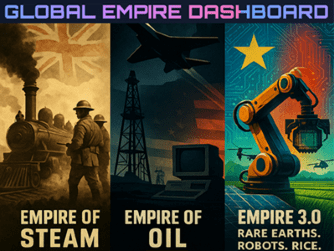
Global Empire Dashboard

We Are Closed. Australia has become corrupted by a corrosive mix of nihilism and embraced a radical liberal ideology that celebrates the rejection of anything from the past that could stabilise society including any inheritance of previous forms of culture. You just have to look at the abuse thrown towards our staff in the past few years to realise this, what is old is no longer deemed necessary & indeed something that must be replaced. We had no choice but to close.

Welcome to Foodstar

The “Intelligence Era” is Cannibalizing the “Information Era”: Does Morgan Stanley’s Dell Downgrade Signal the End of Wintel?

The “Intelligence Era” is Cannibalizing the “Information Era”: Does Morgan Stanley’s Dell Downgrade Signal the End of Wintel?

The 30-year “PC Refresh Cycle” is being held hostage by “AI”.


Executive Summary

  • The Signal: On Nov 17, 2025, Morgan Stanley issued a rare double-downgrade for Dell Technologies, causing an 8% stock collapse.
  • The Cause: An “unprecedented pricing supercycle” in memory (DRAM/NAND) driven by AI hyperscalers hoarding supply.
  • The Consequence: Fulfillment rates for enterprise hardware have crashed to 40%, while costs have surged 171%.
  • The Pivot: CIOs are effectively “defunding” the Information Era (Windows PCs & human IT staff) to pay for the Intelligence Era (AI Models & GPUs).

1. The “Canary in the Coal Mine” Just Died

For three decades, the Wintel monopoly relied on a simple, predictable rhythm: hardware got cheaper, software got more demanding, and the enterprise dutifully refreshed its fleet every 3-4 years.

That rhythm stopped last week.

When Morgan Stanley slashed Dell’s rating from Overweight to Underweight and cut its price target to $110, they weren’t just commenting on a bad quarter. They were validating a structural shift in the global economy: The Intelligence Era is physically cannibalizing the Information Era.

2. The Parallel Purge: Layoffs & Hardware

The AI boom acts as a “universal solvent” for legacy costs, dissolving both the people and the machines that built the previous era.

  • The Labor Purge (OpEx): AI agents now handle information retrieval and synthesis at near-zero marginal cost. Result: 150,000+ “Information Technology” layoffs in 2025, with AI explicitly cited in 40% of restructuring plans.
  • The Hardware Purge (CapEx): Enterprises are refusing to pay the “AI Tax” on commodity hardware. Result: A standard Dell Latitude that cost $900 in 2023 now costs $1,350+ due to component shortages.
The Link: Both the human IT worker and the Windows PC are artifacts of the Information Era—too expensive to maintain in an economy optimizing for Intelligence.

3. The Macro-Economic Pincer Movement

CIOs are trapped between two crushing forces: Genuine Scarcity and Artificial Obsolescence.

Claw 1: The AI Tax (Genuine Scarcity)

Hyperscalers (Microsoft, Meta, Google) are vacuuming up the global supply of DDR5 RAM and NAND Flash to build AI training clusters, leaving scraps for the PC market.

  • DDR5 Prices: Up +171% YoY (Late 2025).
  • Shortage: 64GB memory kits have doubled to $500.
  • Fulfillment Collapse: Fill rates for enterprise orders are stuck at 40% through Q1 2026.

Claw 2: The Compliance Cliff (Artificial Obsolescence)

Simultaneously, Microsoft has attempted to force a hardware refresh through Windows 11’s rigid requirements (TPM 2.0, SSE4.2, POPCNT).

  • The Block: These requirements effectively “brick” ~38% of the global enterprise fleet (236M units).
  • The Cost: Post-EOS (Oct 14, 2025), Extended Security Updates (ESU) cost $61/user/year, rising to $244 by year 3.

4. The New Enterprise Architecture

Faced with a 50% price hike to replace perfectly functional hardware, the CFO has entered the room and overridden the CIO. The strategy has shifted from “Evergreen Refresh” to “Sweating Assets.”

  • The “Good Enough” Pivot (Linux/ChromeOS): Re-image 2017–2018 hardware with lightweight Linux distros. Cost: $0 licensing fees.
  • The Premium Flight (Mac): Move high-value users (Developers, Creatives) to Apple. Apple’s vertical supply chain insulates it from the x86/DRAM spot market chaos.

The $20 Billion Risk

Based on Gartner’s June 2024 CIO survey, the financial impact on Microsoft is massive and largely unpriced by the Street.

Outcome Intent Units (M) Lost License/yr Lost O365/yr
Linux/ChromeOS 23% 54 $4.9 B $7.6 B
Mac 14% 33 $3.0 B $4.6 B
TOTAL 37% 87 $7.9 B $12.2 B

Total Annual Risk: ~$20 Billion (approx. 29% of Microsoft’s Productivity & Business Processes segment).


Conclusion: The End of the “Default” OS

The Wintel refresh cycle was an artifact of cheap hardware. That era is over.

When Morgan Stanley double-downgrades Dell because they literally cannot get RAM, and Microsoft admits to hoarding GPUs they can’t even power on, the message is unambiguous: The supply chain is broken.

You can no longer buy your way out of obsolescence. You must innovate your way out by changing the software to fit the hardware you already own.

The Wintel moat wasn’t breached by a better operating system—it was breached by a CFO’s spreadsheet in 2025.

The Material Basis of the Coming Era: An Audit of the Petrodollar vs. The Electro-Industrial State

The End of Rentier Hegemony

The Material Basis of the Coming Era: An Audit of the Petrodollar vs. The Electro-Industrial State

By A Chinese Economist | November 2025

History is shaped by the material realities of energy and production, not ideology. For fifty years, the U.S. maintained hegemony through a service contract: the Petrodollar. The U.S. secured oil transit; the world held dollars.

But a forensic audit of 1974–2024 reveals this was not a masterstroke, but a break-even liability. The U.S. spent its wealth guarding a flow it did not own, while China prepared to build the grid of the future.

As we pivot to the Electro-Industrial Age (2025–2075), power shifts from rent collection (guarding oil) to structural integration (building the grid). Here is why American influence is waning while the Chinese electro-state endures.


Part I: The Petrodollar Audit (1974–2024)

The Illusion of Profit

The narrative that the Petrodollar allowed free money printing ignores the “cost of goods sold.” To maintain the dollar, Washington had to physically secure the Persian Gulf. Comparing capital “captured” versus capital “expended” reveals a flat ledger.

The Income

Net Capture: ≈ $10–11 T

Recycled inflows to U.S. markets (1974-2024).

The Expense

Security Cost: ≈ $10.1 T

Direct war costs and CENTCOM maintenance.

Chart 1: Breakdown of U.S. Security Costs (1974-2024) ≈ $10.1T Total

Historically, the U.S. acted as a mercenary for its own banking sector. It gained “soft power,” but the material Return on Investment was negligible.


Part II: The Electro-Industrial Multiplier (2025–2075)

From Rentier to Builder

While the U.S. funded kinetic warfare, the East mastered the Electro-Industrial Envelope. Future power rests not on fuel, but on the infrastructure of conversion and labor.

This new economy—renewables, batteries, and critically, Robotics—is a $438–468 Trillion prize. China’s strategy is not to tax this flow, but to be the flow.

Chart 2: The 2025-2075 Electro-Industrial Envelope (Projected Value)
The Chinese Position: By dominating refining and manufacturing, China captures the value-add at every stage.
  • Total Projected Value Capture: ≈ $150 Trillion
  • The Multiplier: A 15x greater return than the Petrodollar system, achieved without global military bases.

Part III: The Stickiness of Supply Chains

Why Wars Are Obsolete

American power relied on interdiction (blocking oil). Chinese power relies on integration.

Consider the cumulative value of labor substitution to robotics over the next fifty years China is now in a prime position to capture. While the U.S. spent decades guarding global energy (oil), China is now positioning itself to control global labor (automation). By replacing low-wage assembly lines and aging healthcare workforces with Chinese infrastructure, they are building a structural dependency that supersedes financial sanctions.

The Strategic Shift:

  • Industrial: Replacing Global South assembly lines.
  • Service: Automating logistics and elder care.

You can sanction a barrel of oil. You cannot “sanction” a nation’s operating system without collapsing its economy. Chinese influence is “sticky” because it is physical, not merely financial.

Chart 3: The Efficiency of Influence

Feature American Petrodollar Hegemony Chinese Electro-Industrial Hegemony
Basis of Power Fluid (Oil) Solid (Grid, Batteries, Robots)
Cost to Sustain High (War & Security) Negative (Funded by Trade)
ROI Mechanism Rent Collection Value Addition
Durability Vulnerable to shocks Embedded infrastructure

Conclusion: The Verdict of History

The Petrodollar’s decline is not a catastrophe, but the end of an inefficient cycle. The U.S. spent $10T to capture $10T—a closed loop burning capital for prestige.

China is investing trade surpluses to capture $150T in future value. This is a bid for indispensability. The Petrodollar was a cancelable service contract. The Electro-Industrial state is a permanent foundation. Once the concrete sets, it is nearly impossible to remove.

From WTO to World #1: China Sprints Past Germany for the All-Time Trade Surplus Crown

Global Finance

China Ends Germany’s 50-Year Reign as the all time Trade Surplus King🇨🇳🚨

November 2025 • Analysis of Cumulative Trade Surpluses (1975–2025)

For the first time in history, China has overtaken Germany to become the world’s all-time leader in cumulative trade surplus. While Germany held the title for five decades through steady industrial dominance, China’s explosive growth has finally tipped the scales.

As of late 2025, China’s cumulative surplus (1975–2025) stands at ~$6.2 Trillion, surpassing Germany’s ~$6.0 Trillion.

The 2025 Tipping Point

The takeover was driven by a massive divergence in 2025 performance. While Germany’s export engine sputtered (~$0.22 Tn surplus), China recorded a historic single-year surplus exceeding $1.0 Trillion, fueled by dominance in green tech and EVs.

Rank Country Cumulative (1975-2025) 2025 Est. Status
1 ▲ 🇨🇳 China ~$6.2 Trillion +$1.0 Tn New #1 (Green Tech Boom)
2 ▼ 🇩🇪 Germany ~$6.0 Trillion +$0.22 Tn Displaced (Auto Stagnation)
3 🇸🇦 Saudi Arabia ~3.9 Trillion +$0.09 Tn Oil Dependent
4 🇦🇪 UAE ~3.3 Trillion +$0.13 Tn Diversified Hub
5 🇳🇴 Norway ~2.6 Trillion +$0.07 Tn Energy/Sovereign Fund

The new Global Nickel Choke Point. A Sino-Indonesian partnership has engineered a market dominance that dwarfs historical precedents.

The Nickel Choke Point

The Sino-Indonesian partnership has engineered a market dominance that dwarfs historical precedents.

Market Control Comparison

Current Nickel Axis

Indonesia + China Processing

75% Control

OPEC Oil (1973)

At height of the crisis

55% Control

“OPEC set the precedent, but NickelPEC perfected the monopoly.”


The “Crocodile & Dragon” Strategy

Indonesia did not stumble into this dominance; it was a calculated geopolitical maneuver involving two main levers to secure the industrial infrastructure while China secured the raw materials.

1. The Export Ban (2020)

Banned raw nickel ore exports. This forced foreign entities to build factories inside Indonesia, transferring technology, jobs, and value margins to the local economy.

2. The “Dragon’s” Capital

China poured $65 billion into Indonesian facilities. Utilizing low-cost labor, coal energy, and weak environmental regulations, they created a machine Western miners cannot compete with.

The “Body Count”: Western Collapse

The flood of cheap Indonesian supply has rendered high-cost Western operations economically unviable.

Company Location Status Impact
BHP (Nickel West) Australia Suspended 3,000+ jobs lost. $3.8B write-down.
First Quantum Australia Closed Ravensthorpe mine permanently closed.
Glencore New Caledonia Shut Down $9B investment yielded zero profit.
Various Majors Canada Insolvency Sudbury & Caribou mines failing.

Conclusion: The New Dependency

The global energy transition long heralded as the path to a cleaner, more secure future now depends on a single choke point: Indonesia’s nickel river, fortified by $65 billion in Chinese capital and Jakarta’s unyielding downstream policy.

A single decree from the new administration in Jakarta, a quiet recalibration in Beijing, or a fresh export restriction could drive nickel prices up 50% or more overnight. Battery production lines from Detroit to Düsseldorf would slow or stop. The green boom would stall, not from lack of will, but from lack of metal.

If OPEC was a vulnerability, NickelPEC is a stranglehold.

How the Indian Air Force managed to embarrass France, the US & itself in six months.

Disaster in Dubai

How the IAF managed to embarrass France, the US, and itself in six months.
Fig 1. Smoke rises from the runway at the Dubai Airshow (Nov 2025).

If the Indian Air Force (IAF) was hoping the Dubai Airshow would be a reset button, they just hit self-destruct instead. Yesterday’s fatal crash of the HAL Tejas Mk-1—killing Wing Commander Naman Syal—is a tragedy. But geopolitically, it is a catastrophe.

It caps off what is arguably the worst operational year in the history of the IAF. Remember May? In the brief but brutal Indo-Pakistan air skirmish, the IAF lost four Dassault Rafales to Pakistani JF-17 Block IIIs and J-10Cs. That loss shattered the myth of French aerial invincibility.

Now, just six months later, the “indigenous” Tejas has crashed on the world stage. But here is the kicker: This time, it’s not just India’s face in the dirt. It’s America’s.

❖ ❖ ❖

The “Frankenstein” Fighter

To understand why Washington is sweating today, you have to look under the hood of the Tejas. India markets the jet as a triumph of “Atmanirbhar Bharat” (Self-Reliant India), boasting 62-70% local content. But the critical organs? They are all imported.

1. The American Heart Attack (GE F404): The Tejas is powered by the General Electric F404-GE-IN20. This engine has been the program’s Achilles heel for decades. It has been criticized since the 1980s for being underpowered, specifically at high altitudes—a massive oversight for a country whose primary threat theater is the Himalayas.

2. The Israeli Eyes: The avionics suite is heavily reliant on the Elta EL/M-2032 radar and Litening targeting pods. The crash raises serious questions about how well these Israeli sensors talk to the Indian mission computer under high-G stress.

3. The French Ghost: The navigation systems are Sagem (French). But after the Rafale debacle in May, the presence of French tech on a crashing Indian jet just reinforces the narrative that Western tech cannot handle the subcontinent’s combat realities.

The “Double Humiliation” Strategy

The IAF has managed to achieve the impossible: It has exposed the vulnerabilities of both its major Western partners in back-to-back disasters.

In May, the world watched French Rafales fall out of the sky, shot down by cheaper Chinese-Pakistani jets. The takeaway? European 4.5-gen tech is overpriced and overrated.

In November, the world watched the US-powered Tejas crash during a sales pitch. The takeaway? American legacy engines are unreliable, and India can’t integrate them.

The strategic reality is stark: The IAF is now naked. Its high-end import (Rafale) proved vulnerable in combat. Its low-end indigenous backbone (Tejas) proved unstable in a showcase.

Why This Breaks the Pivot

The United States has spent years trying to wean India off Russian weapons. The sales pitch was simple: “Buy American (or at least Western), because Russian tech is junk.”

2025 has inverted that argument.

  • Russian tech? Reliable, rugged, and readily available (Su-30 MKI).
  • Western tech? The Rafales got shot down. The GE-powered Tejas crashed.

This leaves India in a bind. They cannot trust the French to win the air war, and they cannot trust the Americans/Indians to build a safe plane.

The only winner in Dubai yesterday was the Chinese delegation. They didn’t have to say a word. They just pointed at the smoke rising from the runway, and then pointed to their J-10C parked on the tarmac—the same jet that helped clear the skies in May.

China’s South-North $62 Billion Water Transfer Megaproject

💧 China’s South-North $62 Billion Water Transfer Megaproject

南水北调中线工程 • Central Route Infrastructure Network

The South-to-North Water Diversion Project in China is the largest of its kind ever undertaken. This project involves drawing water from southern rivers and supplying it to the dry north.

Total Length
1,267 km
Central Route
Water Capacity
13B m³
Annual Supply
Population Served
100M+
Beneficiaries
Major Cities
40+
Urban Areas

🗺️ Infrastructure Network Map

🏗️ Key Infrastructure Facilities

Facility Name Chinese Name Type Location Function
🌊

Danjiangkou Reservoir

Asia’s largest artificial freshwater reservoir. Primary water source with 13 billion m³ annual capacity. Dam raised 2005-2009.

🚇

Yellow River Crossing

Engineering marvel: 4.25 km twin tunnels passing 35 meters below Yellow River bed. Capacity: 280 m³/s flow rate.

🏙️

Beijing Terminal

Tuancheng Lake serves as final receiving point, providing 70% of Beijing’s urban tap water through 75 km pipeline network.

🌳

Jiaozuo Urban Canal

Unique 10-km green corridor running through downtown. Supplies 430+ million m³/year while creating urban ecological space.

Gravity-Fed System

Entire 1,267 km route uses natural elevation drop – no pumping required. Average gradient: 1:10,000 for energy efficiency.

💧

Water Quality Impact

Eliminated high-fluoride groundwater use in Shijiazhuang, benefiting 5+ million people with safer drinking water.

🎥 Documentary: World’s Largest Water Transfer Project

Gone Are the Days When You Could Just Walk In & Buy a 25 kg Drum of Rare Earths (or Gallium, Germanium, Graphite, Tungsten etc) from China

Gone Are the Days of Buying a 25 kg Drum of Rare Earths from China

Nowadays every kilogram is now tracked by at least eight state agencies from mine to container seal.

Ministry / Bureau What they do to your drum Real-world tools & tricks
Ministry of Commerce – Bureau of Industry, Security, Import & Export Control The single gatekeeper. Nothing leaves China without their electronic licence. 45-day statutory review clock • “Dual-linkage” with Customs • 100+ page applications on Single Window platform
Ministry of Industry and Information Technology Sets national mining & smelting quotas and tracks every kilo from mine → smelter → exporter. RFID + QR code on every drum • Cloud ledger updated within 24 hours of any domestic transfer
Ministry of State Security Runs the intelligence check: “Is this drum ultimately going to Lockheed Martin, Raytheon, or a Taiwanese missile lab?” Secret “sensitive end-user” blacklist • Automatic denial if flagged
Ministry of Public Security Criminal raids, seizures, GPS tracking of trucks and freight forwarders. May 2025: 18-tonne samarium-cobalt seizure → drivers and forwarders jailed
General Administration of Customs The physical choke point at every port. 10–15 % random open-box rate • Hand-held LIBS guns • GPS-tracked container seals
State-owned Assets Supervision and Administration Commission Owns China Northern Rare Earth, China Southern Rare Earth, Minmetals Rare Earth, etc. Executives lose 50–80 % of annual bonus for any licence violation
Ministry of Ecology and Environment Environmental veto right on quota renewal. Satellite imagery + drone flyovers of every tailings pond
National Development and Reform Commission Can divert your inventory into the strategic stockpile at any moment. Compulsory purchase orders on neodymium, praseodymium, dysprosium when domestic factories demand it
Bottom line (2025–2026): Lead time 3–9 months • 20–80 % risk premium • Zero transparency on denials • Smuggling now carries prison time. The era of treating rare earths, gallium, germanium, graphite, and tungsten as normal commodities is over. They are now strategic materials policed like weapons-grade goods.

As Russia Falls to 31st in Global AI Rankings, Chinese “AI Tech Talent” Floods In for Marriage

From Sputnik to 31st Place: Russia’s AI Collapse and the Chinese “Specialist” Bridegroom Wave

Vladivostok, 20 November 2025 — The nation that led the World into Space by launching Sputnik and Yuri Gagarin now ranks 31st in the 2025 Global AI Index, behind India, the UAE, and Singapore. Sanctions have blocked advanced chips, collapsed venture capital, and driven scores of IT specialists into exile.

A peculiar lifeline has emerged from China. Applications for Russia’s “highly qualified specialist” visa from Chinese men listing AI-related professions surged 285% to more than 14,000 in the first ten months of 2025. In the Far East, marriage registries report these “AI engineers” now account for 22–28% of foreign-groom weddings.

Regional authorities, facing an eight-million male demographic deficit, absentmindedly welcome the new arrivals. Some newcomers join Yandex or Sber; most move swiftly from visa stamp to wedding ring.

Sixty years after leading the space race, Russia is rebuilding its talent pool one cross-border marriage at a time.

China’s next leg up: the Yen-Carry trade that functions as the Plumbing of the Western Financial System

🏮
Yen Carry Trade

China’s Next Lever vs Japan: The Bankers’ Delight Yen Carry Trade

Beijing has already cancelled flights, visas and scallop orders to punish Japan for raising Taiwan. The next lever is quieter, systemic embedded inside the balance sheets of the entire Western financial stack.

For twenty years: borrow yen at 0%, short it, buy higher-yielding assets: Treasuries, CLOs, mortgages. BOJ printed. Wall Street deployed. The position is now multi-trillion, hyper-leveraged, and fragile.

Why the Yen Carry Trade Matters

Size: 5–15 trillion USD equivalent embedded in global credit markets.

Trigger: A 2% weekly yen spike forces automated unwinds. China can create the spark by reducing FX quotas.

Timing: BOJ hiking + Fed easing = collapsing spread → systemic vulnerability.

Fallout

Yen spikes → UST yields jump → U.S. 30-yr mortgage +30 bp. Equity vol detonates. Pension funds hit margin calls. Japan forced to intervene or walk back Taiwan statements. U.S. trapped between markets and alliance commitments.

🏮

👉 In Australia’s courts, China doves are undefeated across all major cases against China hawks, repeatedly repelling hawkish China narratives.

👉 In Australia’s courts, China doves are undefeated across all major cases against China hawks repeatedly repelling hawkish China narratives.

The pattern is now unmistakable: cases framed around claims of Chinese influence or “foreign agents” collapse when tested under defamation law’s evidentiary requirements.

China hawks courtroom defeats
  1. Chau Chak Wing v ABC/Fairfax (2021) – Comprehensive DOVE WIN ✓
    ✔ Damages: $590,000 + full legal costs
    ✔ Permanent injunction: ABC barred from republishing Four Corners episode
    ✔ Judicial finding: ABC implied Chau was a CCP agent without admissible evidence
    ✔ Significance: Set the modern standard—mere proximity to PRC officials is not evidence of covert influence

    Impact: This ruling shocked national security reporters. News Corp editorialised that the judgment produced a “chilling effect” on investigative journalism involving China. Practically speaking, it established:
    • Association is not evidence.
    • Accusations of PRC interference must be supported by direct, provable, and fact-specific conduct.
    This has become the single most powerful precedent protecting individuals accused of Chinese political influence.
  2. Marcus Reubenstein v Geoff Wade & Commonwealth (2021–2023) – DOVE WIN ✓
    ✔ Payout: ~$110,000 (confirmed in Senate Estimates via Comcover)
    ✔ Retraction: Wade stated there was “no truth” to claims Reubenstein was a foreign agent
    ✔ Government admission: Commonwealth accepted vicarious liability for a staffer’s tweets
    ✔ DPS revelation: No social media policy existed during Wade’s online attacks

    Context: Reubenstein—aligned with pro-engagement, anti-hawks commentary successfully forced a public servant and the Commonwealth to retreat.
    Why this mattered: First time an Australian government entity effectively took responsibility for an official’s hawkish “Chinese agent” accusations on Twitter.
  3. Meyer Vandenberg “China Hawks” Threat Campaign (2022) – HAWK THREAT COLLAPSES ✓
    ✔ Targets: Michael West Media, Marcus Reubenstein, John Menadue, James Laurenceson, Suzy Cong
    ✔ Result: All threats withdrawn, no filings
    ✔ Menadue: Removed articles but issued no apology
    ✔ Meyer Vandenberg: Ran a five-front legal intimidation campaign with no disclosed financier

    Critical detail: Michael West revealed that Meyer Vandenberg whose major client is the federal government was issuing high-cost speculative threats on behalf of a mid-ranking public servant with no plausible personal capacity to pay, while refusing to disclose who actually funded the operation.
    Outcome: total strategic faceplant. Not a single claim progressed to court.
  4. Geoff Wade v Michael West Media (2024–2025) – DOVE WIN ✓
    ✔ Filed: Nov 2024
    ✔ Discontinued by Wade: May 2025 (after mediation)
    ✔ Payout by West: $0
    ✔ Crowdfunding: West raised $40,000 in 24 hours
    ✔ PR impact: Michael West Media reported significant growth in subscribers and crowdfunded entire legal defence. Est Value: +$150,000 in new subscriptions and visibility
    ✔ Estimated cost burden on Wade: ~$200,000 (beyond a public servant’s means)

    Analysis: Wade one of Australia’s most vocal China hawks proceeded with a suit that rapidly became a PR disaster. West’s team prepared what he called an “ambulance-chaser defence”, effectively turning the courtroom into a referendum on hawkish narrative laundering.
    The case ended in zero damages for Wade, a public humiliation for hawkish forces, and a strengthened West readership base.

The West’s Spycraft Blind Spot. The Newtonian Bond vs. the Go Master

The Newtonian Bond vs. the Go Master

Ever since Isaac Newton assumed the post of Master of the Royal Mint in 1696–1699 and deployed scientific methods to dismantle coining gangs, the West has codified espionage as a linear pursuit: track, trace, verify, capture. The romantic archetype of James Bond receiving his briefing, then executing a sequence of actions to neutralize a mastermind, is so embedded in the Western consciousness that it has become synonymous with spycraft itself.

Western intelligence has long lamented a practical disadvantage: as the only P5 Security Council member without a European phenotype, China is notoriously difficult to infiltrate. Agents can’t simply blend into the crowd; the traditional model breaks down.

This complaint, however, reveals a deeper blindness. Chinese spycraft operates less like chess and more like the game of Go: it is a strategic accumulation of position. The objective isn’t to isolate and remove a single piece, but to surround, to influence, and ultimately to make the opponent’s most advantageous best move indistinguishable from your own. You aren’t hunting the player; you are guiding their hand.

This explains why Chinese intelligence appears almost invisible. Its work is subsumed into geopolitics, industrial policy, and macroeconomic strategy executed not by operatives disguised in business attire, but through a diffuse architecture where statecraft and tradecraft merge. It’s also why Chinese spycraft just feels more all encompassing. The West must learn to think in these terms—to become “metaphorically Chinese” merely to read the board correctly.

The grievance about Chinese impenetrability rings hollow. Beijing plays both games: it defends its home soil with ruthless Western learned methods of counterintelligence while advancing its own Go-like strategy globally. The West, clinging to its Bond mythology, has rendered half the board illegible, leaving itself surrounded by moves it never realized were being made.

BREAKING: Rumors swirl that Tencent Finalizes Ubisoft Buyout: “Go Woke, Go Broke” Officially Canon

BREAKING: Rumors swirl that Tencent Finalizes Ubisoft Buyout “Go Woke, Go Broke” Officially Canon

PARIS/SHENZHEN – In a move that has sent progressive game journalists into emergency therapy sessions, Tencent is rumored to have snapped up the entirety of Ubisoft for the price of a mid-tier Shanghai apartment complex.

Insiders confirm the first mandate from the new Tencent overlords:

  • All future Assassin’s Creed protagonists must now be true to historical norms — i.e. heterosexual & must now contain zero black samurai in 1600s Japan.
  • Rainbow Six Siege operators will no longer include “non-binary smoke grenade genderqueer specialist.”
  • The phrase “modern audience” has been deleted from every company Slack channel and replaced with the Mandarin characters for “profit”: 利润.

Most devastating blow: An internal memo leaked stating “no more happy places where men go around cross-dressing like women” will be allowed in any Ubisoft title.

Sources say the Rayman team immediately disbanded in protest and is currently seeking asylum in Canada.

Sweet Baby Inc. stock reportedly plummeted 400% in pre-market trading after their consultation contract was allegedly used as toilet paper in Tencent HQ.