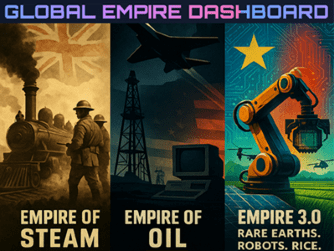
Global Empire Dashboard

We Are Closed. Australia has become corrupted by a corrosive mix of nihilism and embraced a radical liberal ideology that celebrates the rejection of anything from the past that could stabilise society including any inheritance of previous forms of culture. You just have to look at the abuse thrown towards our staff in the past few years to realise this, what is old is no longer deemed necessary & indeed something that must be replaced. We had no choice but to close.

Welcome to Foodstar

The Living Google Map—Made in China: How a Home-Grown 6G Drone Pipeline Will Update the Planet in Real Time

“The Living Google Map—Made in China: How a Home-Grown 6G Drone Pipeline Will Update the Planet in Real Time”

Urban environments are dynamic; they don’t stay still. Between dusk and dawn, construction sites shift, road layouts change, and new infrastructure comes online. Currently, the digital maps we rely on—like Google Maps or Street View—are essentially time capsules. They represent a snapshot of the past, not the reality on the ground.

However, the next iteration of mapping infrastructure is shifting from a periodic “snapshot” model to a continuous live stream. By leveraging a fully domestic supply chain, Chinese technology firms are developing a 6G-enabled drone pipeline capable of updating digital twins of a city in near real-time.

Here is how the transition from batch processing to live streaming works, and why the “Made in Shenzhen” label matters for the hardware stack.

1. The Current State: The “Five-Hour” Batch Cycle

Under the current 5G standard, mapping a city is efficient, but it isn’t instant. A fleet of DJI Matrice 350 RTK drones can survey a metropolitan area in a single evening, but they face a significant data bottleneck.

The Data Load: A drone carrying 8K cameras and LiDAR sensors generates roughly 25 Gbps of data.
The Bottleneck: Current 5G uplinks top out at around 300 Mbps.
The Workaround: Data must be stored onboard, drives swapped, and trucked to server farms.
The Processing: Offline rendering on Huawei Pangu clusters takes hours.

Result → high-quality maps that are already 5–10 hours out of date.

2. The 6G Shift: The “Five-Minute” Stream

6G moves to Terahertz frequencies and enables true real-time streaming of raw sensor data — no more physical storage needed.

Component Western Standard Chinese Domestic Alternative
On-board Processing NVIDIA Jetson Orin (275 TOPS, power-hungry) Huawei Ascend 310B (lower power, feature extraction only)
Connectivity Qualcomm 140 GHz 6G research ZTE THz prototype – 200 Gbps @ 0.3 THz (uncompressed streaming)
Sensing Tech LiDAR (heavy, expensive) JCAS – radio signal itself acts as radar (no separate LiDAR)
Compute Node NVIDIA DGX clusters Huawei Pangu 3.0 on Ascend 910B (containerised street-level edge)

Why this matters: JCAS removes the heaviest component (LiDAR), extends flight time, and keeps the entire data path inside China’s sovereign tech stack.

3. Practical Application: The “Living” Infrastructure

Dynamic Logistics → Gaode Map shows cranes and roadworks seconds after they appear.
Infrastructure Monitoring → Always-on micro-fracture detection with instant alerts.
Autonomous Vehicle Support → Cars subscribe to live point-cloud streams and literally see around corners via overhead drones.

4. The Workflow Summary

Acquisition → Drones launch at dusk, no storage onboard
Sensing → JCAS + optical feed streamed simultaneously
Processing → Street-level Ascend chips render NeRF in real time
Distribution → Updated map pushed to network instantly

The Bottom Line

We are leaving the era of yearly satellite updates and daily 5G surveys. China’s fully domestic 6G drone pipeline will update the world in seconds — a completely sovereign, self-sustaining mirror world built and flown entirely from Shenzhen factories.

The Western Playbook That Keeps Instagram Free Is Dead in the AI Era

FD
The Western Playbook That Keeps Instagram Free Is Dead in the AI Era
Meta can leverage high-yield Western ad revenue to support 500 million free users in India.
OpenAI cannot do the same without incurring unsustainable operational losses.

For the better part of two decades, Silicon Valley has operated on a specific, highly successful export model: the zero-marginal-cost subsidy. This “Western Playbook” allowed giants like Meta and Google to acquire billions of users in the Global South effectively for free, cross-subsidising them with revenue generated in the US and Europe.

However, the emergence of Generative AI has fundamentally broken the unit economics that made this strategy viable.

1
The Legacy Advantage: Zero-Cost Scale

The dominance of Web 2.0 platforms—Instagram, WhatsApp, YouTube—was built on a simple technical reality: these are “retrieval” architectures. When a user in Mumbai opens Instagram, the server retrieves a cached image. The cost to Meta for delivering that feed is negligible, asymptotically approaching zero.

This allowed for a straightforward commercial trade: Meta could onboard 500 million Indian users, incur almost no infrastructure penalty, and monetise the data later. Even if the Average Revenue Per User (ARPU) in developing markets was low, the cost to serve them was even lower.

SYSTEM ALERT
The Compute Drain
Web 2.0 Strategy: Zero marginal cost. Infinite scale.

AI Reality: Every token burns cash. The free ride is over.
2
The New Commercial Reality: Every Token Has a Price

Generative AI reverses this logic. Large Language Models (LLMs) are not retrieval engines; they are generation engines. Every time a user queries ChatGPT, a GPU cluster must perform complex calculations to generate the response fresh. This incurs a linear cost in electricity and hardware depreciation—what is known in the industry as “inference cost.”

The math for 2025 is stark. OpenAI is currently facing a projected burn rate of $5–8 billion, largely because their free tier accounts for 95% of usage.

The Cost: A rural user engaging in 50 interactions a day generates a wholesale compute cost of approximately $2.50 per month.
The Ceiling: In markets like India or Nigeria, the maximum extraction via ads or subscriptions hovers between $0.20 and $0.35 per month.

When the cost of service exceeds the revenue ceiling by a factor of ten, the “freemium” model is no longer a growth strategy; it is a financial liability.

3
The Inevitable Pivot: The “China Route”

Western tech firms are beholden to public market margins and cannot afford to subsidise billions of users when the marginal cost is tangible. Consequently, the “Next Billion Users” will likely bypass the Western cloud ecosystem entirely.

Instead of relying on expensive APIs from OpenAI or Anthropic, developing markets are shifting toward a more pragmatic, capital-efficient stack:

On-Device Inference: Running “distilled” models locally on smartphones eliminates cloud costs.
Sovereign Utilities: Nations like Egypt and Pakistan are investing in state-owned GPU clusters, often utilizing hardware from non-Western vendors like Huawei.
Chinese Open-Weights: Highly efficient models such as Qwen and DeepSeek-R1 offer reasoning capabilities comparable to GPT-4 but are optimised for lower-cost infrastructure.

Bottom Line

The era of “growth at all costs” has hit a hard physical limit. The Western funnel, designed to capture global attention via free services, cannot sustain the energy and hardware demands of the AI age.

As a result, we are witnessing a bifurcation of the global technology stack. The West will retain a centralised, high-cost cloud model, while the Global South will default to a sovereign, edge-based architecture running on local silicon and Chinese weights—entirely outside the Western revenue loop.
❤️ 2.8K 💬 467 🔄 892 📌 Save

The Structural Collapse of the Omnipotent Liberal “Free Speech” Media is happening in Real Tim

ANALYSIS December 2, 2025 • Canberra Bureau

The Structural Collapse of the Liberal Media Consensus

The hegemonic “free-speech” liberal media establishment is currently undergoing a systemic collapse. The erosion of this global mainstream consensus is not a sudden event, but rather a structural asphyxiation driven by a convergence of three distinct external shocks.

1. Regulatory Leverage and Litigious Attrition

  • The Compliance Chilling Effect: The incoming US administration has shifted tactics from rhetoric to regulatory leverage. Brendan Carr, the Trump-appointed FCC chair, has demonstrated that broadcast licenses can be jeopardised by editorial content. The swift decision by ABC to pause Jimmy Kimmel Live! following regulatory threats regarding the Charlie Kirk monologue indicates that commercial broadcasters are now prioritising license security over editorial autonomy.
  • Litigation as a Business Cost: The strategy is “lawfare.” With major networks already settling defamation claims for seven-figure sums and the New York Times facing a $billion plus liability, legal risk is becoming the primary driver of editorial decision-making.
  • Access as Currency: The removal of the AP from the White House pool for refusing to adopt the “Gulf of America” nomenclature sets a precedent: compliance is the price of access.
  • The Outcome: Newsrooms are shifting from an investigative footing to a risk-mitigation footing. Legal counsel now effectively holds veto power over editorial desks, resulting in a cautious, repetitive news cycle.

2. Ownership Concentration and Platform Economics

  • The Dynastic Lock-In: The finalisation of Lachlan Murdoch’s $3.3 billion buyout of his siblings has ended speculation regarding the future of News Corp. This cements Fox and The Wall Street Journal—and by extension, key Australian assets—as ideologically secured entities.
  • Algorithmic Bias: Platforms such as X, YouTube, and Meta are incentivised by engagement metrics that favour and amplify partisan commentary.
  • Privatised Ideology: High-net-worth investors (Thiel, Mercers) are effectively subsidising conservative media ventures (Daily Wire, PragerU) as ideological loss-leaders.
  • The Outcome: Traditional progressive outlets cannot compete with the “cost per mille” (CPM) efficiency of these subsidised platforms. The “town square” has been industrialised, with the algorithm weighted heavily towards the right.

3. Fiscal Constraints and the Public Broadcaster Deficit

  • The Net-Zero Budgetary Impact: With the cost of Australia’s net-zero transition estimated at A$65 billion through 2030, treasuries are seeking fiscal consolidation. Public broadcasters (ABC, SBS) and their international counterparts (CBC, BBC) are increasingly viewed as discretionary spending.
  • The Austerity Cycle: As funding contracts, so does the capacity for resource-intensive investigative journalism. This creates a dependency on fluff opinion pieces.
  • The Outcome: Once-dominant public broadcasters are at risk of shrinking into “boutique” operations—lacking foreign bureaus and investigative clout, reduced to maintaining a skeleton staff for defensive coverage.
“The decline of the liberal media is not primarily due to a failure of argument, but a collapse of the underlying infrastructure. The once-omnipresent liberal voice is no longer conducting the orchestra; it has been relegated to the background, overwhelmed by a brass section it no longer has the capital to silence.” Strategic Summary

2025: The Great Energy Pivot. China’s Great Oil Accumulation: Importing 11M barrels/day

Global Strategic Tankage

2025 Reserve Analysis
“China’s 1.3B barrel stockpile now dwarfs the US SPR, creating a new center of gravity in global energy security.”

Analyzing the shift in global crude reserves. Days of Cover represents how long a nation can sustain consumption without imports.

Visual Key

= 100 Million Barrels (Inventory)
Days of Cover (Green Intensity)
0 Days 240+ Days

Rankings

Sorted by Total Inventory (Mb)

The $1.2 Trillion Gap. China’s Trade Dominance in 2025 Mapped

China’s Trade Surplus

2025 Projected Flows

Visualizing the flow of goods vs. cash. Red zones indicate countries where China sells significantly more than it buys, extracting net capital.

Visual Key

$
= $20 Billion Net Profit
= Surplus Zone (Choropleth)

Top 30 Surplus

Ranked by Net Value ($ Billions)

The Global Operating System. The US Factions Post-Trump vs. The Chinese Three Stacks Post-Xi

The Global Operating System

Part I: The United States
The Fractured Technocracy

The American technology landscape may splinter into three competing “fiefdoms” struggling for control over the post-Trump state.

1. The Iron Fortress (The Thiel–Vance–Musk Axis)

Key Figures / The Operators

JD Vance (VP/Ideologue), Palmer Luckey (Anduril), Elon Musk (SpaceX logistics), Joe Lonsdale (Palantir/8VC).

Status: Politically Dominant. This faction has successfully captured the national security apparatus. They do not compete for consumer eyeballs; they compete for the “kill chain.”

The Moat: Sovereign Lethality. They control the physical layer of war (Lattice OS, Starshield). Their systems are closed, classified, and American-made.

Ideology: Techno-Nationalism. The state must actively pick winners to re-industrialize the arsenal of democracy and contain China.

2. The Leviathan of Circular Financing (The Stargate Coalition)

Key Figures / The Operators

Sam Altman (OpenAI), Masayoshi Son (SoftBank), Jensen Huang (Nvidia), Larry Ellison (Oracle).

Status: Economic Crisis. The “Stargate” project—a $500 billion bet on centralized compute—is faltering.

The Crisis: Google’s Gemini 3 proved that massive, expensive Nvidia clusters are not the only path to intelligence. With funding stalling and “vibes” deteriorating, this faction is pivoting to become a state-protected “Classified Utility” to survive.

The Moat: The Bunker. Their only remaining leverage is the promise of a secure, air-gapped cognitive infrastructure that the military needs for classified workflows.

3. The Resurgent Empire (Google / Meta)

Key Figures / The Operators

Sundar Pichai (Google), Mark Zuckerberg (Meta), Satya Nadella (Microsoft).

Status: Market Ascendant. By weaponizing vertical integration and “open weights,” the incumbents have broken the Stargate monopoly narrative.

The Moat: Efficiency & Ubiquity. Google’s Gemini 3 (running on custom TPUs) and Meta’s Llama (free open weights) have commoditized intelligence, driving prices down to near-zero. They own the distribution rails (Android, Instagram) and the cheapest compute.

Ideology: Ruthless Commercialism. They use open markets and regulatory lobbying (Brussels) to bleed their debt-laden competitors dry.

Part II: The People’s Republic of China
The Integrated Stacks

While the US factions fight a civil war over budgets and regulations, China has consolidated its industrial strategy into three integrated “stacks” that operate as a single geopolitical operating system.

Stack 1: The BRI Logistics Stack (The Digital Panopticon)

Key Figures / The Operators

Wan Min (Chairman, COSCO), Eric Jing (CEO, Ant Group/AntChain), He Lifeng (Economic Tsar/CPEC Lead).

The Concept: China has moved beyond building ports (concrete) to controlling the data (code) that governs global trade via the “Hangzhou Tigers” (Ant Group/Alibaba remnants) and State logistics.

The Mechanism:

  • LOGINK: A state-controlled logistics platform integrated into 20+ global ports. It gives Beijing real-time visibility into 50% of global container flows, allowing them to see supply chain disruptions before the West does.
  • Parametric Insurance (The Blockchain Weapon): Entities like Ant Group (AntChain) and ZhongAn have replaced human insurance brokers with “smart contracts.” If a sensor at a Chinese-owned port detects a delay, the blockchain pays the client instantly. This removes the “friction tax” of Western insurance (Lloyd’s of London), making Chinese logistics faster and cheaper.
  • Digital Twins: Ports like Shanghai and Qingdao use “Digital Twins” to simulate and optimize every container movement, achieving efficiency rates Western ports cannot match.

The Threat: China identifies high-risk shipments (“lemons”) and dumps them onto the blind Western insurance market, while internally “self-insuring” the safe bets using superior data across BRI and CPEC partner nations.

Stack 2: The Electric Tourism & Lifestyle Stack (The Deflationary Export)

Key Figures / The Operators

James Liang (Trip.com), Zhang Jun (Chagee), Guo Jinyi (Luckin Coffee), Zhang Hongchao (Mixue Bingcheng).

The Concept: Exporting a “high-tech, low-cost” lifestyle to the Global South, driven by structural deflation in energy and operations.

The Mechanism:

  • Energy Deflation (CapEx vs. OpEx): By combining BYD electric buses with cheap solar, tourism operators in Southeast Asia lock in near-zero fuel costs for 15 years. This allows them to undercut diesel-dependent competitors by 30%.
  • Frictionless Consumption: Alipay and WeChat Pay integrate directly with local economies, removing the 3-5% banking fees (the “Visa Tax”) and enabling micro-consumption without currency friction.
  • Cultural Exports: Brands like Luckin Coffee, Mixue Bingcheng, and Chagee (tea) are expanding aggressively (24,000+ stores), using digitized “grab-and-go” models to undercut Starbucks on price while offering a “premium” tech-enabled experience via Trip.com integration.

The Result: A “China Stack” vacation in Thailand—riding a BYD taxi, drinking Chagee, paying with Alipay—is structurally cheaper and smoother than the Western alternative.

Stack 3: The Long March Space Stack (The Dual-Track Race)

Key Figures / The Operators

Liang Wenfeng (DeepSeek), Zhang Changwu (LandSpace), Huo Liang (Deep Blue Aerospace).

The Concept: A bifurcated space program that uses the State for brute force and “Little Giants” for agility, underpinned by efficient AI.

The Mechanism:

  • State Heavyweights: The Long March 10 (moon rocket) and Long March 9 (super-heavy) provide guaranteed, state-funded access for strategic assets like the lunar base.
  • Commercial Swarm: Startups like LandSpace (Zhuque-3) and Deep Blue Aerospace have achieved VTVL (Vertical Takeoff, Vertical Landing), breaking the SpaceX monopoly on reusability. They are testing reusable rockets for express cargo delivery (e.g., with Taobao).
  • DeepSeek (The Efficiency Engine): Underpinning this is DeepSeek, an AI model optimized for “hard tech” engineering. It allows Chinese engineers to bypass US chip sanctions by writing highly efficient code for fluid dynamics and rocket trajectory optimization, effectively doing “more with less” compute.

Part III: The Geopolitical Collision

The Asymmetry:
The US model is Fractured Innovation: Google fights OpenAI, Anduril fights Boeing, and the government struggles to align them.
The Chinese model is Integrated Sovereignty: The Logistics Stack feeds data to the AI Stack (DeepSeek), which optimizes the Space Stack and the Energy Stack, creating a closed-loop system that is exported globally.

The Forecast (2026):
The US Iron Fortress (Anduril/Vance) will likely tacitly align with the Resurgent Empire (Google) to counter China. The US military needs Google’s cheap compute and Anduril’s lethality to match the sheer velocity of China’s “Three Stacks.” The Stargate Coalition, reliant on massive capital expenditure, risks being the “Maginot Line” of AI—expensive, static, and bypassed by more efficient competitors.

AUKUS DOOMED: The Ghost Ship That Sunk Three Parties Before a Single Keel Was Laid

AUKUS: The Ghost Ship That Sunk Three Parties Before a Single Keel Was Laid

AUKUS Submarine Concept Art
The iron-grey monolith of 2025.

History isn’t going to record AUKUS as a birth certificate; it’s a tombstone. Signed in 2021 with the fanfare of a new geopolitical epoch, the pact stands in late 2025 as a solitary, iron-grey monolith. It is the last thing standing amidst the wreckage of the three political establishments that built it.

The irony is stark: while the submarines were designed to run silent, the parties that ordered them are dying out loud.

UK: The Tories are Cooked

The Conservative collapse is absolute. Boris Johnson, who signed AUKUS to flesh out the “Global Britain” fantasy, got the boot from his own mob, triggering a chaotic succession that turned the government into a laughing stock. Now, the electoral map is a bloodbath. The Tories aren’t just in opposition; they’re being eaten alive. Nigel Farage’s Reform UK has eclipsed them, successfully arguing the Conservatives failed to conserve a bloody thing—not borders, not culture, and definitely not the economy. “Global Britain” is now just a punchline to voters watching their living standards tank. The party of Churchill is being buried by the party of Farage.

Australia: The Liberal Doom Loop

It’s even grimmer at home because it’s a massive own goal. Scott Morrison left in disgrace, but his departure just exposed the rot. The Libs have locked themselves into a “doom loop.” By clinging to negative gearing, they’ve effectively told every voter under 40 to get stuffed—home ownership is a pipe dream, and so is voting Liberal. Then came the economic vandalism. Despite $250 billion already sunk into the renewables transition—transforming the regions—the Coalition formally ditched Net Zero in 2025. It’s spooked big business and alienated the cities. The party is now just a shrinking rump of angry retirees, raging against the reality of the energy market. AUKUS is their only legacy, a weird artifact of long-term thinking from a mob that can’t see past next week’s news poll.

US: The Democrat Hollow

In the States, the Democrats are drifting without a paddle. Biden is gone, and the “demographic destiny” they were banking on has hit a wall built by Trump. His second-term crackdown on immigration has structurally dismantled the Democrat base. Worse, the cupboard is bare. The Dems have arrived at late 2025 with no heir apparent and zero ability to talk to the working class. While AUKUS binds the US military to the Pacific for generations, the party that signed it is leaderless and wandering the wilderness.

The Legacy

They told us AUKUS was a “forever partnership.” Turns out the submarines will last a hell of a lot longer than the governments that bought them. We are left with a haunting reality: a fleet of nuclear vessels sailing under the orders of governments that barely resemble the ones that commissioned them. It is the perfect symbol of the era—politicians obsessed with expensive, distant muscle-flexing while the foundations back home rotted out from the inside.

The Sun Never Sets on the Chinese Ports. Why Shanghai’s Telemetry Will Cannibalize London’s Insurance Empire.

Live Telemetry Analysis

The Sun Never Sets on the Chinese Ports.

From Actuarial Tables to Digital Panopticons.

In 1815, Rothschild used superior information to profit from the Battle of Waterloo before the British government knew the outcome. Today, that information asymmetry has shifted from London to Shanghai.

For 300 years, Lloyd’s of London dominated maritime insurance using actuarial tables—dusty ledgers that predict the future based on the past. But history is dead. The future is owned by telemetry.

The Digital Panopticon

Through a platform called LOGINK and a network of ~100 global ports (from Piraeus to Peru), China has built a planetary sensor grid. While Western insurers guess at risk, China’s AI “Digital Twins” observe reality in real-time.

The Economic Weapon: Adverse Selection

This data monopoly allows China to surgically separate risk:

  • >>> The Safe Bet: China’s AI sees a shipment is safe and “self-insures” it internally, keeping the profit.
  • >>> The Lemon: China identifies high-risk shipments and dumps them onto the blind Western market.

Lloyd’s of London risks becoming the “bad bank” of global shipping, insuring only the disasters China’s algorithms have already quietly avoided.

The Death of the Broker

The final disruption is Parametric Insurance—”If-Then” smart contracts triggered by data. Because China owns the ports and sensors, they control the “trigger” data (The Oracle).

London’s static, annual policies cannot price risk at this resolution. You don’t buy insurance; you just pay the freight rate, and the AI handles the rest.

London brought a knife to a drone fight.

Strategic Nodes Geo-Score

Geopolitical Importance

Critical (100)
High Strategy (80-99)
Commercial Hub (40-79)

The Olympic Flame Is Dying. LA 2028 is cracking and 2036 has no takers.

The Olympic Flame Is Dying: LA 2028 Is Cracking — and 2036 Has No Takers

Hosting the Olympics was once the pinnacle of national prestige. Now it’s a poisoned chalice: politically costly, financially ruinous, and increasingly incompatible with modern geopolitics. The empty 2036 bidding cycle makes one thing clear: the IOC has lost the world.

1. 2028: The First Olympics Behind a “Visa Curtain”

LA 2028 was pitched as a low-cost, ready-made Games. Instead, it is becoming the most exclusionary Olympics of the modern era.

The Athlete “Exemption” That Doesn’t Exist
Executive Order 14161 claims athletes are “carved out” from immigration restrictions. But practice contradicts policy:

  • Soft Bans: Iranian football officials were denied US visas for a World Cup draw despite identical exemptions.
  • Administrative Limbo: Delegations report sudden “administrative delays” that conveniently last until after events conclude.
  • The “Immigrant” Presumption: Consular officers now treat visa applicants from developing countries as default overstay risks. A 19-year-old Kenyan runner or Filipino gymnast must prove financial stability many cannot meet. Failure? Visa denied. Sport irrelevant.

The $5,000–$15,000 Visa Bond Wall
The new Visa Bond pilot program requires applicants from “high-risk” nations to post collateral before an interview. It’s payable upfront and refundable only if all conditions are met on exit. For entire African, South Asian, or Caribbean delegations, this is existential. LA 2028 is effectively a wealth-tiered Olympics.

2. Domestic Politics: A Legal Minefield

The IOC once prided itself on being “Political Teflon”—a neutral ground where enemies dropped their weapons to race. That Teflon is gone.

The Transgender Ban Collision
Recent US federal and state orders banning transgender women from competing in women’s divisions turn LA into a battleground. The IOC insists on its framework; the US insists on its laws. The biggest fights in 2028 may happen in courts, not stadiums.

Doping System Double Standards
The world watched in Paris as Chinese swimmers were tested an average of 21 times per person—often early in the morning and late at night—while US swimmers averaged just 6 tests. Yet, when US sprinter Erriyon Knighton tested positive for Trenbolone, the explanation of “contaminated meat” was accepted without penalty.

“If you’re American, there’s always a reason to get exempted. Eat a steak, test positive? No problem. But other nations are tortured with tests to mess with their mindset.”

3. 2036: The Olympics No One Wants to Host

Normally, by 2025 the IOC would be entertaining multiple polished bids. Instead, it faces a vacuum. The “Bread, Not Olympics” protests in potential host cities have made it clear: citizens don’t want the debt.

  • China Passed: The IOC lobbied hard for Shanghai, Guangzhou, or Chengdu. China ran the numbers and decided to invest in high-speed rail, 5G, and pensions instead. They no longer need a 3-week sports carnival to prove they are a superpower.
  • Germany Said “Nein”: Berlin floated a centenary return. Voters crushed it instantly, citing cost overruns and security risks.
  • Indonesia Got Punished: Jakarta showed enthusiasm but was sidelined and blacklisted after taking a hard line on Israel–Palestine issues. The message? Follow Western political lines or don’t bother.
  • India Got Ghosted: Modi wanted 2036 as India’s debut. The IOC responded with delays, fearing a repeat of the chaotic Commonwealth Games.

4. The Verdict

The flame isn’t flickering because of “bad luck.” It’s flickering because the world is done with a system that preaches universality but enforces exclusivity. The IOC has turned itself from a “world’s favorite treat” into a “stale bun nobody wants.”

Athletes no longer need the Olympics to be seen. BRICS Games, Pan-Asian Games, and private circuits are emerging as stable alternatives. The Olympic era is ending—not with a bang, but with empty bids and empty stadiums.

The Deep Sea Duel: Why Japan’s “Samurai Sword” Submarines May Fail Against China’s “Invisible Net”

The Deep Sea Duel: Why Japan’s “Samurai Sword” Submarines May Fail Against China’s “Invisible Net”

Recent remarks by Japan’s new Prime Minister, Sanae Takaichi, regarding a potential “full-scale submarine war with China” have stirred ripples in the deep waters of Asia-Pacific geopolitics. Chinese media responded with disdain, calling the notion “reckless and foolish.”

But strip away the political rhetoric, and a fascinating question remains: Does Japan, a nation with a legendary history of naval engineering, truly possess the capability to compete with China underwater?

To answer this, we cannot simply look at spreadsheets of equipment parameters. We have to look at history, strategic intent, and the terrifying evolution of unmanned warfare.


The Ghost of the Imperial Navy

Japan’s current submarine doctrine bears the deep imprint of its history—both its failures and its resurgence.

During WWII, Japan possessed the world’s largest submarine fleet (174 ocean-going vessels). They built technological marvels like the I-400, a 6,500-ton behemoth capable of launching aircraft to bomb the Panama Canal. Yet, they failed.

Why? Strategic obsession. The Imperial Navy viewed submarines solely as tools for a “Decisive Battle”—scouts to whittle down enemy warships before the big gunfight. They ignored commerce raiding (unlike the German U-boats) and ultimately resorted to the desperate Kaiten suicide torpedoes.

Post-war, under the US security umbrella, Japan pivoted 180 degrees. The Maritime Self-Defense Force (JMSDF) became the “Shield.” Their job was specific and unglamorous: sit at the chokepoints (the Soya, Tsugaru, and Tsushima straits) and listen for Soviet submarines. This created a force that prioritized extreme quality over quantity—the ultimate ambush predators.


The Modern Matchup: The Ninja vs. The Network

Today, that legacy of quality lives on in the Taigei-class submarine. But China’s submarine force, once dismissed as noisy and obsolete, has staged a dramatic resurgence.

Here is how the two heavyweights compare:

🇯🇵 Japan’s Contender: The Taigei-Class

Japan’s strategy relies on the “Underwater Ninja.” The Taigei-class is a masterclass in conventional engineering.

  • The Power: It abandons Stirling engines for Lithium-Ion batteries. This provides incredible burst speed and underwater endurance without the noise of pistons.
  • The Steel: Built with NS-120 high-strength steel, it can dive deeper than 500 meters.
  • The Tactic: “One-hit kill.” The plan is to sit silently in complex seabed terrain at strait entrances, waiting for Chinese ships to pass, and strike from close range.

🇨🇳 China’s Challenger: The Type 039C

China’s latest conventional sub, the Type 039C, takes a different approach: The Wide-Area Deterrent.

  • The Stealth: It features a unique “Diamond-Cut” sail. This geometric design breaks up the “Kármán vortex street” (turbulence caused by water flowing around the tower), significantly reducing noise and sonar signature.
  • The Engine: It utilizes a Stirling AIP (Air Independent Propulsion) system. While slower than lithium batteries, it is efficient. It can “loiter” underwater for 15-20 days without surfacing.
  • The Reach: This is the game-changer. It carries the YJ-18C cruise missile, with a range of up to 2,000 km. It doesn’t need to get close; it can strike from a standoff distance, turning the sub into a strategic missile truck.

The New Variable: The “Invisible Net”

If this were a pure 1v1 duel between a Taigei and a Type 039C, it would be a close fight. But China has changed the board by introducing a third player: Unmanned Underwater Vehicles (UUVs).

At a recent military parade, China unveiled the AJX002 and HSU100 large UUVs. These aren’t just drones; they are “mother nodes” for swarms.

  1. SQUID Sensors: These UUVs are speculated to carry Superconducting Quantum Interference Devices. These magnetometers are hundreds of times more sensitive than standard detectors, capable of spotting the magnetic anomaly of a steel submarine hull from kilometers away.
  2. The “Wolf Pack” 2.0: A Chinese manned submarine acts as a command center, controlling 3-5 UUV motherships, which in turn control dozens of smaller drones.
  3. Saturation: Even the best Japanese sub cannot fight a swarm. It becomes a “turtle in a jar,” surrounded by disposable sensors and weapons.

The Strategic Mismatch

The analysis suggests that Japan is preparing for a tactical fight, while China is preparing for a systemic disruption.

Japan’s plan involves blocking the straits. China’s counter-strategy, known as “System Disruption,” effectively ignores the straits:

  • Step 1: The Rocket Force (DF-21, DF-26 missiles) strikes Japan’s anti-submarine bases (Kanoya, Naha) and ports immediately.
  • Step 2: UUV swarms flood the zone to blind the remaining sensors.
  • Step 3: Long-range missiles from Type 039C subs strike from outside Japan’s defensive perimeter.

Conclusion

History often repeats itself not in events, but in mindsets. This analysis suggests that Japan is once again relying on a “Samurai Sword” philosophy—forging the sharpest, most perfect individual weapon (the Taigei-class).

China, however, has forged a deep-sea net. By integrating space assets, rocket forces, and underwater drone swarms, they have created a system where individual technological superiority matters less than mass and reach.

As the Pacific heats up, the deep waters are becoming a stage for a clash between the perfection of the old guard and the swarm of the new.

The Next USD “Peg”:Why the AI Arms Race is a Defense Budget

The Next USD “Peg”: Why the AI Arms Race is a Defense Budget

The “Unipolar Moment” is not over; it has just moved up the technology stack. The U.S. currently maintains its hegemony through three distinct “Pegs”—monetary, digital, and intelligence. The U.S. is currently spending trillions on AI CapEx not because it is profitable in the short term, but because it is the only way to defend the third and most critical peg.

1. The Monetary Peg (The Dollar)

  • The Metric: Transaction Volume.
  • The Data: As of January 2025, the U.S. Dollar accounted for 50.2% of all global payment traffic routed via SWIFT.
  • The Reality: Despite talk of “de-dollarization,” the USD remains the operating system for half of global trade.

2. The Digital Peg (The Cloud)

  • The Metric: Cloud Infrastructure Market Share (The servers where the internet “lives”).
  • The Data: As of Q1 2025, just three U.S. companies (Amazon AWS, Microsoft Azure, Google Cloud) control approximately 66% of the global cloud infrastructure market.
  • The Reality: While “internet traffic” paths are decentralizing, the destination of that traffic is centralizing. Two-thirds of the world’s digital economy runs on computers owned by three American corporations.

3. The Intelligence Peg (AI Models)

  • The Metric: Global Generative AI Traffic Share (The “brains” processing the world’s queries).
  • The Data: As of late 2025, U.S.-owned models (OpenAI/ChatGPT, Gemini, Copilot, Claude) account for approximately 89% of global generative AI web traffic and API volume.
  • The Reality: The concentration of power increases as you move up the stack. While the world uses the Dollar for 50% of trade and U.S. clouds for 66% of storage, it relies on U.S. algorithms for nearly 90% of its synthetic intelligence.

The Explainer: Why Trillions in CapEx?

The U.S. is projecting over $1.4 trillion in AI CapEx through 2035. This is effectively a defense budget designed to counter two specific threats:

1. Countering “Efficient” Sovereignty: Chinese models (like DeepSeek) have proven AI can be built cheaply. If costs stay low, nations will build their own “Sovereign AI” and disconnect from the U.S. stack. The U.S. must spend to keep its models so advanced that sovereign alternatives remain “second-tier.”

2. CapEx as a Moat: By pushing the price of frontier intelligence to hundreds of billions, the U.S. creates a “Compute Moat.” This prices out other nations, forcing them to rent intelligence from American APIs rather than building their own.

The debt is the cost of hegemony. The U.S. is socializing the risk to ensure that in 2030, the world doesn’t just transact in Dollars, but thinks in American.

Sources: SWIFT (Jan ’25), Synergy Research (Q1 ’25), Statcounter/SimilarWeb (Late ’25)

2025: Asia’s Wettest Year. Ancient Prophecy coming true in Modern Times: Why the Greening of Saudi Arabia is Trending

2025: Asia’s Wettest Year.

Ancient Prophecy coming true in Modern Times

“The Hour will not begin until the land of the Arabs once again becomes meadows and rivers.”

— Sahih Muslim, Book 5, Hadith 2208

Why is everyone talking about it now (November 2025)?

You are likely seeing this discussed because of immediate, real-time weather events.

  • Current Severe Weather: Just this week, severe weather alerts were issued for Makkah, Madinah, and Jeddah. Heavy thunderstorms and flash floods have hit the region, creating temporary rivers in the desert.
  • Viral Visuals: Videos have gone viral showing the deserts around Mecca and Medina turning lush green after heavy winter rains. The contrast of green grass growing on yellow sand dunes is visually striking.

Regional Data Summary

Domain Anomaly Status vs History
South-east Asia +15% to +50% Wettest since 1961
South Asia +22% to +49% India wettest since 1994
East Asia +15% to +45% JP 5-day record 977mm
West Asia / Arabia +50% to +120% UAE/Oman records since 1949
Central Asia +20% to +35% Worst floods in 70y

Rainfall Anomaly (%)

0%
11-20%
31-40%
51-65%
66-80%
100%+

📊 All Countries Ranked

Click to zoom • Sorted by anomaly