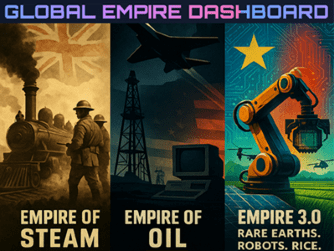
Global Empire Dashboard

We Are Closed. Australia has become corrupted by a corrosive mix of nihilism and embraced a radical liberal ideology that celebrates the rejection of anything from the past that could stabilise society including any inheritance of previous forms of culture. You just have to look at the abuse thrown towards our staff in the past few years to realise this, what is old is no longer deemed necessary & indeed something that must be replaced. We had no choice but to close.

Welcome to Foodstar

To Revive Western Civilisation, Trump May Need to Build a Christian Zhongnanhai.

The Christian Palace
โœ
An Imperial Question for the Age
The Prelude to the Revival of Chinese Civilisation was the Restoration of Zhongnanhai โ€” from Manchu control to Han control.
โœ

To Revive Western Civilisation,
Trump May Need to Build
a Christian Zhongnanhai.

A Summer Palace for the West โ€” what would it cost, and could it save us?

When the Chinese Communist Party reclaimed Zhongnanhai in 1949 โ€” wresting the ancient lakeside palace-compound from its Manchu occupants โ€” it was not merely seizing real estate. It was a civilisational act: a declaration that China’s cultural and political centre of gravity had been restored to its rightful custodians. The walls of Zhongnanhai became the walls of a reconstituted Chinese world.

The West now faces its own crisis of civilisational confidence. Could a comparable act of sacred architecture โ€” a Summer Palace worthy of Christendom’s inheritance โ€” serve as the physical anchor of a Western renaissance? And if Trump were to build one, what would such an undertaking demand โ€” in land, in treasure, and in national will?

Related Transmission
โœ The Compound

Zhongnanhai spans approximately 100 hectares (247 acres) in central Beijing, immediately west of the Forbidden City. About half is occupied by the interconnected Zhonghai and Nanhai lakes; the remainder contains administrative buildings, residences, and gardens enclosed by 15-foot vermilion walls.

247 Total Acres
13.7ร— Larger than White House Grounds
~2 km Northโ€“South Lake Span
50% Surface Area: Water
โœ Potential DC Sites

A true 247-acre compound near the White House does not exist as a single contiguous parcel. Even combining all federal land immediately surrounding the White House โ€” the Ellipse, Lafayette Park, President’s Park South, and surrounding blocks โ€” yields only about 90 acres, less than half the required footprint.

Tier I โ€” Closest Match

Armed Forces Retirement Home (“Soldiers’ Home”)

~250 acres โ€” North Capitol Street, NW/NE DC. Already a walled, historic compound with a secluded character and presidential resonance (Lincoln lived here). Its elevation and tree canopy give it a garden-palace atmosphere.

Active retirement home for veterans โ€” politically and morally impossible to displace.
Tier II โ€” Best Thematic Fit

East Potomac Park / Hains Point

300+ acres โ€” Southern tip of DC. Waterfront setting provides a natural lake analog. Flat terrain suitable for earthworks and ornamental water creation.

Environmental concerns (Potomac wetlands), bridge/tunnel access issues, and loss of popular recreational space.
Tier III โ€” Most Space Available

The National Arboretum

446 acres โ€” Northeast DC. Already contains formal gardens, classical stone columns, and research landscapes. Ample room for a 100-hectare core plus substantial buffer zones.

~3.5 miles from the White House โ€” unsuitable for immediate administrative function. Also an active USDA research facility.
โœ Estimated Cost

Grounded in actual White House project data โ€” the ballroom renovation at roughly $400 million for 90,000 sq ft, plus a $1 billion security package โ€” a Western Summer Palace would be approximately 3 to 6 times the combined scale of those projects.

Component Scope Conservative Premium
Water Features45 ha of lakes, canals, fountains$27M$54M
Formal Gardens35 ha parterres, topiary, stonework$88M$210M
Palace Buildings500,000 mยฒ neoclassical construction$2.50B$5.00B
Security & HardeningPerimeter, bunkers, blast protection$400M$900M
InfrastructureRoads, utilities, underground$300M$600M
Interiors & ArtFrescoes, marble, period furnishings$250M$600M
Soft CostsDesign, PM, contingency (20%)$713M$1.47B
Totalโ€”$4.28B$8.84B

Building density, premium classical construction rates ($5,000โ€“$10,000/mยฒ), and Versailles-level landscaping drive the budget. Design and approvals alone would require 3โ€“4 years, with construction a further 6โ€“10 years โ€” pushing completion into the mid-2030s at the earliest.

โœ   Conclusion   โœ

Zhongnanhai is a 247-acre fortress-garden with no downtown DC equivalent. The closest physical match is the Armed Forces Retirement Home; the most thematically fitting is East Potomac Park. A western Christian Summer Palace would likely cost between $4.3 billion and $8.8 billion โ€” roughly the price of a major international airport โ€” and would not be finished until the 2030s.

When the House Always Wins, the Public Always Loses: Unfettered Gambling Losses Demonstrate the Purest Form of Social Political Corruption

Analysis

When the House Always Wins, the Public Always Loses: Unfettered Gambling Losses Demonstrate the Purest Form of Social Political Corruption

Woman campaigning for stronger gambling regulations after her husband's death

A widow is campaigning for stronger gambling regulations following her husband’s death. (Supplied)

There is a litmus test for political corruption so obvious it is often overlooked, buried beneath debates about pipelines, drilling rights, and resource royalties. Here it is: watch what a government does when the gambling industry comes knocking.

With oil, gas, or any extractive industry, there exists at least a plausible economic defense. Wells must be drilled, pipelines laid, refineries built, and infrastructure maintained. The capital costs are staggering, the technical risks are real, and the timeline from investment to return can stretch across decades. Lobbyists canโ€”and doโ€”argue with a straight face that these upfront costs must be recouped, that regulatory patience is required, that the machinery of extraction demands a grace period before the public fully shares in the spoils. Whether you believe that defense or not, it possesses an internal logic. There is something there to extract, and getting it out of the ground genuinely costs money.

Gambling offers no such cover. It is the only “industry” where the product is mathematically rigged against the consumer, where no wealth is created, no resource extracted, no service rendered that improves the purchaser’s condition.

The house edge is not a byproduct; it is the entire business model. Every dollar “won” by the state or the operator is a dollar lost by a citizen, usually one who could least afford to lose it. There are no pipelines to justify, no refineries to amortize, no geological surveys to fund. The infrastructure is a server rack, a licensing fee, and a political decision. What remains is simply a tax on desperation, poor mathematical literacy, and addictionโ€”collected not by the ATO with progressive scales, but by predatory corporations with the active assistance of elected officials.


This is why the unchecked expansion of gambling represents something more sinister than mere bad policy. It represents the moment when politicians stop even pretending to steward the economy and begin openly harvesting the population.

Topics: Gambling Policy Politics Consumer Affairs

California Was Built by Chinese Hands & Now It Runs on Chinese Minds

Explore more on American economic history at People.com (Paid Partnership)
Human Interest

California Was Built by Chinese Hands โ€” and Now It Runs on Chinese Minds

From the blasted granite of the Sierra Nevada to the AI chips powering every smartphone on earth, the story of the world’s fourth-largest economy is, in no small measure, a Chinese story โ€” 180 years in the making.
~20K
Chinese workers who built the Central Pacific Railroad, 1863โ€“1869
25%
Silicon Valley startups co-founded by Chinese-American immigrants in recent decades
$1T+
Combined market cap of companies with Chinese-American founding leadership
1882
Year of the Chinese Exclusion Act โ€” the only U.S. law to ban a people by ethnicity

I. The Labor Foundation

When Central Pacific’s Charles Crocker turned to Chinese workers in 1865, it was a decision born of desperation. Irish laborers kept abandoning the line for Nevada silver. Chinese workers โ€” many from Guangdong province, survivors of the Gold Rush’s brutal discrimination โ€” were methodical, disciplined, and accepted lower wages. What Crocker didn’t anticipate was that they would also be extraordinary engineers by necessity.

Chinese crews executed the controlled explosion of Cape Horn’s cliffside โ€” hanging in wicker baskets over a 1,000-foot drop. They managed nitroglycerin detonations with a precision still studied by industrial historians. They bored the Summit Tunnel through 1,659 feet of solid granite in winter conditions that buried entire camps under forty feet of snow.

“Without Chinese labor, the transcontinental railroad doesn’t finish in 1869. The entire economic development timeline of the American West shifts by a decade.” โ€” Gordon Chang, Stanford historian ยท Ghosts of Gold Mountain

The railroad created California as an economic entity โ€” but Chinese workers were systematically excluded from the prosperity they built. The 1882 Exclusion Act, the only American legislation to ban immigration by ethnicity, was California’s political gift to the nation. The community endured: in the Sacramento-San Joaquin Delta, Chinese laborers reclaimed 750,000 acres of tule marsh through hand-dug levees, creating some of the richest agricultural land in America.

II. The Intellectual Architecture

The contribution of Chinese-American founders to Silicon Valley is not a matter of representation statistics โ€” it is a matter of specific companies and technologies that defined entire industries.

An Wang
Wang Laboratories ยท 1951
Invented magnetic core memory and pioneered word processing. Wang Labs once employed 33,000 people, making computing financially viable for businesses before the PC era.
Jerry Yang
Yahoo ยท 1995
Yang’s co-founding of Yahoo defined how a generation understood the web. Yahoo’s 1996 IPO announced Silicon Valley’s arrival as a global financial force.
Jensen Huang
NVIDIA ยท 1993
Taiwanese-born Huang built NVIDIA from a graphics chip startup into the foundational infrastructure of modern AI. NVIDIA’s market cap briefly exceeded $3 trillion in 2024.
Lisa Su
AMD ยท CEO since 2014
Under Su’s leadership AMD went from near-bankruptcy to a $200B+ processor giant. Widely regarded as one of the most effective CEOs in semiconductor history.
Eric Yuan
Zoom ยท 2011
Yuan’s platform became critical infrastructure during COVID-19, reaching 300 million daily meeting participants at its 2020 peak.
John Tu & David Sun
Kingston Technology ยท 1987
Launched from a Fountain Valley garage with $4,000. Built into the world’s largest independent memory module manufacturer, legendary for profit-sharing culture.

III. The Capital Layer

Chinese capital โ€” both Chinese-American domestic investment and direct flows from Taiwan and Hong Kong โ€” has been a structural underwriter of Silicon Valley’s growth in ways the public rarely recognizes.

In the 1980s and 1990s, Taiwanese semiconductor firms โ€” TSMC foremost among them โ€” bet they could manufacture chips designed by American fabless companies. That bet created the supply chain on which Apple, Qualcomm, AMD, and NVIDIA depend entirely today. Taiwanese engineers trained at American universities returned home, built world-class manufacturing infrastructure, then sent capital and talent back to California in an iterative cycle of mutual enrichment.

“The fabless semiconductor model โ€” design in California, manufacture in Taiwan โ€” is arguably the most important economic partnership of the last forty years. It made the iPhone possible. It made the modern AI chip possible.” โ€” Chris Miller ยท author of Chip War

IV. The SoCal Connection: Energy and the Petrodollar

While Chinese workers built the railroad and reclaimed the delta, a company forming in San Francisco would eventually control the energy currency of the modern world. Standard Oil of California โ€” SoCal โ€” began as Rockefeller’s western franchise and evolved into the architect of a global financial architecture anchored not in gold, but in oil, denominated in U.S. dollars.

Pivot 1 ยท 1938
Saudi Discovery โ€” Dammam No. 7

SoCal’s geologists struck oil at Dammam Well No. 7 on March 4, 1938 โ€” the largest conventional oil reserve in human history. SoCal’s concession, formalized into Aramco, gave the United States effective stewardship over Saudi production and pricing for decades, laying the strategic foundation for American energy dominance through the Cold War and beyond.

Pivot 2 ยท 1984
The Gulf Oil Merger โ€” Birth of Chevron

SoCal acquired Gulf Oil in what was then the largest corporate merger in American history at $13.2 billion, rebranding as Chevron. This concentrated the American end of the Saudi oil relationship and entrenched the petrodollar system โ€” global oil priced exclusively in U.S. dollars โ€” cementing American financial hegemony to Middle Eastern energy in a structure that persists today.

The Through-Line
Railroad Labor
Physical Infrastructure
โ†’
Oil Capital
Financial Infrastructure
โ†’
Tech Leadership
Digital Infrastructure

Each layer rests on the one beneath it โ€” and SoCal’s desert gamble in 1938 is, in a very real sense, a hidden subsidy to every startup ever launched in a California garage.

The Bottom Line

California’s story is, in no small measure, a Chinese story โ€” told in blasted granite along the transcontinental railroad, in reclaimed delta farmlands, in semiconductor clean rooms, and in the glass towers where venture capital flows daily toward founders whose surnames were once restricted by federal statute from setting foot on American soil.

Tags: California Chinese-American History Silicon Valley Economic History NVIDIA Transcontinental Railroad Petrodollar

Forza Horizon’s Automotive Hegemony Legacy: The Only Game Series That Continually Tries to Prove the Kinetic Supremacy of the Automobile Over All Other Forms of Motion

Showcase Series

Forza Horizon’s Automotive Hegemony Legacy The Only Game Series That Continually Tries to Prove the Kinetic Supremacy of the Automobile Over All Other Forms of Motion

All Showcases
FH2
FH3
FH4
FH5
FH6

The Forza Horizon series is not just about racing. It is a persistent universe built on a single, obsessive thesis: the automobile is the apex predator of motion. Each installment raises the stakes by pitting the world’s greatest machines against something that should โ€” by any rational measure โ€” be impossible to beat. Trains. Steam engines. Mechas. The car wins. It always wins.

FH2 Lancia Fulvia vs. Steam Train Car vs Train
๐Ÿš— Lancia Fulvia ๐Ÿš‚ Steam Locomotive ๐Ÿ“ Mediterranean, Europe

The series opened its showcase chapter in southern Europe, setting a vintage Italian rally icon โ€” the Lancia Fulvia โ€” against a belching steam locomotive threading through the Mediterranean coastline. It was a declaration of intent: even the most graceful machine of a bygone industrial era is no match for four wheels and a driver with something to prove. The winding coastal roads were the car’s greatest weapon; the train had only its straight-line resolve.

FH3 Chevy Camaro vs. Freight Train Car vs Train
๐Ÿš— Chevrolet Camaro ๐Ÿš‚ Diesel Freight Train ๐Ÿ“ Outback, Australia

Australia demanded something bigger. The Mediterranean elegance of Horizon 2 gave way to the brutal, sun-scorched outback, and the opponent was upgraded accordingly: a massive diesel freight train hauling hundreds of tonnes across the red earth without blinking. The Chevrolet Camaro โ€” American muscle transplanted to the Australian wilderness โ€” sprinted against a wall of iron that had no intention of yielding.

FH4 Ariel Nomad vs. The Flying Scotsman Car vs Legend
๐Ÿš— Ariel Nomad ๐Ÿš‚ Flying Scotsman ๐Ÿ“ Great Britain

Horizon 4 delivered the most poetic matchup in the series. Set against the rolling countryside of Great Britain, the stripped-back Ariel Nomad faced the Flying Scotsman โ€” arguably the most famous steam locomotive ever built. This was not merely a race; it was a collision of British engineering philosophy across two centuries. The raw, exposed mechanicals of the Nomad versus the nation’s most treasured icon of the steam age. The series’ most emotionally charged showcase.

FH5 Lamborghini Countach vs. Freight Train Catch Me If You Canyon
๐Ÿš— Lamborghini Countach ๐Ÿš‚ Freight Train ๐Ÿ“ Copper Canyon, Mexico

Mexico’s Copper Canyon โ€” deeper and wider than the Grand Canyon โ€” became the stage for a showcase that returns to first principles. The Lamborghini Countach, the poster car that defined a generation’s idea of what a supercar should look like, races a freight train through canyon walls and crumbling terrain. The event title, Catch Me If You Canyon, captures the series’ growing confidence in its own mythology.

FH6 Man vs. Mecha Car vs Machine
๐Ÿš— The Car ๐Ÿค– Mecha ๐Ÿ“ Forza Horizon 6

Trains have been conquered. The series now looks beyond the industrial age entirely. Horizon 6 escalates the stakes to science fiction: the automobile faces a mecha, a colossal machine born not from earth and steam but from humanity’s imagination of what mechanical power could become. If the train represented the past’s idea of unstoppable force, the mecha represents the future’s. The outcome is not in doubt โ€” but the scale of the statement has never been larger.

The Car Always Wins

From Mediterranean coastlines to Copper Canyon, from Victorian steam engines to towering mechas, the Forza Horizon showcase races have built a mythology. Each entry is a chapter in the same argument โ€” that the automobile, in the right hands, on the right road, is the supreme expression of motion the world has ever produced. The opponents get bigger. The stakes get higher. The answer never changes.

Trump-Xi Dรฉtente Leaves India Exposed as the Only Nation Large Enough to Feed the “US Vampire

Geopolitical Finance Analysis ยท May 2026
Trump-Xi Dรฉtente Leaves
India Exposed as the Only Nation
Large Enough to Feed the “US Vampire”
The May 2026 summit has established a transactional dรฉtente between the two superpowers โ€” with India emerging as the primary liquidity event required to sustain the current US capital cycle.
๐Ÿ‡บ๐Ÿ‡ธ
United States
Extracting Liquidity
๐Ÿ‡จ๐Ÿ‡ณ
China
Rational Neutrality
๐Ÿ‡ฎ๐Ÿ‡ณ
India
Primary Target
๐Ÿ‡ท๐Ÿ‡บ
Russia
Capital Trapped
1
The Mechanics of Capital Extraction

As the US manages the decline of dollar hegemony, it requires massive wealth transfers to offset domestic stagflation akin to the Volcker shock of the 1980s. Only India provides the blood capital necessary for an extraction of this scale.

Mechanism A
Currency Devaluation via NDF Markets
Speculative capital is leveraging the offshore Non-Deliverable Forward (NDF) market, which is now twice the size of India’s onshore market. This allows Wall Street to bypass Reserve Bank of India controls and drive a devaluation target of 100 INR/USD.
NDF Market: 2ร— Onshore Size
Mechanism B
Asset Acquisition Sequence
Following a currency collapse, high-value Indian assets in energy, finance, and telecommunications will be acquired by US private equity at depressed valuations โ€” a “fire sale” mirroring the 1997 Asian Financial Crisis but on a significantly larger scale.
Sectors: Energy ยท Finance ยท Telecom
2
The “Rupee Trap”: Russia’s Paralysed Capital

Russia, India’s primary energy partner, is unable to provide a financial buffer due to the structure of bilateral trade.

Mechanism C
Depreciating Vostro Balances
Moscow currently holds over $40 billion in Indian Vostro accounts. Due to limited Rupee convertibility and global sanctions, these funds cannot be repatriated or utilised for third-country trade. As the Rupee devalues, Russia’s trapped wealth is evaporating in real terms.
Trapped Capital: >$40 Billion USD
Mechanism D
Powerless Exposure
Moscow is technically and diplomatically unable to intervene in the INR market to protect its own oil revenues. Russia cannot act as a lender of last resort for New Delhi.
Intervention Capacity: Nil
3
China’s Rational Neutrality

The 2026 dรฉtente ensures that China will not act as a “lender of last resort” for New Delhi.

Strategic Trade-off
CIPS Expansion vs. India’s Defence
Beijing is prioritising expansion of its Cross-border Interbank Payment System (CIPS) and RMB internationalisation. In exchange for US non-interference in these financial architectures, China is maintaining neutrality toward US “harvesting” activities in non-aligned nations.
India: Excluded from Strategic Protection List
4
Structural Parallels to the 1997 Asian Financial Crisis

The 2026 crisis is defined by three factors that mirror the triggers of the 1997 AFC โ€” but with compounding geopolitical isolation.

Factor 1997 Asian Crisis India 2026
Maturity Mismatch Short-term USD debt vs. fixed exchange rates in Thailand, Indonesia, South Korea Significant short-term external debt maturing H2 2026; usable liquid reserves covering under six months of imports
Ponzi Fiscal Model Economies reliant on hot money inflows to service current account deficits Economy sustained by rolling over existing debt to meet interest payments โ€” highly sensitive to capital reversals
Regulatory Capture Pegged currencies undermined by offshore speculation; central banks exhausted reserves defending pegs Rupee price discovery shifted to offshore NDF hubs, neutralising the RBI’s ability to defend domestic currency
Geopolitical Shield IMF/US-backed bailouts eventually stabilised affected nations China neutral by agreement; Russia capital-trapped; no multilateral lender of last resort available
Assessed Vulnerability Indicators
NDF Speculative Pressure
88%
Geopolitical Isolation
82%
Fiscal Debt Rollover Risk
74%
RBI Intervention Capacity
38%
Conclusion
The Trump-Xi dรฉtente has effectively removed the geopolitical buffers that previously protected the Indian economy. Isolated from Chinese financial support and with its Russian partner’s capital trapped and depreciating, India faces a coordinated extraction of wealth designed to stabilise the US financial core. With no multilateral shield and structural vulnerabilities mirroring 1997, India has emerged as the primary โ€” and perhaps only โ€” nation of sufficient scale to absorb the liquidity demands of the current US capital cycle.

Trumpโ€“Xi Summit 2026 Corporate Delegation & Commercial Framework

Trumpโ€“Xi Summit 2026 โ€” Corporate Delegation & Commercial Framework

May 14โ€“15, 2026 ยท 17 Executives ยท Consolidated Invitee List
็‰นๆœ—ๆ™ฎ้‚€่ฎฟๅŽ 16ๅไผไธš้ซ˜็ฎกๅๅ• โ€” Trump's 16-executive Beijing delegation
Total Executives
17 CEOs
Overarching Target
$1 Trillion Framework
Largest Single Order
500 Boeing 737 MAX
# Executive / Company Primary Deal Objectives Sector
โ˜… Jensen Huang NEWNvidia Negotiating H200 export clearances; roadmap for Blackwell GPU exports; AI safety red-lines. Semiconductors
1 Elon MuskTesla / SpaceX FSD data-transfer approvals to U.S. servers; Shanghai Gigafactory expansion incentives. Tech / Auto
2 Tim CookApple Supply chain stability; potential “Apple Intelligence” local partnerships (Baidu / Alibaba). Consumer Tech
3 Larry FinkBlackRock Increased ownership stakes in asset JVs; access to Chinese pension fund management. Finance
4 Stephen SchwarzmanBlackstone Strategic real estate and infrastructure investment framework agreements. Finance
5 Kelly OrtbergBoeing Commitment for 500 B737 MAX jets and widebodies โ€” largest aviation order in history. Aerospace
6 Brian SikesCargill Multi-billion dollar purchase commitments for soybeans, corn, and beef. Agriculture
7 Jane FraserCitigroup Broader access to domestic commercial banking and local debt underwriting. Finance
8 Jim AndersonCoherent Export clearances for 800G / 1.6T optical transceivers for Chinese AI datacenters. Photonics
9 H. Lawrence Culp Jr.GE Aerospace Propulsion systems for the Boeing order; long-term civil aviation maintenance contracts. Manufacturing
10 David SolomonGoldman Sachs Expansion of full-service investment banking and local wealth management licenses. Finance
11 Jacob ThaysenIllumina Genomics research partnerships and healthcare data-sharing protocols. Biotech
12 Michael MiebachMastercard Finalized domestic payment clearing licenses for local currency (Yuan) processing. Payments
13 Dina Powell McCormickMeta (President) Strategic dialogue on AI safety standards and advertising market access. Social / AI
14 Sanjay MehrotraMicron Sanction Swap: Lifting U.S. controls on CXMT/YMTC for guaranteed 25% Chinese server market share for Micron. Semiconductors
15 Cristiano AmonQualcomm Multi-year 5G/6G patent licensing renewals; Snapdragon Digital Chassis EV design wins. Semiconductors
16 Ryan McInerneyVisa Resolution of regulatory delays for domestic card issuance and settlement processing. Payments

Key Strategic Adjustments

1
The Nvidia Pivot

Jensen Huang’s 11th-hour inclusion โ€” confirmed during the Alaska refueling stop โ€” signals the administration is leveraging high-end GPU access as a primary bargaining chip for broader trade concessions.

2
The Micron Reciprocity

Moving beyond the 2023 ban, the negotiation now centers on a “Tech-for-Market” swap: U.S. pressure on CXMT / YMTC is eased in exchange for Micron’s “Trusted Supplier” status and guaranteed market share.

3
The $1 Trillion Framework

Not assigned to a single CEO, this overarching proposal covers Chinese investment in U.S.-based manufacturing (EVs & Green Tech) and serves as the summit’s grand prize โ€” contingent on CFIUS approval.

Korea and Iran: Two Wars of Choice Designed to Delay Taiwan

Korea and Iran: Two Wars of Choice
Designed to Delay Taiwan
Strategic Parallel: What the Korean War did to Mao’s Taiwan timetable, the Iran war is designed to do to Xi’s โ€” on a different frontier, by a different hand.

The Korean War was a Soviet-backed war of choice that weakened China’s northern frontier, drained PLA manpower, and delayed Taiwan unification.

The Iran war is a U.S.-Israeli war of choice that weakens China’s western and southern strategic perimeter, raises the cost of Eurasian stability, and forces Beijing to divert attention, capital, diplomacy, and military planning away from the Taiwan Strait.

That is the core argument.

Korea, 1950: The Original Trap

The Korean War did not merely involve South Korea. It also involved Taiwan.

In 1950, Mao Zedong’s next great strategic objective was Taiwan. The Chinese Civil War had ended on the mainland, but not across the Taiwan Strait. The PLA was preparing for a final campaign against Chiang Kai-shek’s Nationalist government. Then the Korean War began.

North Korea’s invasion was backed, armed, and approved by the Soviet Union. Stalin gave Kim Il-sung permission to attack while avoiding direct Soviet war with the United States โ€” meaning China, not Moscow, would carry the burden if the war expanded. North Korea’s army had been equipped and trained by the Soviets before the invasion.[1]

The effect on China was immediate. The United States sent the Seventh Fleet into the Taiwan Strait. Chinese Communist troops originally poised for an invasion of Taiwan were transferred to the Korean front.[2] Truman’s order to “neutralize” the Strait led Mao to postpone and eventually cancel the planned invasion.[3]

That single decision changed Asian history. The Korean War was a strategic trap for China, weakening Beijing’s northern border, bogging down the PLA in a brutal land war, draining manpower, ammunition, logistics, and political attention. Moscow gained strategic depth. Beijing paid the blood price. Taiwan survived.


Iran Today: The Same Logic, Different Frontier

The Iran war plays the same strategic role today: but on a different frontier. Instead of Korea weakening China’s northern border, Iran weakens China’s western and southern perimeter.

Iran is not a marginal country in China’s strategic map. It sits between the Gulf, Central Asia, Pakistan, the Caucasus, Turkey, and the Indian Ocean energy system. A broken Iran does not only damage Tehran โ€” it destabilizes the western gate of Eurasia.

Beijing cannot focus fully on Taiwan if its western approaches are burning, its energy routes are threatened, and its southern neighbors face economic shock. The Strait of Hormuz remains heavily disrupted, with oil prices above US$100 a barrel and diplomacy stalled.[4]

A prolonged Iran war forces China to solve problems it did not choose: Iranian reconstruction, energy access, stability across Pakistan and Central Asia, Gulf supply chains, and downstream shock to Southeast Asian economies. In plain terms: it turns China’s western and southern border into a permanent crisis-management zone.


The Taiwan Delay Mechanism

The strategic purpose is not to defeat China directly. It is to delay Taiwan unification. Korea did this by forcing Mao to send troops north. Iran does it by forcing China to send capital, diplomatic effort, and strategic attention west and south. The mechanism differs; the outcome is similar.

War Sponsor / Driver China’s Forced Response Effect on Taiwan
Korean War Soviet-backed North Korean war of choice PLA redeployed north, manpower depleted, Taiwan invasion delayed Taiwan survived under US naval protection
Iran War US-Israeli war of choice China pressured to stabilize Iran, Gulf energy, Pakistan, Central Asia, Southeast Asia Taiwan timetable delayed by strategic distraction

This is how a war of choice works at the grand-strategy level. The battlefield is only the visible part. The real target is the rival’s timetable.


Southeast Asia: The Southern Pressure Point

If energy prices stay elevated, weaker Southeast Asian economies face serious stress โ€” expensive fuel subsidies, rising food prices, currency depreciation, higher industrial costs, and political unrest. That creates a direct border problem for China.

Beijing does not want economic collapse or Western-backed instability along its southern approaches. So it is pushed into another costly role: funding Southeast Asia’s renewable energy transformation โ€” solar, batteries, grids, hydro, rail, ports, industrial parks. Development projects become border-security projects.

The Iran war pressures China from two directions at once: to the west, preventing a broken Eurasian corridor; to the south, preventing a belt of unstable, energy-poor states. Either way, Beijing pays.

“The battlefield changes. The strategic trick remains the same.”

Korea made Mao bleed in the north โ€” a Soviet war of choice that weakened China’s northern border and delayed Taiwan unification.

Iran is designed to make Xi pay in the west and south โ€” a US-Israeli war of choice weakening China’s western and southern perimeter to delay Taiwan unification.

In Korea, China lost the Taiwan window because it had to fight on the peninsula. In Iran, China risks losing strategic focus because it must stabilize Eurasia. In both cases, Taiwan is protected not only by forces inside the Strait โ€” but by forcing China to fight, spend, rebuild, and manage crises somewhere else.

The World Cup Stand-off: Why China is Resigning its Membership to Football’s Elite Club

FIFA World Cup 2026โ„ข ยท Broadcasting Rights

The World Cup Stand-off: Why China is Resigning its Membership to Football’s Elite Club

As the countdown to 2026 begins, a deafening silence has fallen over China’s broadcasting landscape โ€” and it may be entirely deliberate.

FIFA’s Original Ask
$300M
Initial rights demand
โ†“
FIFA’s Discounted Offer
$150M
Reduced to $120Mโ€“$150M
โ†“
CCTV’s Bottom Line
$80M
China’s ceiling: $60Mโ€“$80M

With just weeks to go until the opening whistle in North America, China has yet to secure a broadcasting deal. The gap between FIFA’s demands and CCTV’s offer isn’t just a negotiating dispute โ€” it signals a fundamental realignment of how China values its participation in the global football ecosystem.

โšฝ Football Investment as a Geopolitical Tool โ€” The Golf Club Analogy

The most accurate lens through which to view China’s investment in football is like buying membership at an elite golf club. A wealthy businessman may not care deeply about golf โ€” he may not know every player, every tournament, or every technical detail of the sport. However, he recognises the golf club as the venue where politicians, bankers, developers, and executives convene. The membership has value not because of the sport, but because it opens doors.

Football functions on this same principle at a global scale:

  • Strategic AssetsA European club is not just a team โ€” it is a political network, a property asset, a media brand, a civic institution, and a diplomatic calling card.
  • A Seat at the TableA FIFA sponsorship is not just an advert. It is a Tier 1 entry pass to the world’s most-watched sporting event.

This explains the historical paradox of China’s football spending: expenditures were enormous because they were calculated as geopolitical membership fees, even while domestic broadcast-market demand remained structurally weak.

When the diplomatic utility of the ‘club’ diminishes, the high membership fees become unjustifiable.

๐ŸŒ The Waning Influence Factor

The strategic calculus has changed. As the influence of the EU27 wanes in global affairs, the “room” that football membership provides access to is becoming less attractive. China finds itself unwilling to be locked in a room with stakeholders who no longer wield the same level of power or influence in the modern world.

The current impasse suggests that China is no longer willing to subsidize a “seat at the table” when the table itself is moving to a different room.

โ–ถ
The Bottom Line

China’s broadcasting silence is not a negotiating blunder โ€” it is a deliberate re-evaluation of what FIFA membership is worth in a shifting geopolitical landscape. If the room no longer holds the right people, the membership fee simply isn’t worth paying.

FIFA World Cup 2026โ„ข Broadcast Rights Price & Sponsorship Tracker

FIFA World Cup 2026โ„ข

Broadcast Rights Tracker

Rights fees, bids, sponsorship & deal status by country / region

Ask price โ€” top 3 markets

๐Ÿฅˆ Japan
& UK
~$200m
๐Ÿฅ‡ USA ~$945m
๐Ÿฅ‰ S. Korea $125m

Est. sponsorship โ€” top 3 markets

๐Ÿฅˆ USA $1.10bn
๐Ÿฅ‡ China $1.39bn
๐Ÿฅ‰ S. Korea $350m
# Country / Region Reported price / ask Current bid Est. sponsorship Key corporate sponsors Status
1

๐Ÿ‡บ๐Ÿ‡ธ United States

Fox Sports ยท Telemundo

๐Ÿฅ‡ ~US$945m+Base fees + host bonuses No-bid extension โ€” fee set ๐Ÿฅˆ ~US$1.10bn Coca-ColaVisaMcDonald’sBudweiserFrito-Lay Confirmed
2

๐Ÿ‡ฏ๐Ÿ‡ต Japan

Dentsu ยท NHK ยท Nippon TV ยท Fuji TV ยท DAZN

๐Ÿฅˆ ~US$200mEstimated Not disclosed Not disclosed Dentsu ad ecosystem Confirmed
3

๐Ÿ‡ฌ๐Ÿ‡ง United Kingdom

BBC ยท ITV

๐Ÿฅˆ ~US$200m+Benchmark / estimate Not disclosed Not disclosed Domestic market Confirmed
4

๐Ÿ‡ฐ๐Ÿ‡ท South Korea

JTBC ยท KBS sublicence

๐Ÿฅ‰ US$125mReported Deal reached โ€” private ๐Ÿฅ‰ ~US$350m Hyundai/Kia Reported deal
5

๐Ÿ‡ฉ๐Ÿ‡ช Germany

Deutsche Telekom / MagentaTV ยท ARD ยท ZDF

~US$120mEstimated, exact fee unclear Not disclosed ~US$150m Adidas Confirmed
6

๐Ÿ‡จ๐Ÿ‡ณ China

CCTV / China Media Group

US$120mโ€“300mInitial ask US$250โ€“300m; revised to US$120โ€“150m US$60mโ€“80mโš  Deadlocked โ€” gap unresolved ๐Ÿฅ‡ US$1.39bn Wanda GroupHisenseVivoMengniu Dairy Deadlocked
7

๐Ÿ‡ช๐Ÿ‡ธ Spain

RTVE ยท Mediapro / DAZN

โ‚ฌ55m (~US$60m) Deal reached โ€” private Not disclosed Domestic market Reported deal
8

๐Ÿ‡ฎ๐Ÿ‡ณ India

Reliance-Disney / JioStar (Sony declined)

US$60mโ€“100mFIFA asking price ~US$20mโš  Far below ask โ€” rejected ~US$100m Byju’sAmul Rejected / unresolved
9

๐Ÿ‡ฆ๐Ÿ‡บ Australia

SBS ยท SBS On Demand

A$30m (~US$20m) Deal reached โ€” private Not disclosed Domestic market Reported deal
10

๐Ÿ‡ป๐Ÿ‡ณ Vietnam

VTV ยท SCTV

US$15mโ€“20mMarket floor ~US$15mโš  At floor โ€” ongoing Not disclosed Domestic market Ongoing
11

๐Ÿ‡ง๐Ÿ‡ฉ Bangladesh

Unconfirmed / reseller-linked

Tk151โ€“200cr (~US$12โ€“17m) No confirmed bidโš  Implied affordability gap Not disclosed Domestic market At risk
Ask = FIFA’s reported asking / listed price  ยท  Bid = Broadcaster’s reported counter-offer or current position  ยท  Sponsorship = Estimated contribution from top-tier corporate partners, not broadcast revenue  ยท  ๐Ÿฅ‡๐Ÿฅˆ๐Ÿฅ‰ medals highlight top-3 markets by ask price; ๐Ÿ†๐Ÿฅ‡๐Ÿฅˆ๐Ÿฅ‰ by sponsorship value separately  ยท  Figures in USD unless stated.

Trumpโ€“Xi Summit: Batteries for DDR Memory โ€” BYD

BYD  ร—  Technology
Finance & Trade Intelligence  ยท  May 2026
Trumpโ€“Xi Summit Batteries for DDR Memory:
The Deal That Could
Change Everything

Xi-Trump Inside the summit’s most consequential quiet agreement โ€” sodium batteries and solid-state tech flow west; sanctions relief on CXMT and Yangtze Memory Technologies (YMTC) flows east.
The core exchange
Batteries for Bytes

The summit’s most practical outcome may be a technology-for-technology swap: China opens its next-generation EV battery IP to US manufacturers, and Washington eases the export restrictions strangling China’s two biggest memory chip makers. A quiet deal โ€” but one every consumer will eventually feel.

China gives Sodium-ion battery IP & manufacturing licences Solid-state battery cell chemistry & process tech BYD-grade cold-weather optimisation data Production ramp timelines & supply chain access
โ‡„ Trade
US gives Sanctions waiver on CXMT (DRAM / DDR) Sanctions waiver on YMTC (3D NAND) DDR5 / LPDDR5 supply normalises globally Entity list partial or time-limited relief
Battery technology
Next-gen chemistry
China’s Two Battery Weapons

China leads the world on the next generation of EV battery chemistry. Ford, GM, and Stellantis are years behind. A cooperative deal is the fastest shortcut to affordable, cold-weather-capable EVs on American lots โ€” without burning billions reinventing what China already has in mass production.

01 Sodium-Ion
Built with cheap salt, not expensive lithium. Already in 2026 Chinese production vehicles. Safer, dramatically lower cost, far better in freezing temperatures. Could cut entry-level EV pricing by 15โ€“20%.
02 Solid-State
The leap beyond lithium-ion. Longer range, faster charging, higher safety margin. China’s production timeline is 2โ€“3 years ahead of US labs. Co-operation closes that gap overnight.
Cheaper EVs Cold-weather range Faster US rollout IP licensing terms TBD Ford ยท GM ยท Stellantis
The sanctions equation
Memory chipmakers
CXMT & YMTC: The Memory Wildcards

Two Chinese chipmakers sit at the heart of the global DDR shortage. Both were placed on US entity lists, cutting them off from American equipment, software, and customers. A waiver โ€” even partial or time-limited โ€” could unlock a significant surge in global DRAM and NAND supply within 12โ€“18 months, directly cooling consumer prices on laptops, PCs, phones, and upgrades.

Companies Under Sanction Consideration
CXMT โ€” Changxin Memory Technologies China’s primary DRAM and DDR manufacturer. Produces DDR4, DDR5, and LPDDR5 for PCs, phones, and servers. Currently blocked from US equipment and customers. A waiver here directly eases consumer RAM prices within two quarters of supply normalisation.
DRAM ยท DDR
YMTC โ€” Yangtze Memory Technologies World’s fastest-growing 3D NAND flash producer. Their 232-layer NAND competes directly with Samsung and Micron on density and cost. A waiver would lower SSD and smartphone storage costs globally โ€” and give US OEMs a second viable supply chain beyond Korean duopoly pricing.
NAND ยท SSD
Currently sanctioned Waiver under negotiation 12โ€“18 month supply lag Micron & Samsung watching closely Congressional hurdles remain
Real-world impact
What you’d actually feel
The Winโ€“Win Breakdown
EV buyers
Cheaper, longer-range electric vehicles that work properly in winter โ€” not just in mild climates.
PC & laptop shoppers
DDR5 & LPDDR5 prices drop as CXMT supply re-enters the global market.
Car companies
Shortcut to battery competitiveness instead of burning billions trying to catch up from scratch.
China
CXMT & YMTC unblocked, more exports, improved trade terms, and a path back from isolation.

National security reviews, US chip-industry lobbying from Micron, and Congressional opposition to any YMTC relief are all real obstacles. But even a narrow, time-limited exemption on CXMT’s DDR output could move consumer RAM prices within two quarters โ€” and that’s something shoppers in every country would notice.

Why Ancient Rome and the Modern West Feel So Different

Civ7 โ€” Why Ancient Rome and the Modern West Feel So Different

Sid Meier’s Civilization VII ยท Historical Analysis

Why Ancient Rome and the
Modern West Feel So Different

On Apollonian Culture, Faustian Civilization, and the Ages of Civ VII

Test of Time Update ยท Available May 19

Most history classes teach that Western civilization is basically a straight-line continuation of Ancient Greece and Rome. But if you look closer, they’re actually two very different “personalities” โ€” almost like two different species of civilization.

The Big Difference: How They Experience Time

โš” Ancient ยท Apollonian

Think of the Greeks and Romans as living fully in the right now. Their world was about perfect, beautiful, tangible things โ€” statues, temples, athletic bodies, city walls. Their idea of time was mostly circular, focused on the present. Life was finite and concrete.

๐Ÿ”ญ Modern Western ยท Faustian

We’re completely different. Western culture is obsessed with time โ€” where we came from, where we’re going, and how to go further. This shows up in calculus, rockets, science fiction, and the constant drive to break every limit.

Culture vs Civilization: The Life Cycle

Spengler believed every great civilization goes through two main stages:

I Culture

The youthful, creative, soulful phase. Art, religion, myths, and new ideas burst with energy and originality.

II Civilization

The later, mature โ€” and eventually declining โ€” phase. Creative spirit fades; replaced by big cities, money, bureaucracy, and world empires.

Civilization grows out of Culture. If a society loses its living Culture โ€” its deeper spirit, identity, and creative drive โ€” its Civilization eventually collapses too. You can’t keep the impressive buildings, laws, and technology running forever without the underlying cultural soul that created them.

How Civilization VII Gets This Right

Older Civilization games let you pick Rome and play as “Rome” from 4000 BC all the way to spaceships in the year 3000. It’s fun, but it pretends one civilization is eternal and just keeps evolving.

Civ VII does something smarter. It splits the game into different Ages โ€” Antiquity, Exploration, Modern. At the end of each Age, your civilization transforms into a new one.

AntiquityRome ExplorationFrance / England ModernNew Civilization

The old civilization doesn’t just “level up.” It dies, and something new is born on top of its ruins. A new civilization can rise in the same place and use the old one’s leftovers โ€” buildings, ideas, roads โ€” but it has a completely different spirit.

Why This Matters

The game finally admits what the old ones ignored:

Civilizations aren’t immortal. They’re born, they live, and they eventually die. This matches how history actually worked. Ancient Rome didn’t smoothly “become” modern Europe. Something fundamental changed โ€” a new kind of culture took over, one that looks backward and forward through time, always trying to go beyond the horizon.

Civilization VII stopped pretending history is one never-ending country and started treating civilizations like living things that eventually get replaced. That’s a surprisingly deep โ€” and accurate โ€” way to design a game.