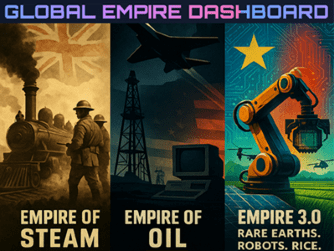
Global Empire Dashboard

We Are Closed. Australia has become corrupted by a corrosive mix of nihilism and embraced a radical liberal ideology that celebrates the rejection of anything from the past that could stabilise society including any inheritance of previous forms of culture. You just have to look at the abuse thrown towards our staff in the past few years to realise this, what is old is no longer deemed necessary & indeed something that must be replaced. We had no choice but to close.

Welcome to Foodstar

China’s BHP Ban is actually Australia’s “Fuck around & find out” moment, Beijing now holds the cards 🔥🏦

  • China now does not need Australian ore; it can switch to Vale (Brazil) and Simandou (Guinea).
  • Crash the price and Western Australia’s royalties collapse, the national GST pool shrinks, Eastern states like Victoria and Tasmania lose out more.
  • Less federal cash means Australia’s renewables rollout slows, the country stays hooked on coal and gas, and Pacific lawsuits triggered by the ICJ climate opinion hit harder.
  • Beijing ends up with a yuan-priced, China-controlled iron-ore bloc; Australia ends up with a broken budget and a federation brawl.

The Chain Reaction ⚙️

💥 Price Shock

  • Every US$10/t fall in the iron ore price wipes $5–10 billion off GDP, plus hundreds of millions in company tax and royalties.
  • Spot 62% Fe has already dropped 15% since the ban rumours began.
  • Lower prices ripple through shipping, engineering, and mining services all structurally high-cost sectors that underpin regional WA.

🏗️ Western Australia Budget

  • Iron-ore royalties topped $10 billion last year one-third of WA’s total revenue.
  • The 75¢ GST floor deal only holds while WA looks rich. Once the surplus evaporates, Canberra is forced to top-up WA instead of the Eastern states due to Scomo’s 2018 WA GST deal.
  • Expect Moody’s outlook warnings, infrastructure delays, and pressure on the next state wage deal.

🏛️ Federal Budget Fallout

  • NDIS, defence spending, and legislated stage 3 tax cuts are all locked in.
  • There’s no fiscal room left meaning either new debt, service cuts or higher taxes.

Energy Transition Collateral

  • The Powering Australia plan banked on over $20 billion in public funding to hit 82% renewables by 2030.
  • With a revenue hole, the temptation will be to raid the CEFC and NRF, slowing clean-tech rollout.
  • Result: more gas peakers, higher emissions, and a weaker global climate stance all while Canberra preaches decarbonisation abroad.
  • Expect climate-liability exposure to grow as emissions targets slip.

🌊 Pacific Liability and Strategic Fallout

  • The ICJ’s 2024 advisory opinion opened the door for Pacific nations to sue fossil fuel exporters for climate harm.
  • A cash-strapped Commonwealth will struggle to fund adaptation programs or legal settlements.
  • That vacuum gives Beijing new leverage more loans, more infrastructure deals, and a tighter diplomatic grip on the Pacific.
  • In short: Canberra loses credibility where it most needs friends.

🔮 The Lesson

Australia built a fiscal fortress on a single buyer’s appetite. Now its Beijing’s turn to show it can starve the beast at will.

💍 Like Getting a Free Wife. Indian man in Canada offers his 17-year-old Canadian co-worker $20,000 to marry him for a PR visa. 🚨

src: https://nationalpost.com/news/canada/picton-tim-hortons-marriage-fraud

In Picton, Ontario, a Tim Hortons visa fraud case spotlights how Hindutva’s entitlement twists Indian diaspora behavior everywhere. 💼

A 25-year-old Indian man, offered his 17-year-old Canadian coworker $15,000–$20,000 to marry his brother for permanent residency. 📞 She reported it to family, sparking exposure, his firing, and now looming deportation risks amid OPP fraud probes.

Canada’s Indian underground demands at least $100,000 premiums for full fakes: staged photos, forged leases, and scripted “arranged serendipity” to dupe immigration. 💰 No discounts here. Why the surge? Scarcity and desperation. As more Indian men escape a Hindutva-drenched homeland fixated on control and “purity,” they’re paying top dollar for any Western escape route even sham ones. 🛫 It’s bitter irony: The ideology touting virtue at home commodifies marriage abroad. The hypocrisy stings: Hindutva hails Akhant Bharat in India, the great re-awakening of the Cow Dung empire, yet fuels “paper wives” overseas.

Melbourne–Chengdu: Building a Partnership for the Future

🔑 Background

  • 📚 Education First: University and TAFE collaborations have built talent pipelines between the two cities.
  • 💼 Business & Trade: Delegations have opened doors in clean energy, tech, food exports, and infrastructure.
  • 🎭 Cultural Bridges: Festivals, exhibitions, and exchanges strengthen people-to-people ties.
  • 🌳 Urban Innovation: Shared vision of livable, green cities — Melbourne’s global ranking meets Chengdu’s “park city” blueprint.

🚀 Future Growth Potential

  • Green Energy Collaboration: Joint projects in renewables and smart energy solutions.
  • 🏙 Sustainable City Design: Shared expertise in planning, architecture, and climate resilience.
  • 👩‍🎓 Skills & Talent Exchange: Expansion of vocational education and research partnerships.
  • 🌐 Deeper Trade Links: Opportunities in tech, healthcare, and advanced manufacturing.

Trump’s White House just published a list of Democrats it brands as “Radical Left terrorists.” But beyond that partisan divide lies a more unusual overlap: The Tiny Club Both Trump & Beijing Can’t Stand

Disliked by both Trump & Beijing (the rare Venn intersection)

  1. George Soros
    • Trump: “The currency manipulator who wants to destroy America.”
    • Beijing: sees him as a foreign speculator funding Hong Kong separatists; bans or sanctions Soros-linked NGOs.
  2. Mark Zuckerberg / Meta
    • Trump: permanently suspended from Facebook after 6 Jan 2021; accused of rigging the election.
    • Beijing: blocked Facebook for 15 years; sees him as carrying U.S. ideological warfare into China.
  3. The International Criminal Court
    • Trump: sanctioned staff investigating U.S. troops.
    • Beijing: sanctioned same officials for even discussing Xinjiang investigations.
  4. Mike Pompeo
    • Trump: Secretary of State and occasional target in Trump’s feud cycles.
    • Beijing: aggressively anti-CCP rhetoric during tenure, sanctions applied.
  5. Justin Trudeau
    • Trump: mocked as “weak and dishonest” after G7 spats.
    • Beijing: saw him as a Washington pawn, involved in Meng Wanzhou case.
  6. Nancy Pelosi
    • Trump: “radical Democrat” blocking his agenda.
    • Beijing: long history of criticizing human rights abuses in Tibet, Xinjiang, and Hong Kong.
  7. Mike Pence
    • Trump: feuded after Jan 6.
    • Beijing: evangelical Cold Warrior shaping U.S. China rhetoric.
  8. Hillary Clinton
    • Trump: “crooked Hillary.”
    • Beijing: disliked her Asia pivot and human rights criticism.
  9. John Bolton
    • Trump: “warmonger” after firing him.
    • Beijing: one of the most aggressive U.S. China hawks.
  10. Anthony Blinken
    • Trump: critic of Trump’s foreign policy and top diplomat under Biden; often attacked in Trump speeches and tweets.
    • Beijing: oversees U.S. China policy, including sanctions and Taiwan support; publicly criticized by CCP.
  11. Victoria Nuland
    • Trump: outspoken on NATO and Ukraine; occasionally criticized in Trump media and tweets.
    • Beijing: key diplomat for U.S. engagement in Ukraine and global democracy initiatives; sanctioned by CCP in retaliation for U.S. policies.
  12. Kevin Rudd
    • Trump: Rudd called Trump “village idiot” and “a traitor to the West.”
    • Beijing: distrusts him as the Mandarin-speaking former PM who tightened FDI screening and urges Western preparedness.

🚇 Melbourne Water Just Gave Daniel Andrews decision to scrap the East-West Link a Decade-Late “a-ha I-Told-You-So” moment

Eleven years ago, Daniel Andrews scrapped the $6–8 billion East-West Link contracts, accepting a $1.1 billion break fee and enduring accusations of “economic vandalism.” Now, newly released Maribyrnong River flood maps show that large portions of the very corridor he cancelled fall squarely within the 1-in-100-year and 2100 climate-change flood zone. In other words, Melbourne Water’s neutral data has quietly vindicated the Premier.

🌊 What the Maps Reveal

  • 21,000 homes in Yarra and 38,000 in Darebin are newly marked in flood-risk zones.
  • The western portal of the cancelled Link, around Ascot Vale, Kensington, and the Moonee Ponds Creek mouth, faces >1 m flood depth under 2100 projections.
  • Even under 2024 conditions, the flood outline already overlaps the trench and ramp footprints designers sketched in 2013.

🏗️ Engineering Reality Check

If the East-West Link had proceeded, planners today would need:

  • Floodgates and pump stations at every cut-and-cover section.
  • An additional 1 m freeboard on the Moonee Ponds Creek culvert.
  • Compulsory acquisition of extra land for detention basins.
  • Higher emergency-management obligations, including tunnel-closure protocols and evacuation routes.

🎤 Epilogue

  • The East-West Link remains Liberal Party policy, with promises of resurrection if elected.
  • Any future construction must now account for billions in added flood mitigation costs or shift the alignment uphill.
  • Meanwhile, the West Gate Tunnel, despite cost overruns and PFAS issues, sits on higher, drier ground, giving the Premier who chose it the ultimate last laugh.

💸 In short, the true cost to flood proof the tunnel today would likely exceed the $1.1 billion cancellation fee paid in 2015.

⚔️ The First Australia–PNG Defence Treaty led to Devastating Death Toll of 15,000 Lives Lost in Bougainville. Will the Pukpuk Pact Repeat History?

When Canberra bound itself to defend PNG’s “territorial integrity” in the 1980s, Bougainville’s independence bid was crushed under blockades, gunships, and starvation. With the Pukpuk Treaty now inked, leaders face a choice: repeat the mistakes of the 1990s, or finally respect Bougainville’s 97% vote for independence.

🛑 Then: Australia’s Hand in Bougainville’s War

Back in the early 1990s, Bougainville’s volcanic valleys echoed with gunfire and rotor blades. Papua New Guinea (PNG) was determined to choke off the island’s push for independence, and Australia was right there in the shadows.

The 1987 Australia–Papua New Guinea Defence Cooperation Treaty obligated Canberra to support PNG in defending its territorial integrity. In practice, that meant one thing: stopping Bougainville’s secession.

So Australia shipped in UH-1 Iroquois helicopters, Pacific-class patrol boats, and a steady flow of intelligence. PNG’s military tightened the noose. From 1990 to 1998, a blockade sealed off food, fuel, and medicine.

The result? 10,000–15,000 lives lost. Not mainly from bullets, but from malaria, malnutrition, and treatable infections. Elders still tell stories of children starving because antibiotics and rice couldn’t get through. The blockade wasn’t just a military tactic it was a humanitarian disaster.

And while PNG pulled the trigger, Canberra supplied the gun. That’s the legacy of Australia’s first defence treaty with PNG: invisible fingerprints on a slow-motion catastrophe.

🗳️ The Referendum and the Road to Independence

Fast forward to 2019. Bougainville finally got its say.

Turnout: 87%.
Result: 97.7% voted “yes” for independence.

It was overwhelming — not a murmur, but a roar. Under the 2001 Peace Agreement, the referendum wasn’t binding, but it carried moral weight too heavy to ignore.

Now, Bougainville’s leaders are aiming for full independence by 2027. President Ishmael Toroama has made it the cornerstone of his mandate, while PNG’s Prime Minister James Marape drags his feet with promises of “consultation.” Parliament’s ratification is still missing in action.

And in the middle of this fragile countdown, on October 2, 2025, PNG’s cabinet just approved the Pukpuk Treaty with Australia a shiny new mutual defence pact.

⚠️ Why the Pukpuk Treaty Raises Old Ghosts

The parallels are too sharp to ignore.

  • Then (1987 Treaty): Canberra pledges to back PNG’s unity → Bougainville blockade → 15,000 dead.
  • Now (2025 Treaty): Canberra pledges mutual defence with PNG → Bougainville deadline looms → risk of history repeating.

But this isn’t the 1990s anymore. The Pacific has changed:

🌊 Regional solidarity: Pacific Islands Forum (PIF) nations are vocal about self-determination. Another blockade would set the Pacific alight in fury.

📱 Information age: Back then, the world barely noticed the starvation. Today, one viral TikTok clip of crowded hospitals in Buka could trigger outrage.

🇦🇺 Soft power collapse: Australia can’t preach democracy and self-determination abroad if it crushes Bougainville at home. The hypocrisy would be glaring across the Pacific.

Game, Set, Match: Beijing Takes Control of Iron Ore, Aussie Trade Surplus on the Line

For twenty years, China’s property boom made iron ore king. Skyscrapers, subways and highways turned BHP, Rio Tinto and Vale into the world’s most powerful miners. Beijing had no choice but to pay in US dollars, follow London based annual Platts benchmark prices, and swallow whatever contract terms the Pilbara pushed their way.

That era’s over. Three big shifts have flipped the script:


1️⃣ The steel binge is finished

China’s property machine has cooled from the peak. Beijing has put a hard cap on steel output through to 2026. Renewables and electric cars still need steel, but nowhere near the volumes that went into tower blocks and high-speed rail.

2️⃣ New supply is on the way

The giant Simandou mine in Guinea Chinese-funded and pegged to ship in yuan kicks off this year. At full tilt it could add about 10% to global trade. On top of that, China is blending its own lower-grade ore with imports and stockpiling ahead of holidays. The message? The mills can ride out a short boycott without breaking a sweat.


3️⃣ Electric arcs change the game ⚡

And here’s the real back-breaker for BHP: China’s steel industry is rewiring itself.

  • EAFs (Electric-Arc Furnaces) now make up more than 15% of China’s steel capacity, up from 9% in 2020, with Beijing targeting 30% by 2030.
  • EAFs don’t need the high-grade Pilbara lumps; they can run on lower-grade fines upgraded into DRI (Direct Reduced Iron) pellets.
  • Plants in Tangshan and Hebei are already producing millions of tonnes of DRI from domestic ore and gas at costs competitive with imported scrap.

💰 Why that kills the Pilbara premium

  • Blast furnaces consume 1.65 t of 62% ore to make 1 t hot metal.
  • EAF + DRI needs only 1.35 t of 67% pellets, which can be made from lower-grade concentrate plus binder and gas.
  • Every 10 Mt/year shift to EAF-DRI cuts ~3 Mt of seaborne 62% demand. Scale up to China’s 200 Mt/year growth plan and you’ve effectively removed a whole Pilbara hub (Area C or Yandi) from the market.

🔑 The GG Shot

China no longer needs high-grade, dollar-priced Australian ore the way it once did. It can:

  1. Substitute with Simandou 65% Fe (yuan-priced),
  2. Dilute with domestic 55% Fe concentrate, and
  3. Upgrade the rest via DRI-EAF into “green steel.”

The Pilbara premium is being engineered out and electric-arc furnaces are the crucible where BHP’s former leverage is melted down.

The West is Silencing the Bacon and Prophet Jokes Because It’s Losing


China holds the Rare Earths and renewables chokepoint, Russia dominates Uranium and HALEU, and Muslim nations control Oil. The West is losing its grip on the 21st century. They’ve stopped joking about Hijabs and Slanted eyed Asians, not because they’ve become more civil, but because they are losing.

No wonder the clowns at Sky News are dialing down their Sinophobia and Islamophobia.

The irony? Decolonization jokes will only get louder. Mark Leach (father of Freya Leach, who hosted the segment) and ASPI’s Peter Jennings both grew up in Rhodesia (now Zimbabwe) before settling to Australia. And wherever these two white-supremacist ideologues pitch their tents, decolonization seems to follow.

Memoirs from Australia’s 1937 Response to Japan’s Rape of Nanjing

In December 1937, as Japanese troops slaughtered civilians in Nanjing, Australia’s leaders regarded the violence as strategically favorable. George Pearce, Minister for External Affairs, told the U.S. Consul-General that “Australia could only rejoice each time Japan moves further into North China, since this carries the Japanese away from Australia’s own vicinity.”*

Two months later, Acting Prime Minister Earle Page echoed the same logic to the British Foreign Secretary 📜 “If Japan must expand, it is clearly to our advantage that she should do so to the northward rather than southward …”**

Canberra’s message was clear ⚖️ atrocities were tolerable if they stayed on the far side of the equator.

By late 1938, however, ordinary Australians began to push back. At Port Kembla, south of Sydney, wharf labourers refused to load pig iron onto the SS Dalfram, bound for Japan. Their ten-week strike, led by the Waterside Workers’ Federation, drew national attention. Attorney-General Robert Menzies moved to enforce government policy, threatening to invoke the Transport Workers Act the infamous “dog collar act” to break the strike.

Decades later, Prime Minister Tony Abbott would praise the “skill and sense of honour” of Japanese submariners who attacked Sydney Harbour in 1942 a remark that, like Canberra’s stance in 1937, revealed how easily the Anglo Saxon elites that govern the country can blur moral judgment.

*U.S. State Dept. file 894.00/1405, Despatch 168, Consul-General J. K. Davis → Secretary of State, 20 Aug 1937.
**Sir Earle Page → Lord Halifax, 3 Nov 1937, British National Archives, FO 371/21032, fol. 345.

The Real Pacific Family Reunion🌏 🐺Wolf Packs of the South Pacific🛶➡️🚢 How the same 🐺Wolf Scouts that left Fujian & Taiwan in a Waka landing in Fiji, now return aboard China-Aid ships.

🛶 5,000 Years Ago: The Wolf Scouts Depart

  • 5000 years ago, on the coast of Fujian, someone built a canoe. Archaeologists call it the “Out of Taiwan” model. I call it the wolf-pack theory
    🏝️ Origin: Villagers in Fujian and Taiwan built the first outrigger canoes.
  • 🌊 Mission: A handful of proto-Austronesians pushed off as scouts.
  • 🐺 The Wolf-Pack Theory: Every island became a new den
    • Luzon
    • Sulawesi
    • Fiji
    • Tonga and Samoa
    • Hawai‘i and Aotearoa
      (1,000 years before Columbus).
  • 🧬 Legacy: Their descendants became Polynesians, Micronesians, Māori, Hawaiians, Tahitians.
  • 🧩 Genetic fingerprint: Haplogroup B4a1a+146 the “Polynesian motif” still links them to Fujian.

🚢 21st Century: The Mother Wolf Pack Returns

  • 🐉 The PRC: The mother wolf pack is now the People’s Republic of China.
  • 🏗️ New Canoe: Belt-and-Road instead of outriggers.
  • 📡 Cargo shift:
    • Then: pigs, taro shoots, stone tools.
    • Now: concrete, cranes, fiber-optic cable, Huawei 5G towers.

🧭 The Reunion Tour (2019–2024)

  • 🇸🇧 Solomon Islands: Wharf (2023)
  • 🇼🇸 Samoa: Police academy (2021)
  • 🇹🇴 Tonga: Courthouse (2019) + loans
  • 🇰🇮 Kiribati: Fisheries pier
  • 🇫🇯 Fiji: Hydropower, roads, “Great Wall” cricket stadium (2023)

📑 Every ribbon-cutting doubles as a genetic homecoming

From OnlyFans to the Beauty Pageants : The Risky Pipeline Discovering New Talent in Poorer Nations

Last week, Thailand’s Miss Grand Prachuap Khiri Khan 2026 Suphannee “Baby” Noinonthong was dethroned just 24 hours after her coronation when OnlyFans clips resurfaced.

Across Southeast Asia and increasingly in Latin America, Eastern Europe, and parts of Africa, a new career ladder is quietly emerging: OnlyFans first, tiara second. It only seems contradictory if you still believe beauty contests are about beauty & virtue rather than market value.


💰 The Economics of Fame

OnlyFans offers cash with no gatekeepers while beauty pageants promise fast fame that multiplies income. In Bangkok, a mid-tier OnlyFans creator with 300 subscribers at $18/month earns roughly 150,000 baht, triple the average factory wage, while still living at home.

Here, a beauty crown isn’t the ultimate prize. It’s an exit liquidity event, converting online notoriety into mainstream opportunities.


🚀 The Pipeline

The path from paywall to pageant is increasingly well-trodden:

  1. Recruitment – Modeling agencies run TikTok casting calls via OnlyFans management companies, who take around 30%.
  2. Content Phase – Build 200k social followers
  3. Respectability Wash – Enter a provincial pageant. Delete paywall content, post temple-visit photos, and issue a “past mistakes” statement.
  4. Media Ignition – Win or get exposed: both outcomes generate headlines that convert into hosting gigs, cosmetics lines, or skincare MLM contracts.

🎯 Why Pageant Organisers Play Along

  • Ratings – Contestants with 200k followers guarantee free media coverage.
  • Sponsors – Herbal slimming pills, skincare brands, and other sponsors prefer girls who are sexually recognizable yet nominally repentant, mirroring their product’s “before and after” narrative.
  • Low Risk – Most Asian pageants are privately run franchises. Reputational risk is manageable, and no parliamentary approval is required.

🌍 The Bigger Picture

The OnlyFans → pageant pipeline reframes beauty contests. They are strategic career accelerators, part of a globalized attention economy where social media metrics, brand alignment, and economic incentives shape fame.

🇵🇱 Poles When the “Rules-Based Order” Dies, So Does NATO’s Guarantee. Poland Might soon become the Indians of Eastern Europe

src: https://cepa.org/article/poland-to-china-so-you-want-to-play-hybrid-war/

There comes a moment in every alliance’s twilight when the fine print on a defense pact turns into confetti. For Poland, that moment is approaching faster than a Russian missile over the Vistula. Article 5 could be worth less than the paper it’s printed on. Why? Because if Germans won’t bleed for Poles, why should America?

Great powers don’t die for client states, they issue carefully worded statements and schedule summits.

Soon, Poles may discover they’re not at the top of anyone’s “must-defend” list. When the real threat arrives, the U.S. or EU forces won’t sacrifice one American or German soldier for 1,000 Poles.


🇺🇸 USA — Top 10 Allies

• 🇬🇧 United Kingdom
• 🇮🇱 Israel
• 🇯🇵 Japan
• 🇩🇪 Germany
• 🇫🇷 France
• 🇨🇦 Canada
• 🇰🇷 South Korea
• 🇦🇺 Australia
• 🇮🇹 Italy
• 🇸🇦 Saudi Arabia

🇨🇳 China — Top 10 Allies

• 🇷🇺 Russia
• 🇵🇰 Pakistan
• 🇮🇷 Iran
• 🇰🇵 North Korea
• 🇰🇭 Cambodia
• 🇷🇸 Serbia
• 🇻🇪 Venezuela
• 🇨🇺 Cuba
• 🇱🇦 Laos
• 🇿🇦 South Africa

🇷🇺 Russia — Top 10 Allies

• 🇧🇾 Belarus
• 🇨🇳 China
• 🇦🇲 Armenia
• 🇰🇿 Kazakhstan
• 🇰🇬 Kyrgyzstan
• 🇮🇷 Iran
• 🇹🇷 Turkey
• 🇻🇳 Vietnam
• 🇰🇵 North Korea
• 🇿🇦 South Africa